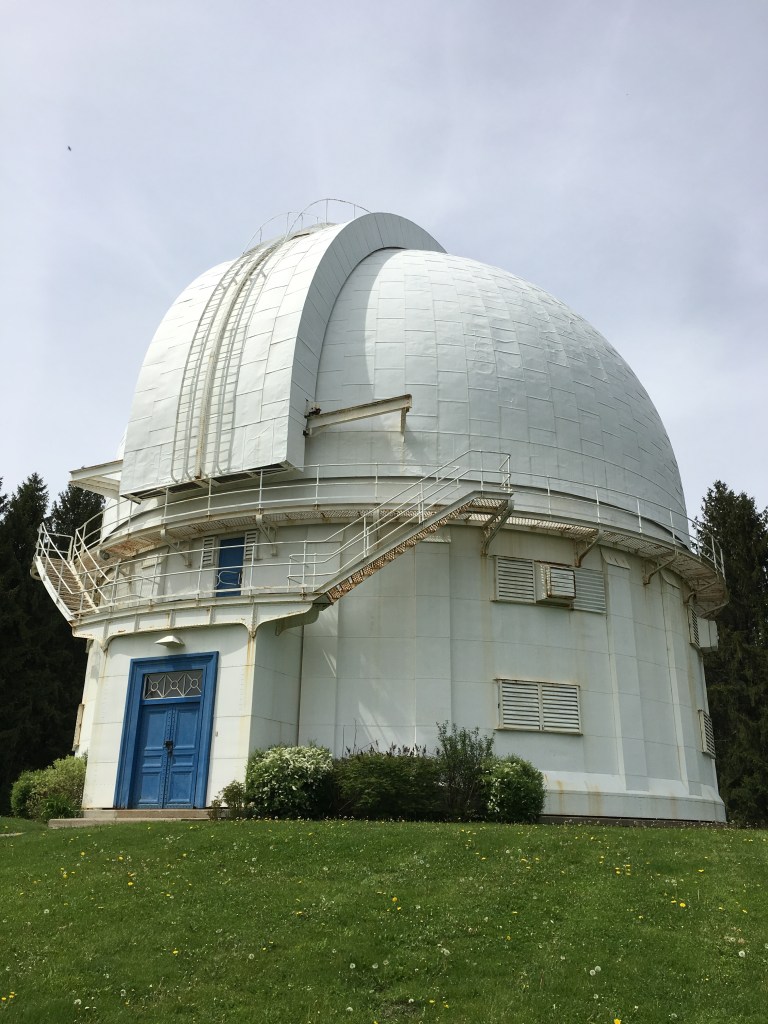
The David Dunlap Observatory (photograph by Peter Wilson)
The City of Richmond Hill is seeking public feedback on proposed designs for an accessible pedestrian/cycling overpass bridge and pickleball facility at the Richmond Hill David Dunlap Observatory (RHDDO) Park.
An online survey is available until March 17, 2023 and a Virtual Information Centre will be held on Thursday, March 9 from 6 – 8 pm. For complete details, access to the survey and a link to register for the Virtual Information Centre, visit https://www.richmondhill.ca/en/find-or-learn-about/ddo-ongoing-projects.aspx.
The David Dunlap Observatory opened in 1935, and was built on land donated by Jessie Dunlap in memory of her husband David. The main Observatory building, pictured above, houses a 74-inch (1.88m) reflector telescope.
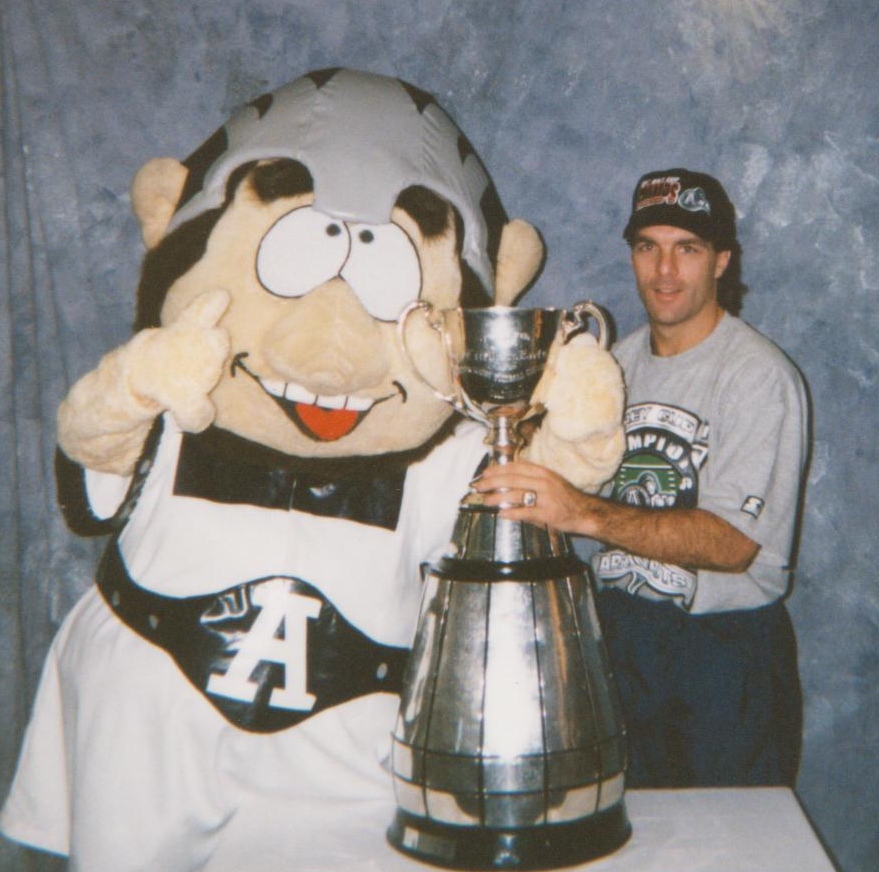
Russ Horner as Toronto Argonauts mascot Scully with former Argos quarterback Doug Flutie in the 1990s
The Richmond Hill Historical Society is pleased to welcome Russ Horner to our next meeting, scheduled for Monday, February 20, 2023 at 7:30 pm. Our regularly scheduled meeting will be held in Wallace Hall at the Richmond Hill Presbyterian Church at 10166 Yonge Street.
After starting his character career at Canada’s Wonderland, Russ went on to make over 8,000 costume character appearances over 35 years. Russ shares the inside scoop on what it is really like in the unique “world” of costume character performing, training and managing, Although physically and emotionally rewarding and of course extremely fun, there is also a serious side to the business with great responsibilities, safety concerns and even dangers.
While we hope that you consider joining the Society as a member, guests are welcome to attend our meetings for $5, payable at the door.
Marj Andre and Mary Kot are pleased to announce the Spring 2023 Richmond Hill Speaker Series. The series features 7 high calibre virtual talks featuring a wide-range of topics and speakers.
The entire series will be offered virtually so that you can enjoy these engaging and informative talks from the comfort of your own home and allows for a broad collection of presenters. Each talk runs from 10 am to 12 pm via Zoom.
Series Cost – $50 (+$2.88 handling and service fees) for all seven talks!
The series includes:
March 9th – Daniol Clair Coles: Sharing Indigenous Worldview: Reflections of Metis History and Experience
March 16th – Seth Klein: Mobilizing Canada for the Climate Emergency
March 23rd – Merilyn Simonds: The Many Astonishing Lives of Louise de Kiriline Lawrence
March 30th – Daniel Robert Laxer: Listening to the Fur Trade: A New History of it’s Sounds, Songs, and Ceremonies
April 6th – Deirdre McCorkindale: The Underground Railroad and Free Black Communities in Canada West
April 13th – Michael Arntfield: Cold Cases and Forensic Genealogy: The End of Whodunits?
April 20th – Lindsay Keegitah Borrows: How Indigenous Legal Traditions are Protecting the Environment for Canadians
In undertaking some recent research into local land records, I stumbled across a great collection of heritage resources put together by the Regional Municipality of York. Entitled Built to Last: Heritage Properties from York County through to York Region, it includes a number of historic maps, miscellaneous historical information and a collection of heritage properties from across the region.
One of the most fascinating parts of the site (I think) is a “spyglass” that you can drag over a recent satellite view of York Region, which has been overlayed on the 1860 Tremaine Map of the County of York, Canada West, published by George R. Tremaine. Tremaine published a number of large county maps in the 1850s and 1860s, which have become invaluable for researchers across the province. Not only do they provide the standard information found on such maps, such as roads, churches, post offices, land owners, etc., but also small illustrations of notable buildings. It also serves as a form of business directory, with businesses and subscribers listed around the map itself.
If you would like to see the full 1860 Tremaine map, it can be viewed online by visiting York University’s website. We also have copies of the Tremaine map in the Richmond Hill Public Library’s Mary-Lou Griffin Local History Room, located on the 4th floor of Central Library at 1 Atkinson Street.
The Richmond Hill Historical Society is pleased to announce the confirmation of their Executive for the 2023 year. They are as follows:
Jim Vollmershausen, President Andrea Kulesh, Past President Laura McMullen, Treasurer Vera Tachtaul, Secretary Karen Dance, Membership Kevin Dark, Programming Barbara Di Mambro, Publicity
The Society is still looking to fill the vacant position of Social Coordinator. Complete details may be found in our call for volunteer announcement. Anyone interested in this position is invited to contact Society President, Jim Vollmershausen at r.hillhistsoc at gmail.com.
The Richmond Hill photo booth at the official raising of the RH150 flag at East Beaver Creek. It will be making stops around Richmond Hill throughout the year.
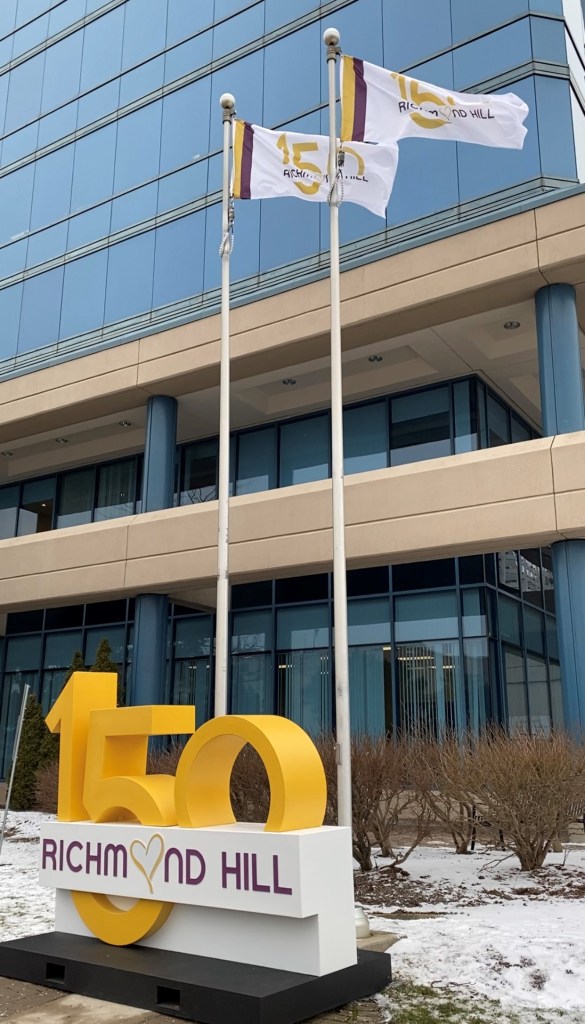
Mayor David West and a host of dignitaries and special guests gathered at East Beaver Creek at 9:00 am on Wednesday, January 25, 2023 for the official raising of the Richmond Hill 150 flag. This kicks of a full year of activities planned by the City to commemorate Richmond Hill’s milestone 150th Anniversary.
A series of special banners are already on display along Yonge Street in the heart of the original Village of Richmond Hill, which was officially incorporated on January 6, 1873. Abraham Law served as the first Reeve of the village.
The Richmond Hill Historical Society, also celebrating its own 50th Anniversary milestone, will be helping to commemorate this special year. Our biggest project is a partnership with the City – the presentation of a Heritage Summit on Sunday, September 10, 2023 at the Richmond Hill Centre for the Performing Arts.
The afternoon component of the Summit has been dubbed “An Appreciation of Richmond Hill’s Heritage” when a number of City organizations that have been contributing to the City’s heritage over the years will have an opportunity to showcase those contributions and discuss them with what we anticipate will be a good crowd. The evening component will take place in the theatre and has been dubbed “A Celebration of Richmond Hill’s Heritage.”
Throughout the year, we will be sharing information about this special event and all that we have in store. We invite you to join the Society as we celebrate these two special milestones.
This executive position is key to the fellowship of our society. You provide a welcoming atmosphere for members and guests alike. The society provides refreshments through the generous donations of members who are served coffee and tea at each of our meetings. Four or five members are asked to donate and prepare and bring food for each meeting. This is all prepared and ready for the members to enjoy at the conclusion of the evening and provide time to speak with the monthly speaker.
Duties required for 8 months of regular meetings and 2 months for special events from September – June of each year:
Purchases supplies-monthly (milk and cream) and as needed (coffee, tea, sugar and napkins). Note: Tote provided for all supplies
Sets up table for refreshments and prepares coffee and tea to be served at the conclusion of meetings.
Oversees set up of food, napkins etc. for the meeting.
Organizes and purchases food and supplies for Strawberry Social in June and the caterers for the Holiday Dinner Party in December.
Keeps a record of expenditures and revenue from
donations and makes a head count on a monthly basis
Attend monthly executive meetings-1st Wednesday of each month. Report record for monthly minutes.
Time required to perform duties:
1 hour for shopping for an regular monthly meeting – more if there are other purchases needed. June is a special event so there is committee support for the purchasing of supplies, if help is required. Executive members help with the set up and take down.
Time required for contacting caterers and arranging for the Christmas and Holiday
Dinner. This event is organized by the Executive. Set up and take down prepared by Executive members.
6:30 p.m. it is ideal to be on hand early to begin preparations. (meetings begin at 7:30 p.m.) Members that are bringing food will deliver it to the kitchen to be set out. You can organize helpers for each meeting.
Once members have left the meeting, everything must be taken down and cleaned up. The table has to be cleared and cleaned. Hand wash any dishes that need to be cleaned and put away. Distribute any leftover food that remains to the member who brought it. Clean up kitchen and put back supplies in the social tote supplied. Remove garbage (Wallace Hall requires us to take our garbage away) and wash tea towels at home.
If this position interests you, please contact the Society at r.hillsoc at gmail.com
The Richmond Hill Historical Society is saddened to learn of the passing of former Lieutenant Governor of Ontario, David C. Onley on January 14, 2023. Mr. Onley was a great ambassador of history in the Province of Ontario, as well as a life-long champion of accessibility. He will be missed by so many across our province, our country and around the world. Our deepest condolences go out to Mr. Onley’s family, friends and colleagues.
The Honourable David C. Onley served as the 28th Lieutenant Governor of Ontario from September 5, 2007 to September 23, 2014. Learn more about his incredible legacy by visiting the official site of the Lieutenant Governor of Ontario:
2023 marks a very special year for the Richmond Hill Historical Society as we celebrate our 50th Anniversary. Throughout the year, we will be looking back at our history and sharing photographs and stories of our past.
The first projects undertaken by the Society were to save and restore two buildings, Burr House and an old church, that was moved to the site from the corner of Carville Road and Bathurst Street.
Burr House was thought to have been built c. mid-1820s by Rowland Burr for his bride. Situated on Carrville Road, formerly Lot 40 Side Road, Vaughan Township. The original structure was plank on plank construction. In 1851, an addition was added to the rear. It was continuously occupied as a residence until sold to property developers, then acquired by the Town of Richmond Hill in 1975. To save the house from demolition the Society undertook the task of restoring it. With the assistance of Hill Potters Guild, the Richmond Hill Spinners and Weavers and WINTARIO Grants, restoration was completed.
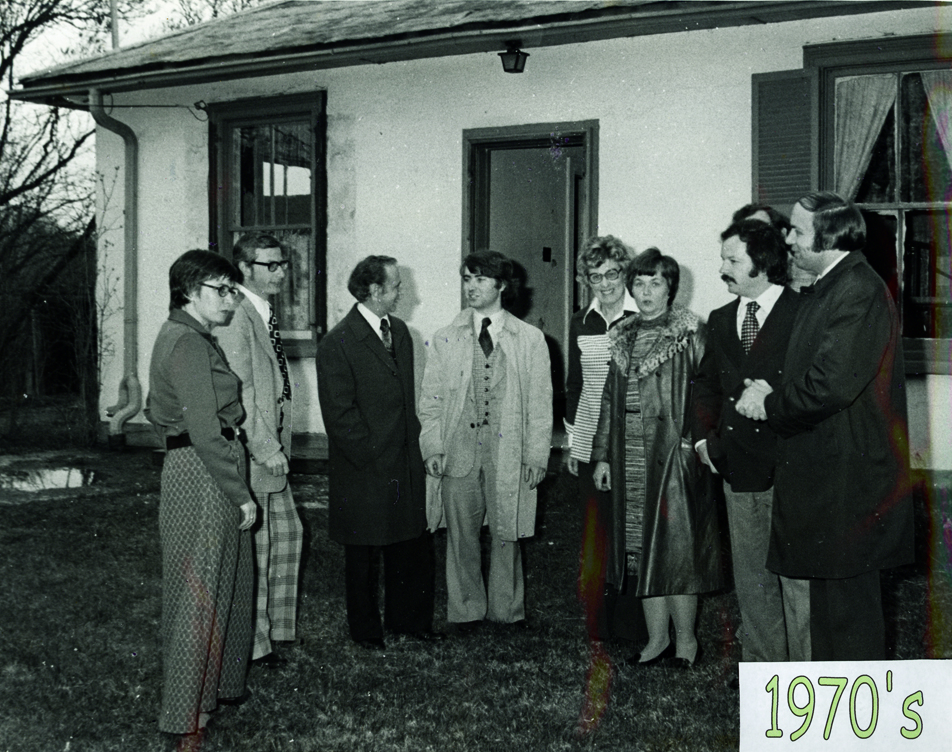
In 1974, members of Richmond Hill Council visited Rowland Burr House and are pictured with Historical Society President Janet Fayle, Acting Clerk William Rice, Society member Malcolm Jardine, Chief Librarian Patricia Hart.
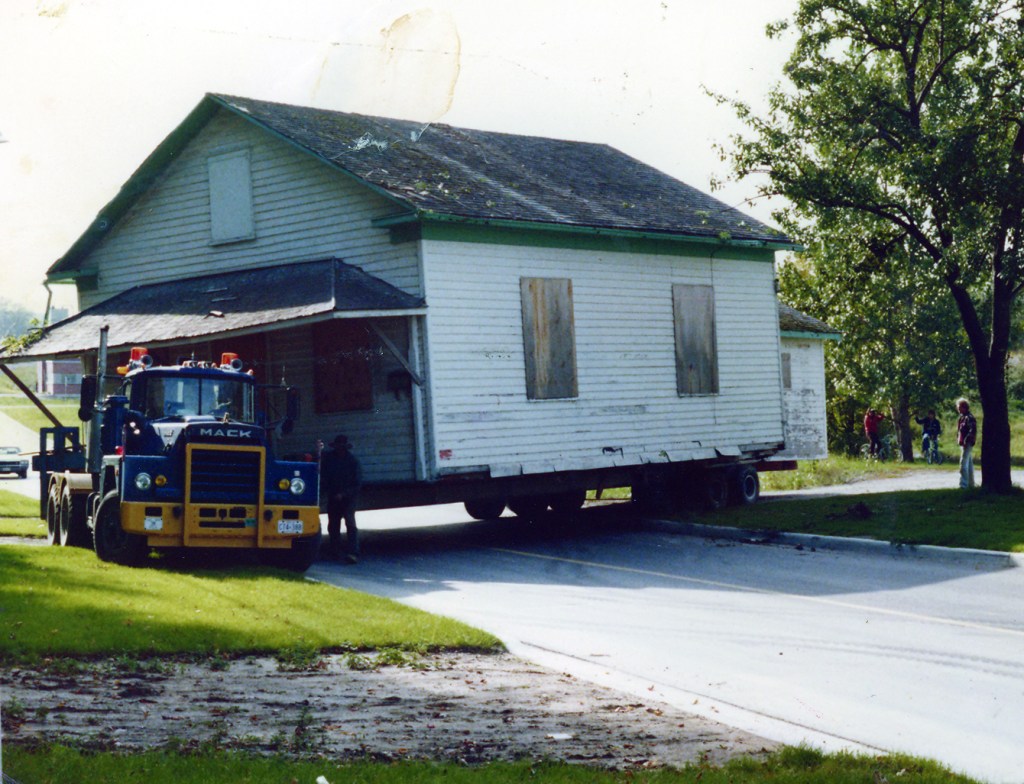
Guild Hall was erected in 1857 as a church for the Canadian Conference of the Evangelical Associates in North America. In 1975, the Town of Richmond Hill acquired it from the property developers and moved it from its original location at the north east corner of Carrville Road and Bathurst St. to its present site beside Burr House. The Society and Burr House Spinners and Weavers restored the building. Both buildings are a familiar landmark on Carrville Road.
The former church building arriving on site to be installed as the Guild Hall beside Burr House in September 1978. It would officially open on October 23, 1982
to preserve in our present community an awareness of the culture of our forefathers;
to hold monthly meetings for the presentation and discussion of historical information relating to the Richmond Hill area;
to promote existing historical publications, publish books, articles, and newsletters etc. for the advancement of the awareness of local sites, deeds and peoples of interest; and
to cooperate with other historical societies and related organizations.
For more information about joining the Society, which meets 10 times per year, please visit our Membership page.
Little evidence of park remains, but it was a happening spot in the first 20 years of the 20th century, writes Jim Vollmershausen Originally published in the Richmond Hill Liberal, September 15, 2022
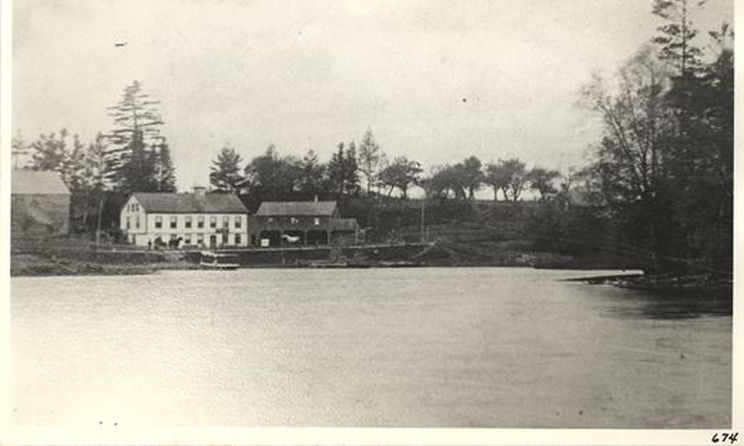
The Bond Lake Hotel and stables, circa 1920s. – Richmond Hill Public Library photo
Today, Bond Lake, just south of Oak Ridges on Yonge Street, is a popular part of the Oak Ridges Trail, whether as an entry to the full length (260 kilometres) of the trail or the short loop around the lake itself. One has to wonder if the hundreds of people who enjoy the lake trails today realize that, 120 years ago, thousands of people were enjoying what the lake and its park had to offer.
From the earliest days of Richmond Hill, settlers and townsfolk used Bond Lake for fishing, swimming and boating in the summer, and curling in the winter. This casual use changed after 1899, though, when the Metropolitan Railway, which had just reached Richmond Hill the year before, began to extend its line north toward Newmarket. The railway needed more power to supply the line as it was extended, and Bond Lake provided a good supply of water for the generating station they built near its shore.
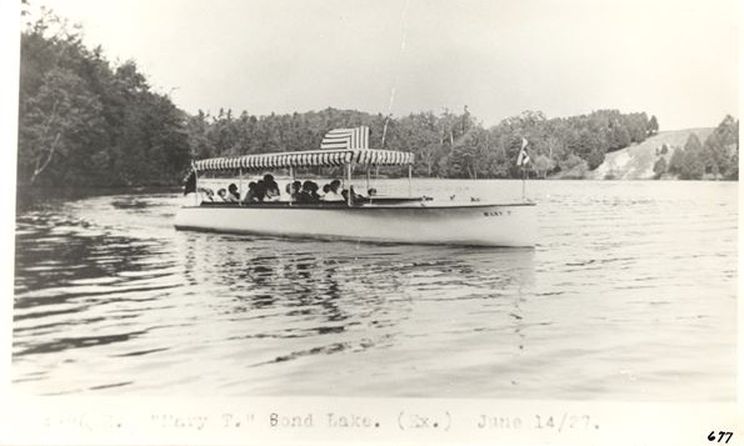
The Mary T. cruising Bond Lake in June 1927. – Richmond Hill Public Library photo
Knowing the lake was already a popular spot, the railway bought the farm surrounding the lake. Soon, landscaping was underway and railway siding and the Bond Lake Station were built to welcome the tourists they hoped to attract to the lake.
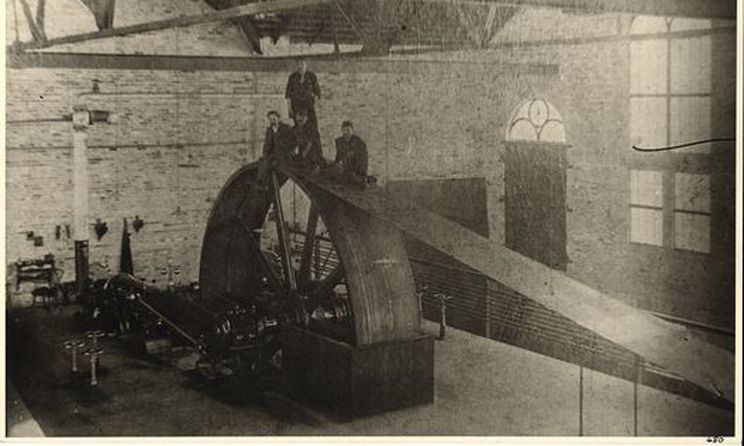
Inside the Bond Lake Powerhouse, circa 1900. The fly-wheel was approximately 18 feet in diameter. – Richmond Hill Public Library photo
The railway did its best to try to create a real tourist attraction just a short rail ride from the growing Toronto area. Using surplus power from the generating station, Bond Lake Park became the first “electric” park in Ontario, and it quickly began to experience amazing attendance. In the 1901 season alone, 60,000 visitors passed through the park gates. This was great news for the railway — in addition to their park visit, the vast majority of these tourists also paid fares on the railway to get there. It is certain that local businesses also benefitted from this influx of visitors. A nearby tavern and a local hotel would have enjoyed a real increase in business as a result.
The railway did not skimp on park amenities. In addition to traditional picnic facilities, pleasant landscaping and access to swimming, fishing and boating, the park soon boasted a large concert pavilion, baseball grounds, a wading pool and a merry-go-round. Sunday school and company picnics were popular, and the park also attracted family groups and young couples. Rowboats were available for rent, or you could tour the lake in a larger launch.
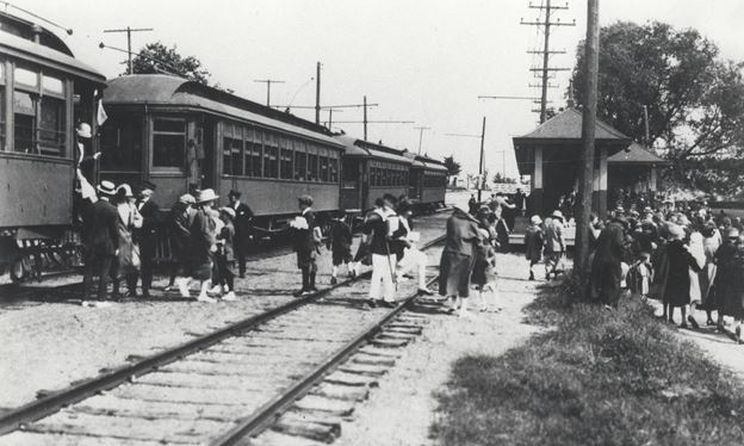
The Radial Railway arriving at Bond Lake Park in June 1924. – Toronto Public Library photo
The Metropolitan Railway Guidebook was eloquent in its praise for the park and its offerings. Clean air and cool breezes, clean water and few mosquitoes were all part of the pitch to attract visitors north, hopefully by rail. It touted the park, with its lake and trees and amenities, as a perfect place to relax, enjoy the outdoors, or even find romance through its pleasant promenades and dancing in the pavilion to a small orchestra.
Bond Lake Park was a going concern through the first 20 years of the 20th century, though its future came into question when the Toronto Transit Commission acquired the Metropolitan Railway Company in 1922. By 1929, the TTC was ready to close down the Radial Line north of Toronto due to poor ridership, and its primary interest in transit left little room for the park at Bond Lake. The park saw its last visitors in 1929.
Today, there is little evidence of Bond Lake Park to be found. Two crumbling brick pillars mark the old entrance on Yonge Street, and scattered along the trail beside the lake, hikers might find the remains of a few foundations or a twisted and partially buried merry-go-round. It’s difficult to imagine 60,000 visitors enjoying this beautiful spot in 1901.
—Jim Vollmershausen is the president of the Richmond Hill Historical Society

 Richmond Hill Historical Society