May 20, 2025 Meeting; 6:30 pm

Join us for our next regular member’s meeting on Tuesday, May 20, 2025 where Maggie Mackenzie from the City of Richmond Hill will tell the story of Growing Up Yonge. This is the first of two presentations to the Society by Maggie, Heritage Coordinator in the City’s Community Services Department. This first talk will cover the 19th Century.

Lieutenant-Governor John Graves Simcoe officially stablished Yonge Street in the 1790s. A military road from the Town of York ( now Toronto ) to Holland Landing, Yonge Street opened up the northern part of York County. Richmond Hill was an essential stopping point along the two-day journey.

Gather to visit at 6:30 pm, talk begins at 7:00 pm. Our regular meetings are held in Rooms A & B, 2nd Floor, Central Branch, Richmond Hill Public Library
1 Atkinson Street

For Home and Country: The Richmond Hill Women’s Institute

by Peter Wilson

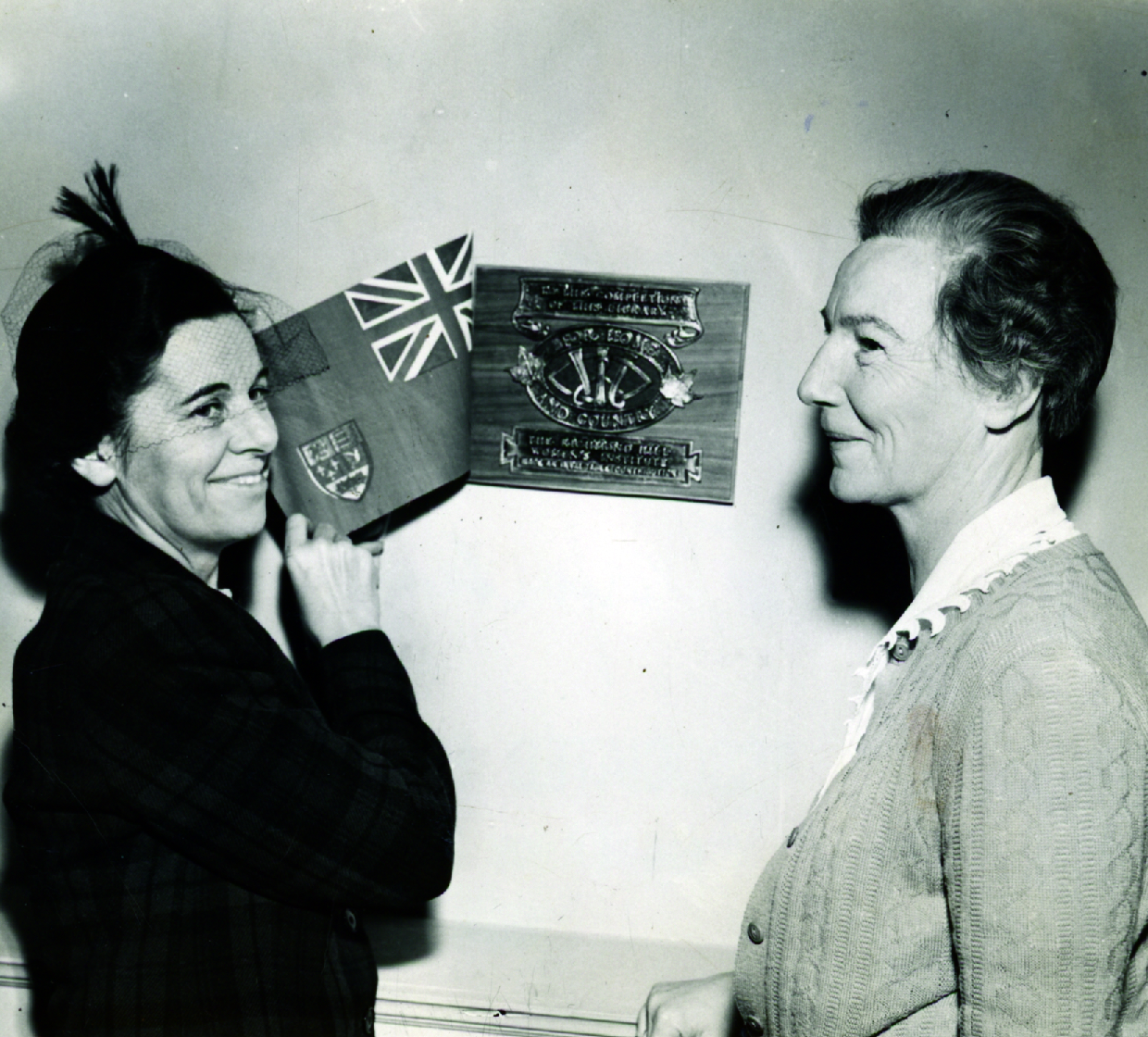
Mrs. H. H. MacKay unveiling the Women's Institute plaque with Edna Izzard representing the Library Board. The plaque commemorates the Institute's contribution to the library in 1949. (Richmond Hill Public Library, Tweedsmuir History Fonds)
Mrs. H. H. MacKay unveiling the Women’s Institute plaque with Edna Izzard representing the Library Board. The plaque commemorates the Institute’s contribution to the library in 1949. (Richmond Hill Public Library, Tweedsmuir History Fonds)

The first Women’s Institute (WI) was formed in Stoney Creek, Ontario on February 19, 1897 by Erland and Janet Lee, who invited approximately 100 women to hear educational reformer Adelaide Hoodless. Ms. Hoodless turned the personal tragedy of the death of her 14 month old son into a movement that encouraged women to see the importance of domestic science education and to be advocates in areas of health, education and community service.  Since its inception, there have been upwards of 1,500 branches of the WI across the province of Ontario. While most have disbanded over the years, the Institute continues with 220 active branches across the province. Their motto “For Home and Country” was adopted by the Institute around 1904.

RICHMOND HILL WOMEN’S INSTITUTE

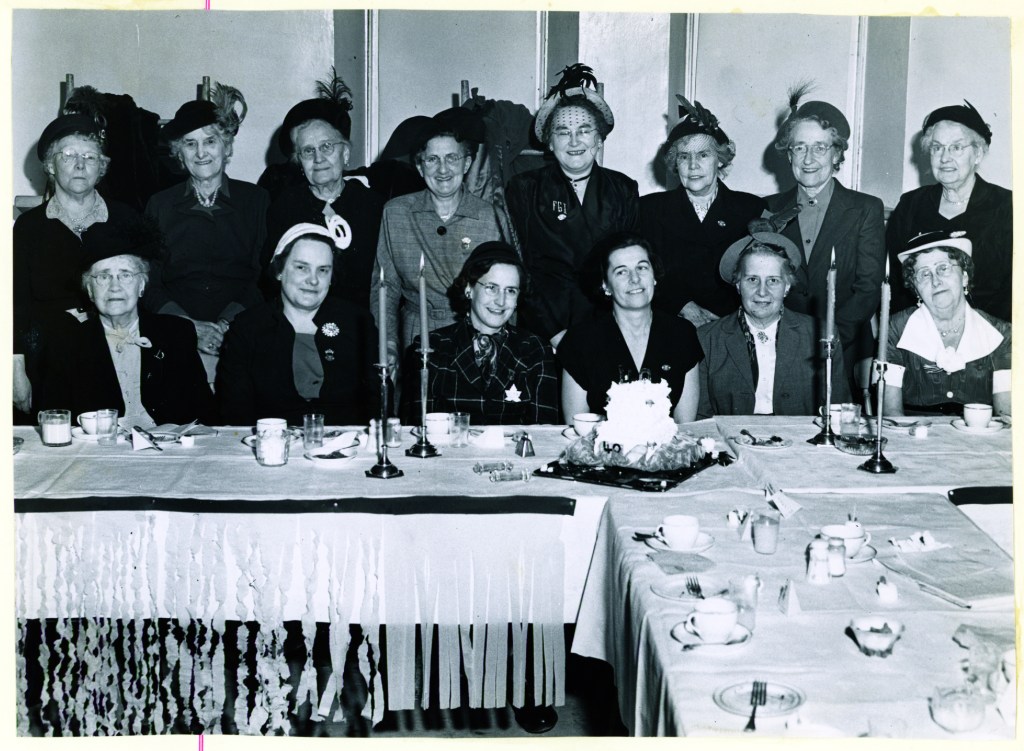
Head table at the 40th Anniversary of the Richmond Hill Women's Institute, January 8, 1953. (Richmond Hill Public Library, Tweedsmuir History Fonds, 079a)
Head table at the 40th Anniversary of the Richmond Hill Women’s Institute, January 8, 1953. (Richmond Hill Public Library, Tweedsmuir History Fonds, 079a)

The Richmond Hill branch of the Women’s Institute (RHWI) was formed in 1913 and held its organizational meeting on January 27th at the Masonic Hall on Yonge Street. The first keynote presentation was delivered by Dr. Lillian Langstaff, who spoke on the topic of “Facts about Flies,” beginning a long history of talks on home economics and health. Presentations and demonstrations included sewing and dressmaking, baking, canning and preserving, flower arranging and more. Monthly meetings presented opportunities to socialize, learn and develop skills, pursue personal interests, but perhaps most importantly, to plan and carry out work to the benefit of the entire community.

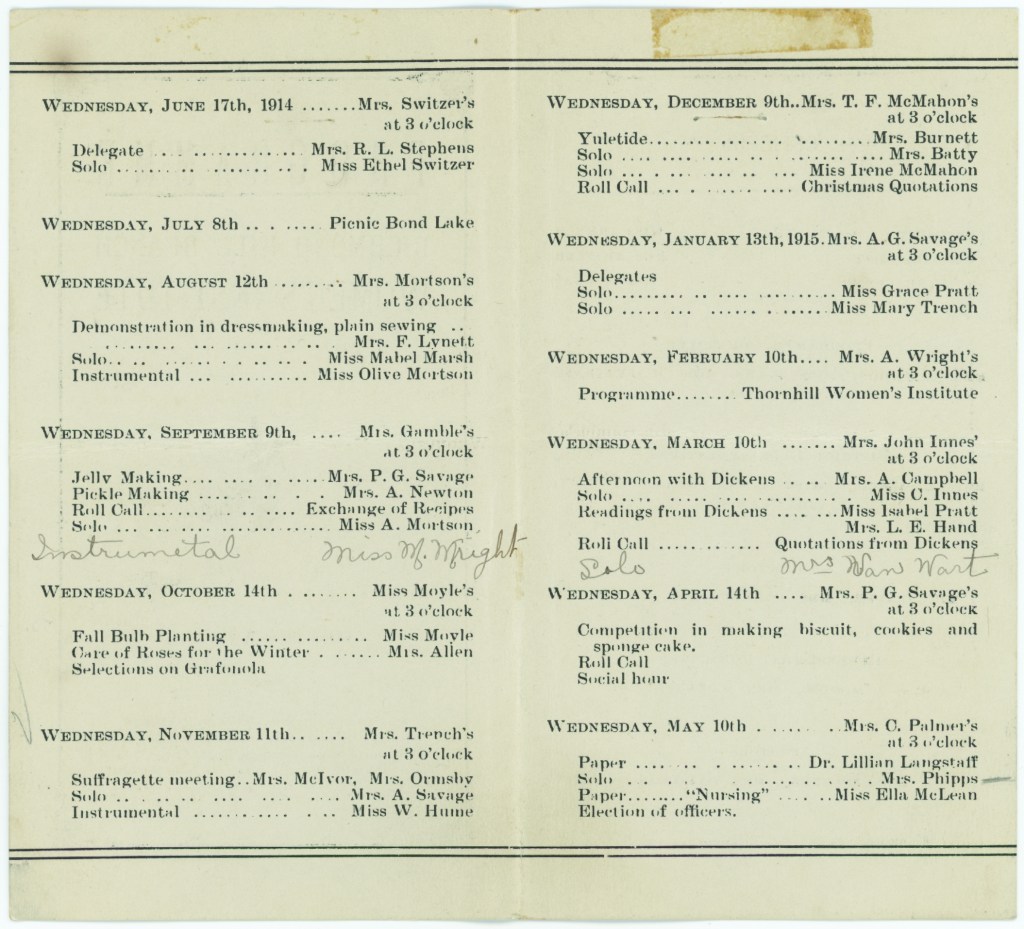
Richmond Hill Women's Institute Program for 1914-1915 (Richmond Hill Public Library, Tweedsmuir History Fonds, 075-01a)
Richmond Hill Women’s Institute Program for 1914-1915 (Richmond Hill Public Library, Tweedsmuir History Fonds, 075-01a)

The lasting impact of the RHWI was in their educational, charitable and civic-minded pursuits. Some key highlights included: the introduction of medical inspections in schools resulting in the appointment of school nurses; actively working towards obtaining the rights of women to vote; advocating for playgrounds for children; the introduction of litter receptacles on Richmond Hill streets and the beautification of village in cooperation with the Richmond Hill Garden and Horticultural Society; and the donation of pianos and other furnishings to our elementary and secondary schools. The Institute also undertook years of advocating and fundraising for a new public library building, which culminated in a donation in 1949 of over $1,700 dollars. That library would eventually be built on Wright Street in 1959.

The Women’s Institute also undertook war and relief work, which began in 1914 with the purchase of cloth to be rolled into bandages for a women’s hospital ship. In that same year, food was gathered for soldier’s families in need. Collections were undertaken for Belgian and Armenian relief. Members helped support the Red Cross as well as providing donations for war relief. During the Depression, they undertook relief work, in cooperation with teachers, for the unemployed.

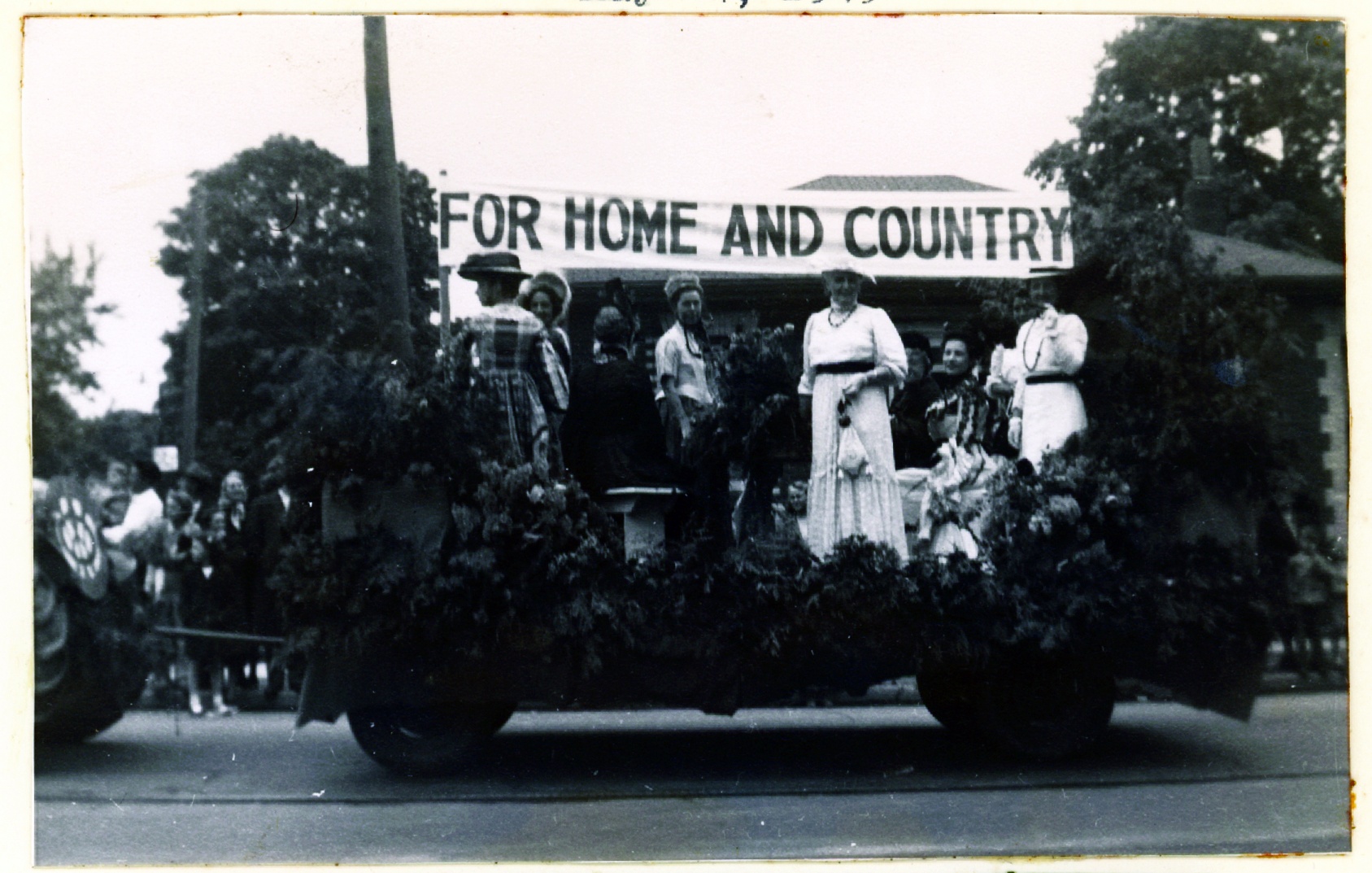
Richmond Hill Women's Institute float during parade to commemorate the 100th anniversary of the Richmond Hill Agricultural Society, May 24, 1949. (Richmond Hill Public Library, Tweedsmuir History Fonds, 080a)
Richmond Hill Women’s Institute float during parade to commemorate the 100th anniversary of the Richmond Hill Agricultural Society, May 24, 1949. (Richmond Hill Public Library, Tweedsmuir History Fonds, 080a)

Representatives of the Richmond Hill WI were appointed to a number of boards across the community, where they were able to add an important voice to decisions being made for the benefit of all. Their focus on women’s issues and education positioned them well for having a profound and valuable impact to the lives of residents. Their spirit and drive helped them support many in need, not just in our community, but around the world. Their accomplishments and impact on people’s lives is impossible to fully articulate here.

TWEEDSMUIR HISTORY OF RICHMOND HILL

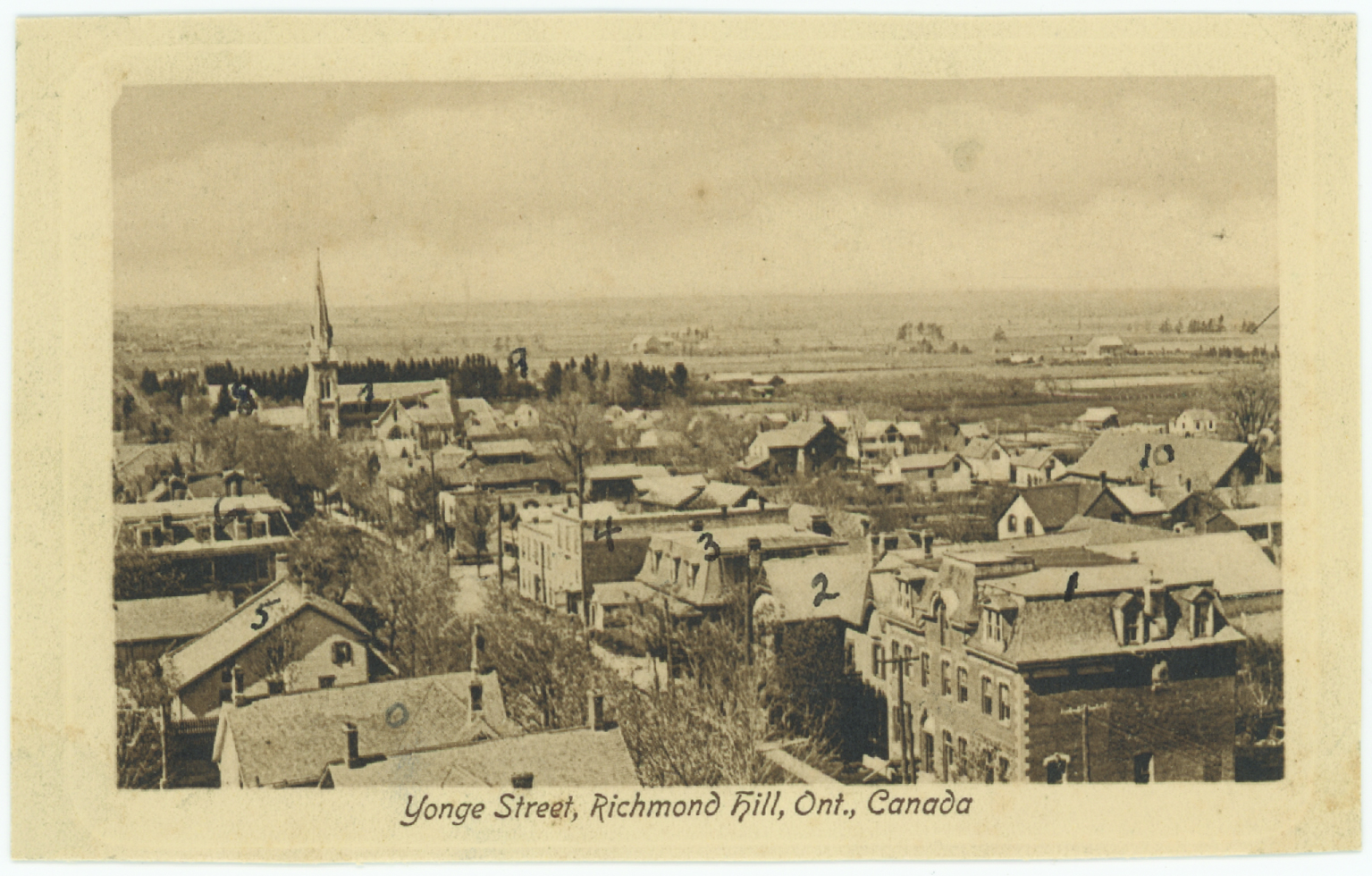
Postcard of Yonge Street looking north from the steeple of the Richmond Hill Presbyterian Church in 1908 from the Tweedsmuir History of Richmond Hill. (Richmond Hill Public Library, Tweedsmuir History Fonds)

One of the most valuable and enduring legacies of the RHWI is the Tweedsmuir History of Richmond Hill. The Richmond Hill Public Library holds the original and digitized copies. The Tweedsmuir History Books, chronicles of local history, were created all across Ontario in the name of John Buchan, The Right Honourable The Lord Tweedsmuir, Governor General of Canada from 1935-1940.

The Tweedsmuir History of Richmond Hill was begun in April 1949 and transferred into its final form in 1957. The work was coordinated by their Tweedsmuir History Committee and is in the form of a scrapbook with a mix of typed and scrapbook pages. It contains a number of photographs, newspaper clippings, postcards, letters, family histories, and other ephemera covering a wide variety of current events of the day, local individuals and families, and historically significant local events.

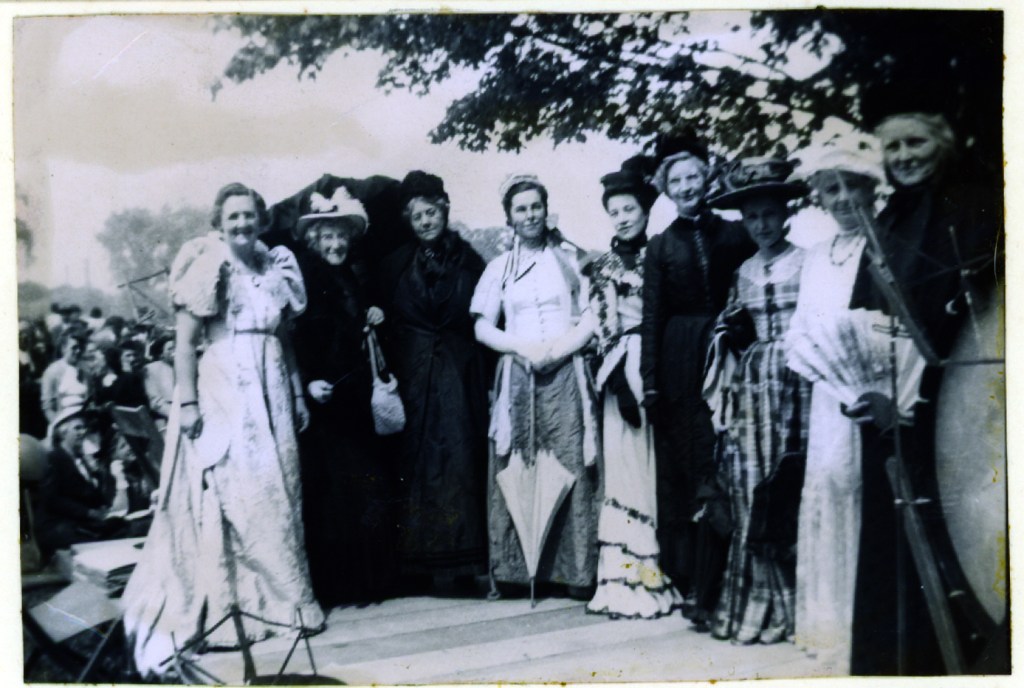
Members of the Richmond Hill Women's Institute in costume to commemorate the 100th anniversary of the Richmond Hill Agricultural Society, May 24, 1949. Left to right: Mrs. W. Sayers, Mrs. O.L. Wright, Mrs. J.P. Wilson, Mrs. H.H. Mackay, Mrs. Rabinovitch, Mrs. Blanchard, Mrs. Pipher, Mrs. N. Glass, Miss Annie Stong. (Richmond Hill Public Library, Tweedsmuir History Fonds, 080b)
Members of the Richmond Hill Women’s Institute in costume to commemorate the 100th anniversary of the Richmond Hill Agricultural Society, May 24, 1949. Left to right: Mrs. W. Sayers, Mrs. O.L. Wright, Mrs. J.P. Wilson, Mrs. H.H. Mackay, Mrs. Rabinovitch, Mrs. Blanchard, Mrs. Pipher, Mrs. N. Glass, Miss Annie Stong. (Richmond Hill Public Library, Tweedsmuir History Fonds, 080b)

They say that all good things must come to an end and this is what transpired for the RHWI, officially disbanding in 1964. For a write up of the end of the Institute, see “Richmond Hill Women’s Institute,” in The Liberal, June 25, 1964, p. 2 (https://history.rhpl.ca/3216109/page/3). For home and country and for everything (and everyone) in between; our lives and communities have been made better from their enduring legacy.

Peter Wilson is a librarian at the Richmond Hill Public Library and editor of the Richmond Hill Historical Society’s newsletter and website.

Richmond Hill Tweedsmuir History Highlights

The Richmond Hill Tweedsmuir History can be viewed in the Richmond Hill Public Library’s Digital Archive.

• a history and records of achievement of the Institute

• recounting the early days in Richmond Hill

• biographies of early settlers: Abner Miles, Hugh Shaw, Col. Wilmot, John Stooks, Col. David Bridgford, James Miles, John Stegman, the de Puisaye settlers, Quetton St. George, Col. Robert Moodie, the Playters and the Langstaff family

• a history of Yonge Street

• a history of early mills in Richmond Hill

• biographical sketches of notable past residents: Amos Wright, William Wright, William Powell, Susannah Maxwell, Matthew Teefy, Alex Hume, Thomas McMahon, Nicholas Miller, William Trench, Francis Boyd, the Wilkie family, Robert Marsh, John Switzer, David Boyle, Samuel Thompson, John Coulter, Leslie Innes and Robert Hopper

• listing of the village residents of 1871

• listing of Reeves and Councillors

• school and church histories

• history of the mechanics’ institute and library

• unique historical documents related to Thomas Kinnear, murdered with Nancy Montgomery in 1843

• residents who served in First and Second World Wars

• histories of the Atkinson and Trench families

• reminiscences of Dr. Rolph Langstaff (1950s)

• extensive coverage of current events of the 1950s

Christmas at the Post Office 1945-48

As we continue to celebrate the Society’s 50th Anniversary, we are sharing articles from past issues of our membership magazine. In honour of our anniversary, we look back to the Christmas 1994 issue of Heritage on the Hill and this article by Jim Monkman looking back to Christmas work at the post office from 1945-48.

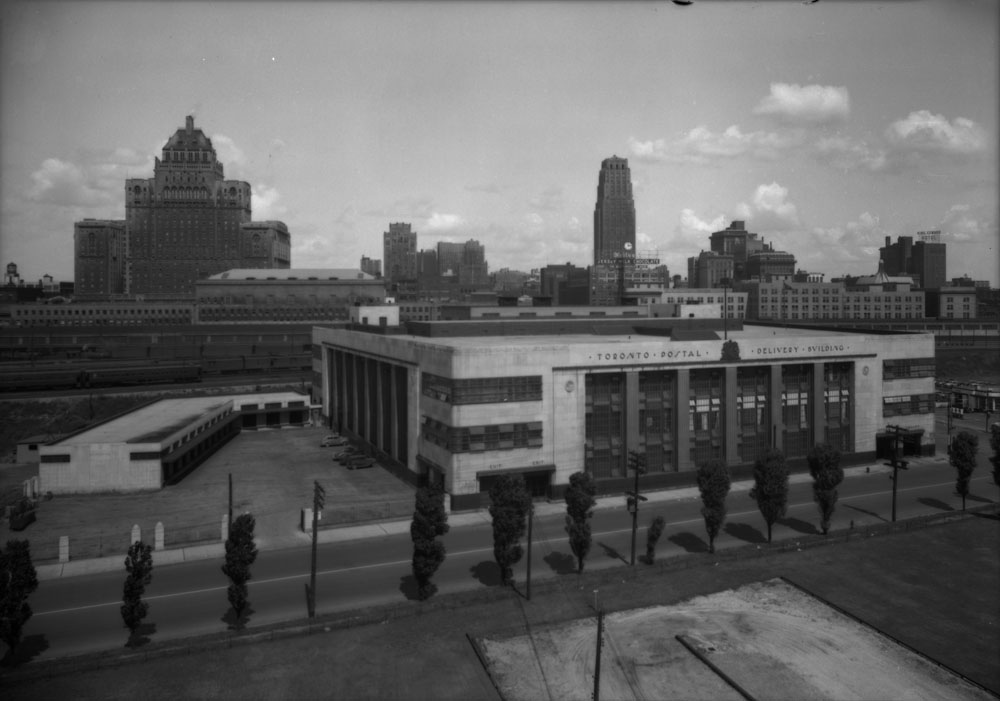
The Toronto Postal Delivery Building at Bay Street and Lake Shore Boulevard. It was commissioned by the Federal Government in 1938 and designed by architect Charles Dolphin. Completed in 1940, it was immediately taken over by the Department of National Defence. It was returned to Canada Post near the end of 1946 and was refitted for its intended use. Part of the building has been incorporated into the Air Canada Centre, home to the Toronto Maple Leafs and Toronto Raptors. (Photograph: Toronto Harbour Commissioners / Library and Archives Canada / PA-098562)

Recently Avonelle and I attended a Band Concert at Roy Thomson Hall with Nancy and Bill Price.

I insisted on driving to the concert because some years ago, when I retired, from work in downtown Toronto, I vowed that I would try and avoid ever using the subway system again- thus it was that we were all sitting in the car waiting for the traffic light at Lakeshore Boulevard and Bay Street to turn green. That was when Nancy pointed to a building on the north west corner and said ‘that looks like the building where I used to work sorting Christmas mail.’ I replied that indeed that must have been the building because that was where I had been similarly employed at Christmas when I was in High School.

I was a teenager in the middle to late 1940’s. Mail handling and sorting was done manually. No computer sorting and postal codes in those days. To handle the volume of mail at Christmas the Post Office would hire part time help.

As I recall in those days there wasn’t much part time work for students throughout the school year, except for paper routes and family businesses. None of my associates had part time jobs and any opportunity to make some money for Christmas was eagerly sought. When I was about fifteen my parents finally gave in to my pleas and agreed to let me try and get a Christmas job with the Post Office. The procedure to get such employment was simple. One went to Jack Smith’s Richmond Hill Liberal Newspaper Office, which was located in an old building on the east side of Yonge Street, immediately south of Bill Neal’s and opposite the Public School. The person at the front desk usually knew every one by name, often it was Jim Grainger, and you told him you would like a job at the Post Office on the midnight shift and your name would be put on the list.

For the next few weeks my parents never had to remind me to pick up the mail at the Post Office on the way home from school at noon. All who had applied for such work checked every day to see if a letter notifying them when to start had arrived. At last the notification for me and my compatriots came. Eagerly we checked the details of our employment. This was important to us as we had to attend our regular classes at school. The day shift was of no use to us and the 4:00 p.m. to 11:00 p.m. was no good because classes did not end ’till 3:30 which didn’t leave us enough travel time. We always applied for the 11:00 p.m to 7:00 a.m. shift which allowed us some time after school for study and sleep before leaving for work about. 10:00 p.m. and enough time to get back to Richmond Hill for school at 9:05 a.m. Classes commenced at 9:05 to enable students who travelled to school via the 9:00 a.m. street car to arrive in time.

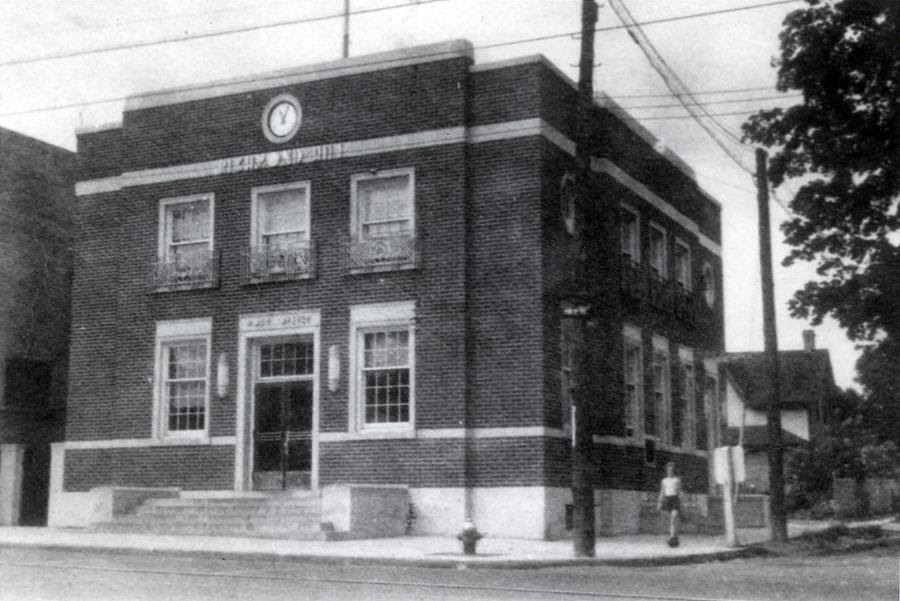
The Richmond Hill Post Office (ca. 1950) at the corner of Yonge and Centre Streets. The new building was officially opened December 6, 1936 by the Honourable Colonel William Mulock, M.P. for North York and Postmaster-General. It was designed by architects Forsey Page and Co. and built at a cost of $40,000. (Photograph courtesy of Richmond Hill Public Library, 102a)

Robert Hirtle and I always travelled together. We were, and still are the best of friends. Rob’s father, who was the Minister at the Presbyterian Church let Rob have, what seemed to me to be, unrestricted use of his car. Indeed he secured a driver’s licence for Rob when he was fifteen. It allowed him to drive only the one car which, if I remember correctly, was noted on the licence.

Rob, using his father’s 1941 Dodge sedan transported a carload of us to and from the Toronto Mail Sorting building at Bay and Lakeshore Boulevard. That first year, it was exciting to leave for work at what a short time before, was my curfew for getting home. Our route was down Yonge Street to the top of Hogg’s Hollow Hill. There we would swing off to the right over the viaduct where the road curved to the south to meet Avenue Road at about Wilson Avenue. Highway 401 and the Avenue Road cloverleaf approximately follows that stretch. We travelled Avenue Road to Front Street where we would turn left and then south on Bay Street to Lakeshore Boulevard. If my memory is correct there was ample free parking on the west side of the building. The trip was fairly quick as traffic was light and traffic lights were few. I believe the first one was at Sheppard Avenue and the next at Eglinton.

On reporting to work Robert and I and some of our friends, were given our time cards and assigned to sort mail for the streets of Toronto that began with the letter ‘L’. We each faced a wooden case divided into cubicles. Each cubicle was labelled with the name of an ‘L’ street. The labels were in alphabetical order starting at the top left hand corner of the case. The letters to be sorted were dumped onto the front part of the bench on which the cases rested. We spent the entire shift sorting an endless supply of letters into the appropriate cubicle. We could work standing up or sitting on the high stools provided. It was dangerous to sit on the stool too long because often one tended to go to sleep and fall off.

It didn’t take long for Rob to realize that some streets had more mail than others. Following this observation we moved the labels so that the streets which received the most mail were immediately in front of us and at the easiest height to pop the letters into their cubicle. This change made our work much easier. That it also helped us to sort letters faster was not of great concern to us because there was never an instant when the supply of letters on our bench ran out.

Every evening when we reported for work we found that the street labels on our cases had been put back in alphabetical order. Each shift, before we picked up a letter, we reorganized the street labels to make our work easier. Needless to say this did not give us a very high opinion as to the efficiency of the Post Office supervisors or the employees on the other shift. Maybe we were just lazier than the others.

Our employment ended the morning before Christmas. As school had usually closed a day or so before that, we had caught up on our sleep and were able to enjoy Christmas and following week of holidays. Our pay cheque would arrive, we could repay our parents the money they had advanced us for work expenses and the purchase of Christmas presents and still have some left over for ourselves.

We did this almost every Christmas during our high school years. Of course our teachers knew what we were doing, and thinking back I realize how much patience they exercised in dealing with a bunch of students, who if not falling asleep in class were exceedingly dopey from lack of it. For most of us it was our first experience working in Toronto for people who did not know us and our families. I’m sure it helped prepare us for our future careers away from the secure environment of the Village of Richmond Hill.

A Backward Glance

As we continue to celebrate the Society’s 50th Anniversary, we are sharing articles from past issues of our membership magazine. In honour of our anniversary, we look back to the September/October 1998 issue of Heritage on the Hill and this article by Jim Monkman looking back at 25 years of the RHHS. Article edited by Janet Fayle and Doris Leno.

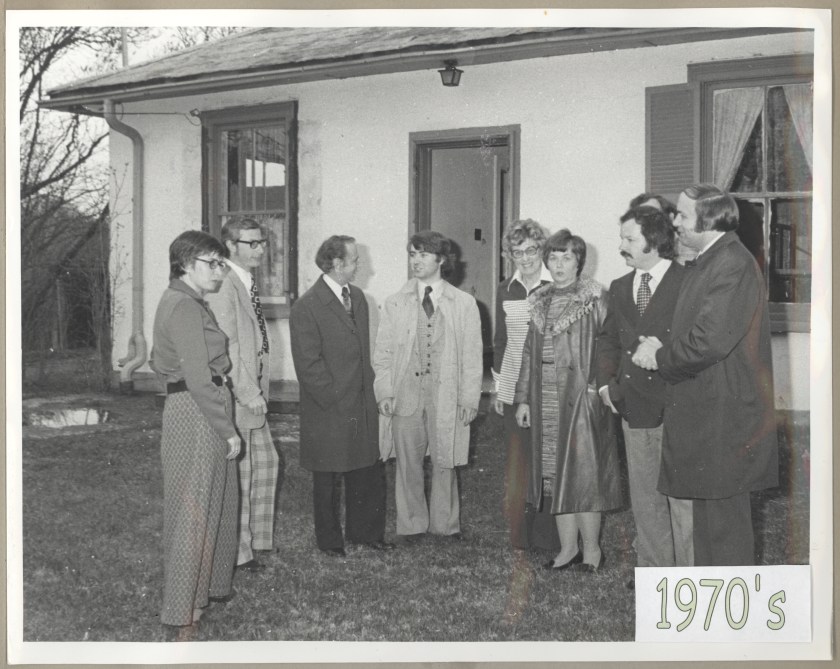
Richmond Hill Council visits Burr House with members of the RHHS Executive
In 1974, members of Richmond Hill Council visited Rowland Burr House and are pictured with Historical Society President Janet Fayle, Acting Clerk William Rice, Society member Malcolm Jardine, Chief Librarian Patricia Hart.

On October 18th 1973, at a meeting held at St. Mary’s Anglican Church, The Richmond Hill Historical Society was founded. Its objective “To Preserve In Our Present Community An Awareness Of The Culture Of Our Forefathers ”

On January 18th 1974, at the first annual meeting, an election of officers installed Mrs. Donna Bales as President., Mrs. Dorothy Gummersall as 1st Vice President, Mr. John LeClaire as 2nd Vice President, Mrs. Janet Fayle as Secretary, and Mr. Brian Cowan as Treasurer.

The first project undertaken by the newly organized Society was the restoration of Burr House, saved from demolition at the insistence of Mrs. Patricia Hart, Chief Librarian and historian. In June of 1974 The Society urged the Town to acquire Burr House and advised that they were prepared to lease and restore it. The Town was receptive to the Society’s proposal. While the legal technicalities and paper work were in progress restoration work was begun.

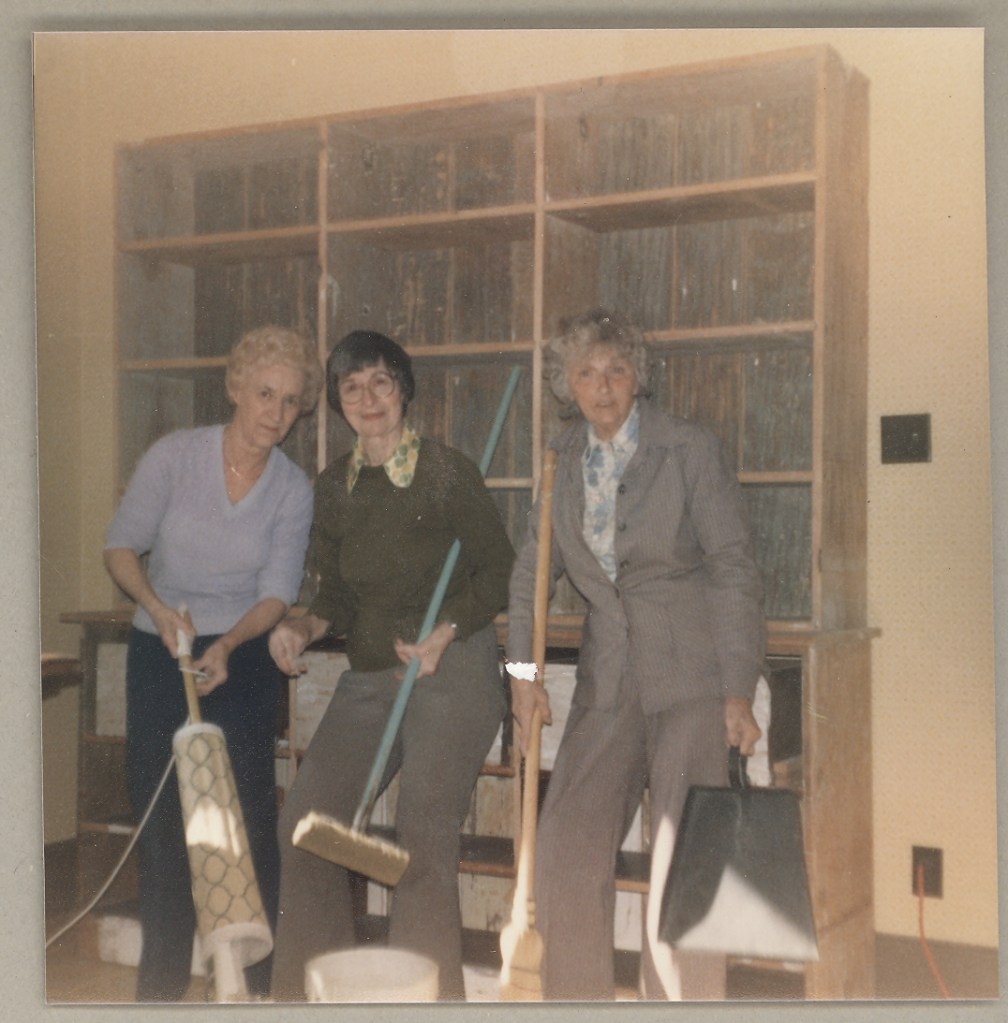
Richmond Hill Historical Society members Alice Dewsbury, Helen Barclay and Doris Leno during the early Burr House renovation.

In February 1975 The Society was incorporated as “The Richmond Hill Historical Society” and also was designated as a Charitable Organization for tax purposes. In May 1975 the Society entered into a lease agreement with the Town for a period of five years. The terms of the lease required the Society to pay an annual rental fee of $1.00 per year; to restore the said house, at its own expense to a structurally habitable condition before the sixteenth day of May 1976; and to carry out a restoration program of the house, with furnishings appropriate to the period when it was constructed, as funds become available to the Lessee.

By May of 1976 when Richmond Hill established a “Local Architectural Conservation Advisory Committee (LACAC)” the task of restoring Burr House was well underway.

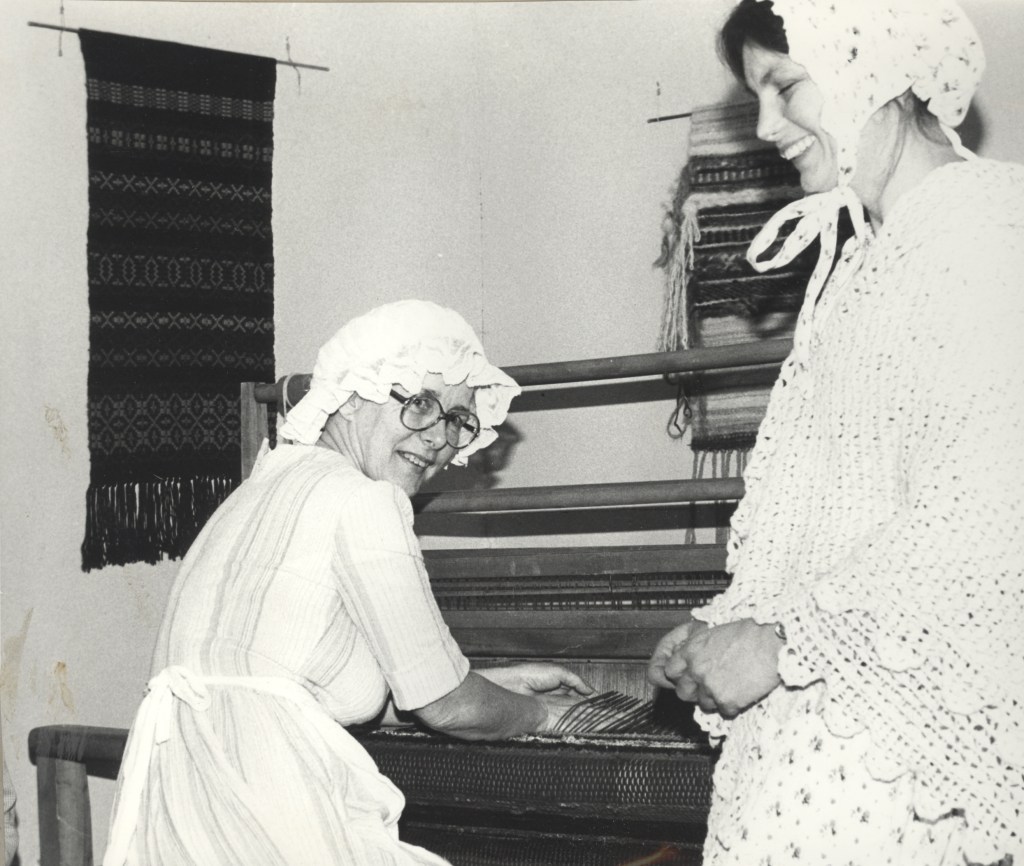
The Society applied for and obtained a Wintario Grant. With the assistance of the Hill Potters Guild, the Burr House Spinners & Weavers, and helped by annual financial grants from the Town, Burr House was soon made structurally habitable. Occupancy of the premises was then shared by the Hill Potters, the Spinners & Weavers, and the Society.

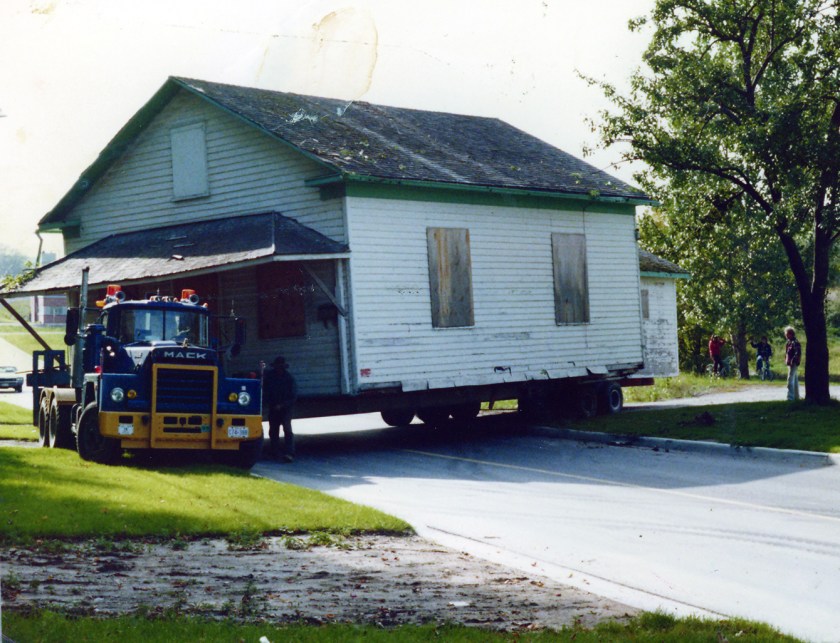
Photograph of the former church building arriving on site to be installed as the Guild Hall beside Burr House in September 1978.
Moving the Evangelical Church to the Burr House site, September 1978

By 1978 the Town had acquired the Church of the Evangelical Association in North America, now known as the Guild Hall, but at that time located at the comer of Bathurst Street and Carrville Road. In July of 1978 the Society entered into an agreement with the Town to lease it under terms similar to the Burr House lease. With the assistance of the two Guilds they proceeded to relocate the building to Woods Park and to restore the building. Restoration work on Bun- House was temporally suspended and all efforts were directed to completing the Guild Hall so that the Guilds could vacate Burr House.

To obtain a Wintario Grant for the restoration of Guild Hall, the Society pledged financial funding to the project in the amount of nine thousand nine hundred and fifty-four dollars and the Potters pledged one thousand five hundred dollars. It is interesting to note that although only fifteen hundred and forty dollars worth of donated labour was pledged four thousand eight hundred and eighty-five dollars worth of labour was donated by the three groups.

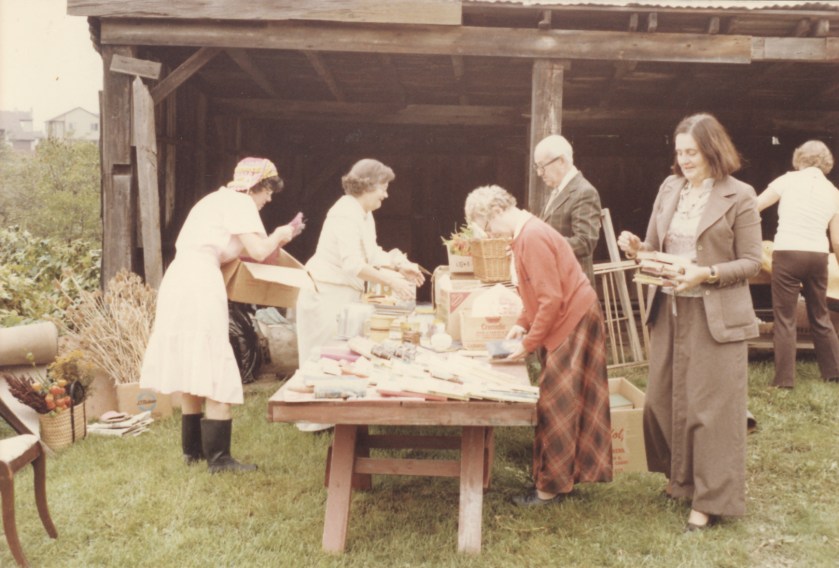
Fundraising came in various forms for Burr House like this 1978 Stuff ‘n Such sale.

The Guilds potted, spun and wove and as fundraising endeavors conducted craft classes. The Society promoted fund raising projects – Quilt Raffles, Stuff & Such Yard Sales, selling souvenir plates, post cards, hastinotes and ink and water colour drawings of Burr House at Mall displays and at the Richmond Hill Fair. Tea and scones were served regularly at Burr House and classes were offered in such crafts as chair caning, and quilting. Revenue from all fund raising projects was dedicated to the restorations as required by the terms of the Wintario Grants. The Society’s operating expenditures were limited to rental of meeting space at the Richmond Hill Library, an occasional speaker’s honorarium, and publication of a one page newsletter. When the Guild Hall was completed the Potters and Spinners & Weavers moved. At long last Burr House was vacant, restoration work was immediately resumed. It was a formidable task and took many hours of labour in dusty dirty surroundings.

Weaving at Burr House

During the restoration of Burr House the Society sponsored Archeological digs in the yard and under the floor of the Kitchen. “Dig” sessions for students were arranged and over 500 students participated.. Many artifacts were recovered and were added to the Society’s growing collection of histone items which had been donated by local residents. As there was no available storage space Society member’s stored the collection in their homes.

When restoration work was completed and the terms of the Wintario Grants satisfied, fund raising was continued and the money raised used to rent space in the new McConaghy Centre. The artifacts were inventoried, cleaned and placed on shelves and tables which had been donated for this purpose. The rental charge for this facility was $2000.00 per year and when we could no longer afford to pay this amount the Town provided a smaller storage space without charge. When the Heritage Centre opened the entire collection was donated to the Town.

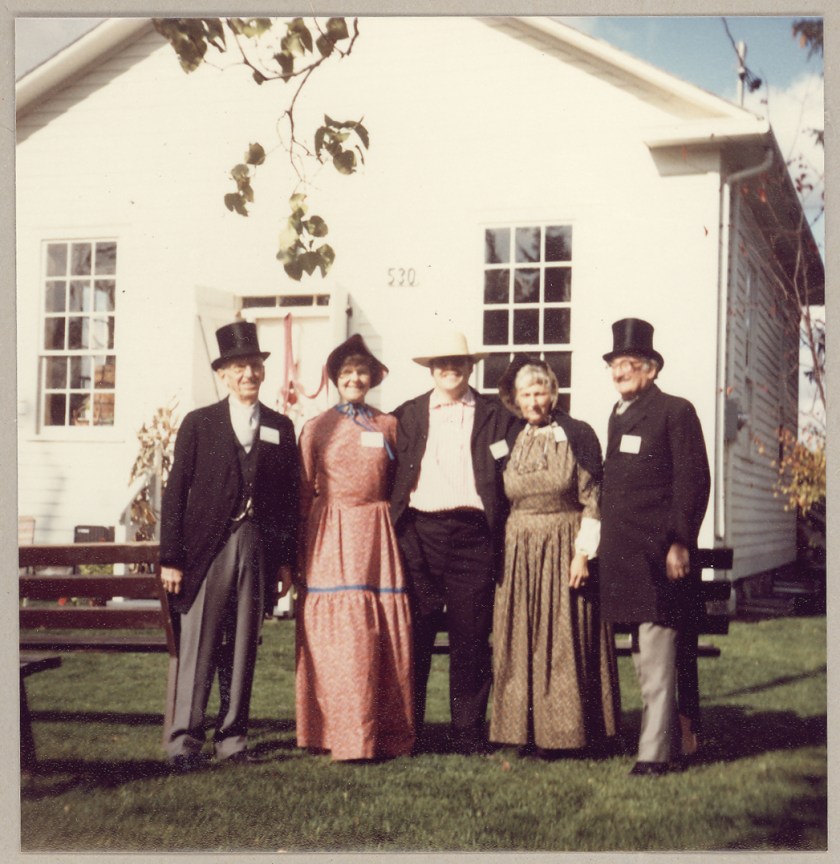
Official opening of the Guild Hall on 23 October 1982
Official opening of the Guild Hall, October 23, 1982

In 1982, while restoration work was still in progress, the Society opened a craft shop and tea room in Burr House. The Shop was very successful and in 1985 the Potters and Spinners & Weavers entered into a partnership with the Society and the Craft Shop became The Burr House Craft Gallery and Tea Room, Much has been accomplished since that first meeting in October 1973. As well as restoring two houses and operating a craft shop, the Society published a book that is now in its second printing. Lectured on local history in schools, taped some oral history, expanded the one page newsletter into a media in which members and non-members can publish their memories of old Richmond Hill. We have participated in many projects and unforgettable fund raising and social events. Strawberry Socials, Christmas Parties held in members homes, Picnics at such far away places as the Museum at Midhurst, Stuff and Such Sales on the lawn at Burr House, a Fall Festival complete with costumes and cider making. Our float in the Christmas Parade; Founders Day Service in the cemetery; and Quilt Raffles! Remember what happened the year the prize quilt was stored in a green garbage bag?

Society members should be proud of these accomplishments and celebrate the 25th anniversary of our founding with glee.

Postscript
I regret that in this brief backward glance I was unable to include all of the events and accomplishments of our Society or to mention the names of the many many members who so freely gave of their time and talents to make things happen. Perhaps we should begin our next quarter century by compiling a history of our past. – Jim Monkman

Richmond Hill High School: The ‘Monument’ of the Community When Completed in 1897

by Vera Tachtaul
Originally published online with the Richmond Hill Liberal, September 21, 2023

With the start of another school year, it is interesting to look back at our school history, as Richmond Hill celebrates 150 years.

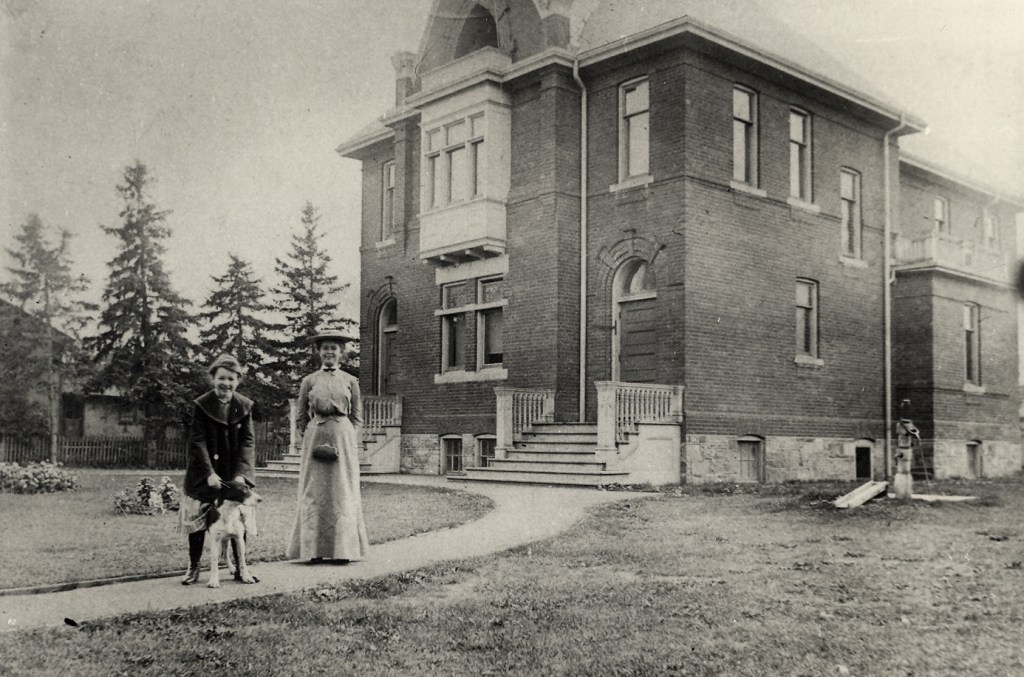
Richmond Hill High School at the corner of Yonge and Wright Streets, circa late-1890s (photograph courtesy of Richmond Hill Public Library, PA-90-004B)

Richmond Hill High School is one of the oldest schools in York Region, and has moved several times in its long history. After Richmond Hill was incorporated in 1873, a school was built behind M.L. McConaghy Seniors’ Centre (as we know it today) that served the community for 23 years until it was destroyed by fire in 1896. The Board of Education set up a makeshift school at Temperance Hall, located at 11 Centre St. W., and rented it for $6 a month. Sixty desks with seats were purchased for $2.95 each from Newmarket Novelty Works.

was marginal compared with today’s standards, and the dilemma of where this new school would be built became the concern. In a letter to the editor of the Liberal, one resident voiced his concerns over the location and the style of this new school, stating that communities were judged by the appearances of the schools that were built there and that the school grounds were just as important for satisfactory educational results.

When the education committee met with the village council to discuss the situation further, three possible locations for the new high school were discussed. One was at the site where the school had burned down, and the other was at Village Park. The third option was at the Richardson estate at the north edge of town, but since no vote was taken, a committee was established to consider the purchase of half an acre of property from the Powell family for $800. Another was to purchase the Hopkins property, which was located at the corner of Yonge and Wright Streets.

Postcard depicting the Richmond Hill High School, circa. 1910 (photograph courtesy Richmond Hill Public Library, Lynett Collection, card-09)

By April of that year, several letters were received by the Liberal from readers distraught about the length of time it was taking to build the new high school. The Liberal’s editor realized that there was enough interest for a regular column from readers who could vent their frustrations to the public. Some wrote in with full lists of disapproving facts. One petition that had been circulated throughout the village claimed that the board had made a mistake in its selection of the Hopkins property site. The board decided to take its plans to the Ministry of Education, where the petition was disallowed. Those named in the petition who had favoured the Yonge Street site saw the old grammar school of 1851 get torn down, which was donated by Abraham Law, who became the first reeve of Richmond Hill.

The board had already approved the first site, had received the $3,000 needed to build the school and had asked for the $1,500 for costs associated with the planning and design of the building from John Harris.

In May, it was again suggested that the Hopkins property be purchased at Yonge and Wright Streets. The board, which met weekly, had also considered six other locations, but it was Mr. McConaghy who pointed out to the board that Chapter 57 of Section 46 of the High School Act precluded Mr. McNair from selling the Hopkins property to the board, since he was also the executor. He was also not allowed to vote. It was moved that the chair and secretary act as a committee and buy the Hopkins one-and-a-quarter-acre lot for $1,000.

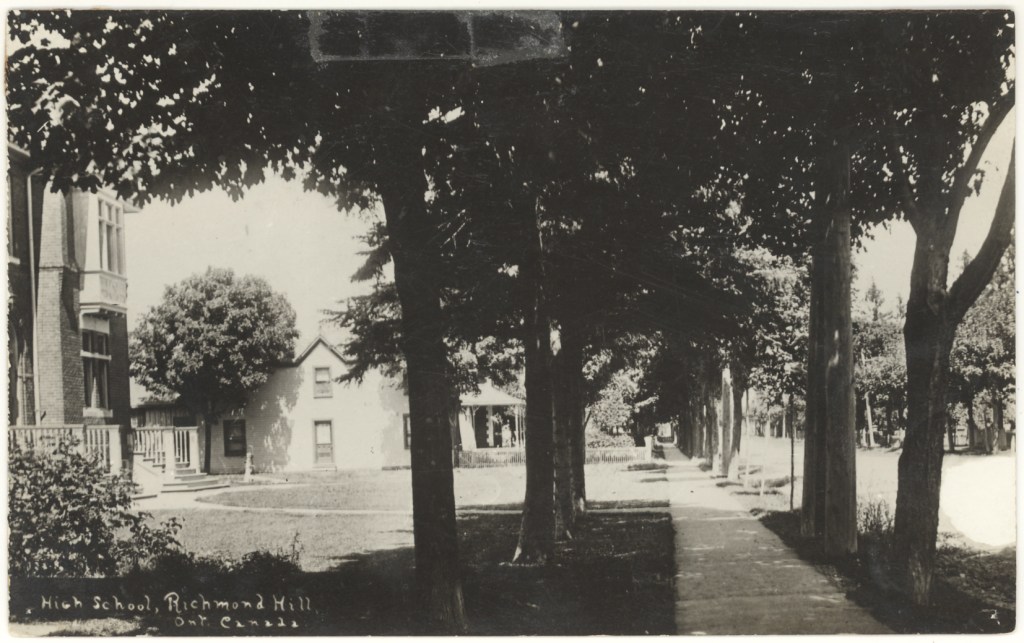
Sidewalk in front of the Richmond Hill High School, circa. 1920s (photograph courtesy Richmond Hill Public Library, Lynett Collection, card-19)

Construction of the brand-new high school officially began at the corner of Yonge and Wright streets in June 1897, just a few weeks before village residents celebrated Queen Victoria’s Diamond Jubilee. Masonry work was completed by J. Kelly and the lumber work by L. Innes and Sons. J. Francis Brown, who was a leading and remarkably prolific architect in the industry at the time, was the architect for the project.

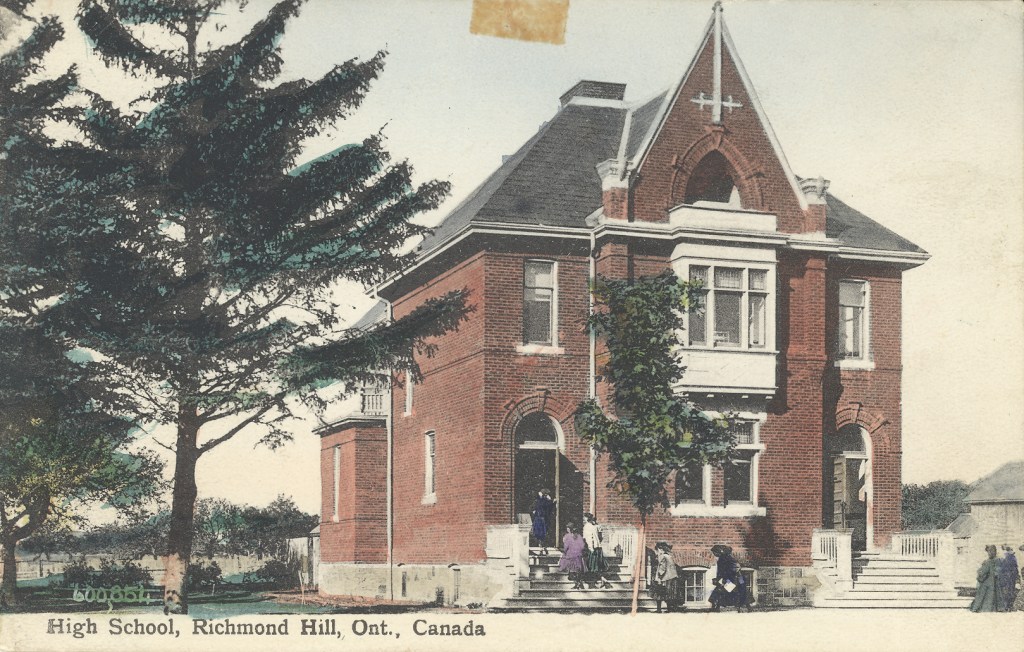
The new school was officially opened on December 30, 1897, just one year from the time the former one had been burned down. There was a great pride of accomplishment felt in the community when the new high school was finally completed. It was referred to as a “monument” to both its builders and architects. Its exterior laid out in red brick with grey stone foundation accommodated two entrances, as well as a rear entrance to the basement sitting neatly on the Mill Street lot.

With well-lit classrooms and a science room “supplied with every apparatus for practical work,” the entire building was heated in the winter and ventilated in the summer, and was perfectly modern for its time.

Postcard depicting the Richmond Hill High School (photograph courtesy of Richmond Hill Public Library, Lynett Collection, card-02)

Today, the building still stands proudly at the corner of Yonge and Wright Streets, and it’s worth remembering its history because it recognizes the hard work and effort of the many people involved with this project.

Read the full account of the official opening of the school on the front page of the January 6, 1898, issue of the Liberal, available in the Richmond Hill Public Library’s historic local newspaper archive.

The Origins of the David Dunlap Observatory

As we continue to celebrate the Society’s 50th Anniversary, we are sharing articles from past issues of our membership magazine. In honour of the official opening of the David Dunlap Observatory, we look back to the November/December 2002 issue of Heritage on the Hill and this article by Elinor Humphreys Graham.

The existence of an observatory in our midst is positively dependent on three persons, namely Mrs. Jessie Donalda Dunlap, Dr. Clarence August Chant, and Dr. Reynold Kenneth Young. It stands today as a vital and living monument to them.

The City of Toronto and the University of Toronto needed a research centre for the oldest and most majestic of the sciences astronomy. Mrs. Jessie Dunlap was a very wealthy widow, living in Rosedale in 1926, when she received a copy of an article from The Star Weekly, written by Dr. C. A. Chant, professor at the University of Toronto and founder of its Department of Astronomy. Both Mr. and Mrs. Dunlap had long shared a deep interest in the science of Astronomy and when Dr. Chant asked if she might be interested in supporting his project – a research centre – she responded positively and enthusiastically. Needless to say, Dr. Chant was overjoyed.

Due to Mrs. Dunlap’s magnificent gift to the University of Toronto, she and Dr. Chant found the ideal site on a hill on the east side of Yonge Street, 15 miles north of the old city limits, now part of Richmond Hill. In due course the David Dunlap Observatory became a reality and was officially opened on May 31, 1935, by Mrs. Dunlap, and named in memory of her late husband, David. It was the culmination of nine years of hard work, and the lifelong dream of Dr. Chant, who had been on the staff of the University of Toronto since 1904, founded and became the first head of its Department of Astronomy and then founded the Royal Astronomical Society of Canada.

May 31st was chosen as opening day especially since it was the 70th birthday of Dr. Chant, and he was formally retiring, so became Director of the Observatory for one day only. Officially, Dr. R. K. Young, professor of astrophysics at the University of Toronto, followed Dr. Chant as Director on June 1st, 1935; in reality its first director. Dr. Young was born on a Binbrook, Ontario farm, on October 4th 1886, one of thirteen children born to Robert Young and Jean Bell. Reynold Young was very studious, excelled academically and graduated with honours and was a gold medalist from the University of Toronto.

With Dr. Chant he had led a Canadian party on an eclipse expedition to Australia, and afterwards joined Dr. Chant as Professor of Astronomy at the University of Toronto in 1924. Dr. Young obtained his PhD at the Lick Observatory on Mount Hamilton in southern California and held positions at Kansas Observatory and at the Dominion Observatory in Ottawa, thence to the Dominion Astrophysical Observatory in Victoria, B.C. with its 72 inch telescope, the second largest in the world at that time, 1918.

Dr. Young’s contributions to the U. of T. are embodied and made manifest in the present David Dunlap Observatory. He had the necessary experience at major observatories for design, specifications, construction, instrumentation, installation, and testing of the 74 inch reflecting telescope and its dome, the finest in the British Empire and second largest in the world at the time. The observatory administration building with its laboratory and shop equipment were his responsibility also. In his spare time between 1926 and 1928 he built a nineteen inch reflecting telescope which is still in use at the observatory. Dr. Young as director kept the large 74 inch reflector fully active during World War II in spite of a shortage of staff. He published 96 scientific papers, determined the radical velocities of 2,152 stars and the absolute magnitudes of over 1,100 stars. He worked on the sub-commission of the International Astronomical Union. He was a Fellow and life member of the Royal Astronomical Society of Canada, serving as National President for two years, 1932 and 1933. He was a life member of the American Association for the Advancement of Science, a member of the American Astronomical Society, an Elected Fellow of the Royal Society of Canada in 1923, and in 1973 was made an Honourary Life Member, the first to receive this rare honour.

Dr. Young retired January 1st 1946 with the title of Professor Emeritus of the University of Toronto, and Director Emeritus of the David Dunlap Observatory. He had married for the second time in September 1936, to Mrs. Amy Gertrude Phillips Graham, a resident of Richmond Hill, and widow of the late William Howard Graham and mother of four children, Philip, Marjorie, Wallace, and George.

Dr. and Mrs. Young continued to live in Richmond Hill, until 1964 when they moved to Cobourg where Mrs. Young passed over in 19 73, and Dr. Young in 1977. They are both resting in Richmond Hill Presbyterian Cemetery.

Due to his loyal dedication, disciplined devotion to duty, and unrivalled capabilities, Dr. Young was indispensable to Dr. Chant and the Department of Astronomy. The role that the University of Toronto was and is able to play in modem astronomy was determined by the way Dr. Reynold K. Young built and launched the David Dunlap Observatory 67 years ago in 1935.

Richmond Hill 150th Walk and Learn

Richmond Hill’s Rose Industry
Sunday May 28 at 1 pm

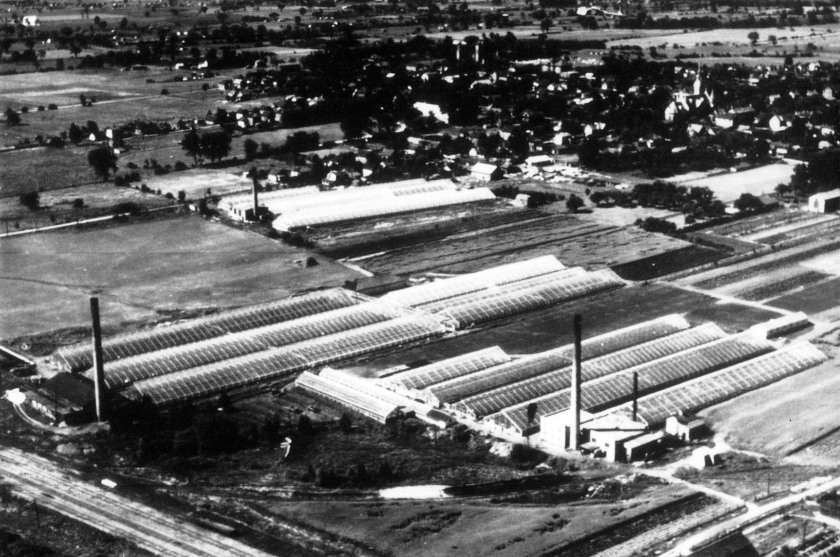
An aerial view of the greenhouses in Richmond Hill
An aerial view of the greenhouses in Richmond Hill (Photo courtesy Richmond Hill Public Library)

The rose industry was Richmond Hill’s major employer during the early half of the last century. In fact, the greenhouses played a key role in Richmond Hill’s ability to survive the Great Depression. Come walk through an area of the City’s early economic and demographic growth as you discover why Richmond Hill was once called the “Rose Capital of Canada.” A registered adult must accompany all registered participants under the age of 16.

Meet at the Heritage Centre/Amos Wright Park — 19 Church Street North (see map)

REGISTER ONLINE

24 May 1939 Victoria Day on Yonge Street

As we continue to celebrate the Society’s 50th Anniversary, we are sharing articles from past issues of our membership magazine. In honour of Victoria Day, we look back to the May/June 1996 issue of Heritage on the Hill and this article by Harry Suter.

Dark clouds of war hung low over Europe that bright Spring of 1939. Young people felt threatened because they would be needed to staff the Armed Services. Stories from World War I (the Great War, it was still called) began to spike our conversation with its tales of carnage. High school students compared the life styles and uniforms of the Navy, Army and Air Force. The life expectancy in each branch was debated with some interest.

Richmond Hill’s telephone poles were plastered with the 24th of May Fair flyers. Games! Horses! Street Dance! Come to the Fair! Towns all over Southern Ontario held such Fairs. Richmond Hill was famous for it’s Street Dance, an annual rural institution. I had never attended the dance, only the hoopla in the fair grounds.

A short walk down Lorne (Avenue) brought you to the Arena where the gate was festooned with flashing lights. The chatter of the crowd and the carioca music carried out to Church Street where the echoing chants from the midway announcers, booming out of the loud speakers were overwhelming. You jangled the money in your pocket to decide just which booth you would try first.

There was the ubiquitous coconut throw where you got three baseballs for ten cents to throw at stacked wooden pins about twenty feet distant on a wooden table. It seemed a ridiculously large target for teenage soft ball players. In the end it usually cost at least fifty cents to win a ropy fifteen cent coconut.

There were ring throwing games where you must encircle a wooden block under a glamorous prize to win. The hoop was almost identical in size with the diagonal over the corners of the block making the game deceptively difficult.

There was a honey tongued barker coaxing each girl to buy a ticket to allow him to guess her weight within five pounds. If he failed she won a kewpie doll.

Brawny young fellows hammered at a lever which shot a heavy ball up a twenty foot track topped with a ball. He showed off bulging biceps to his girl while smacking the device mightily. When the bell rang, it was accompanied by an ecstatic shout of victory over the loud speaker from the attendant and the dramatic presentation of a giant panda toy to the competitor’s girl.

A redolent buttered popcorn aroma floated temptingly over the crowd and many a mother’s supper was thwarted by the frothy stickiness of pink cotton candy.

When your cash was getting low or you had won a giant teddy bear for your princess, you would sit on the grass and watch the horses. The late afternoon hours could be spent quietly watching earnest young aristocrats urge giant horses over loose railed hurdles.

The sharp ammonia aroma of the horses and the flying clods from their hooves were a relaxing end to an exciting day at the fair. After supper the serious gamblers took a whirl at the roulette wheels. The currency at the wheel was cigarettes but one could sell the prizes back to the croupier for the retail price, twenty five cents a package of twenty five.

After dark, near eight o’clock, the glamour of gambling wore thin except for some fanatic gamblers. The remainder of the young adults began to drift up towards the band stand on Yonge Street for the street dance.

This was the first year that dancing had caught my fancy. Up until now, girls had been shadows in the water. They could be seen, but were difficult to get your hands on.

One could expect country western music, square dances and the like at a pre-war street dance. They were obviously lively and fun, but never the less old fashioned, the diversion of the previous generation. My age class had their own thing.

Things got off to a roaring start at eight o’clock with a Virginia Reel and a high stepping Dip for the Oyster, Dive for the Clam square dance. The radial track scarred pavement of Yonge Street was powdered and yet shiny under the harsh glare of street lights.

The orchestra was ensconced on a 20 foot square wooden platform thrown up in the middle of the street at Yonge’s north end near Crosby. The fiddle bows screeched. The dos-i-dos and allemande lefts were exciting and lively, setting a fast pace for the country dancers.

As time crept on the young adult crowd called for some jive. Many of us had never heard the term.

A group of teenagers from Lawrence Park Collegiate in the north end of Toronto called for the orchestra to play Jazz. The band responded with gusto.

In the last hour before midnight they showed us the new craze which was sweeping the country. It had started in New York’s Harlem about 1935.

I saw Roy Holmes and his girl Ruth Kerswell watching but they were too dignified to be caught up in this type of melee. University students were of a different genre. Dave McGibbon was a bemused spectator. The farmers who lingered were as intrigued as I.

The pace speeded. Drums rumbled with vigour as In the Mood and Frenesee were pounded out. Clarinets and saxophones wailed.

Lanky teenage youths and gum chewing girls swarmed on to the street to swing at arm’s length and sway to the fast rhythm of this intoxicating new music. Heads were high and backs straight as these Bobby Soxers hopped to the new beat, swaying and weaving with the gait so smooth a glass of water would al¬most balance on their heads.

Much of the time these pagan prancers were not even in contact. They gyrated at about three feet from one another, meeting to pirouette, even turning away from partners to clap hands, wave, step out and return. Round young fannies gyrated like bobbing bumble bees.

The girls wore pony tail hair styles with fancy barrettes, and were mostly clad in calf length plaid skirts, tight at the hips and flaring just above the knees. They wore flat sole shoes and ankle length socks with tartan design at the top. They chewed gum almost in time with the music and bore a faraway look as they danced appearing almost hypnotized. The girls seemed to be focused on the music while the boys relaxed in loose gaited abandonment.

It was an intricate dance with many sequences. A girl I knew from Earl Haig Collegiate beckoned me to her with a grin over the side line ropes. I stumbled through a few bars before retiring in confusion when I found how complex the steps were. When I returned to the next street dance a full year later, I had still not mastered the jitterbug steps.

When I was on leave in London, I took some dance lessons which stood me in good stead in Belgium and Holland where the girls all seemed able to float like a cloud to a simple accordion solo.

I do not remember any 24th of May jamborees when I returned from service.

The dancers in Richmond Hill this night bobbed and weaved in syncopated lock step until 11:55 P.M. The band played Good Night Ladies and The King sharp at midnight.

The trolley was allowed to rumble past the barrier at the station up to the north terminal at Elgin when the crowd pitched in to dismantle the band stand. There were mighty few automobiles at that time of night.

Most of the dancers found their way into Fetch’s Trolley Station Grill at Lorne (Avenue). I replenished my bottomless cave with a toasted western sandwich and hot cocoa.

When the last trolley rolled south, a happy crew of teenagers greeted it in good natured banter with Corsets, the conductor who stood stiff as a ram rod while piloting the radial rocket. He was usually good natured and put up with the hijinks of the school crowd with a grin and a shrug as we filed aboard.

The radial swerved sharply from the centre of Yonge when it reached Major Mac (Markham Road). Then it hurtled in heart throbbing haste down the hill, travelling on the east side of No. 11. The first stop was May Ave.

When I alighted at stop 20, there were still as many riders going further south, as far as Toronto. They were happily dos-i-doing in the drivers cubicle at the rear end of the radial car while the conductor just shook his head and grinned.
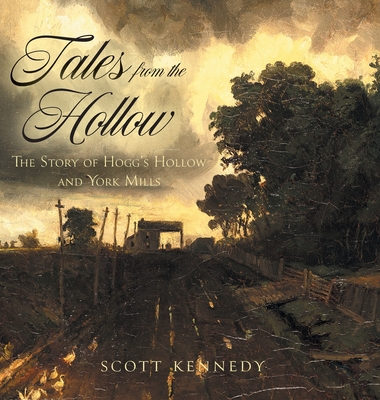
Tales from Hogg’s Hollow with Scott Kennedy – May 15, 2023

Cover of Scott Kennedy's book Tales from the Hollow: The Story of Hogg's Hollow and York Mills

We are very excited to welcome back Scott Kennedy who will be sharing stories from his latest book Tales from the Hollow: The Story of Hogg’s Hollow and York Mills.

Join us at 7:30 pm on Monday, May 23, 2023 in Wallace Hall at the Richmond Hill Presbyterian Church, 10066 Yonge Street in Richmond Hill. Guests are welcome for only $5, so bring all your friends to hear fascinating stories from this area rich in history!

Plaquing at Burr House (1986)

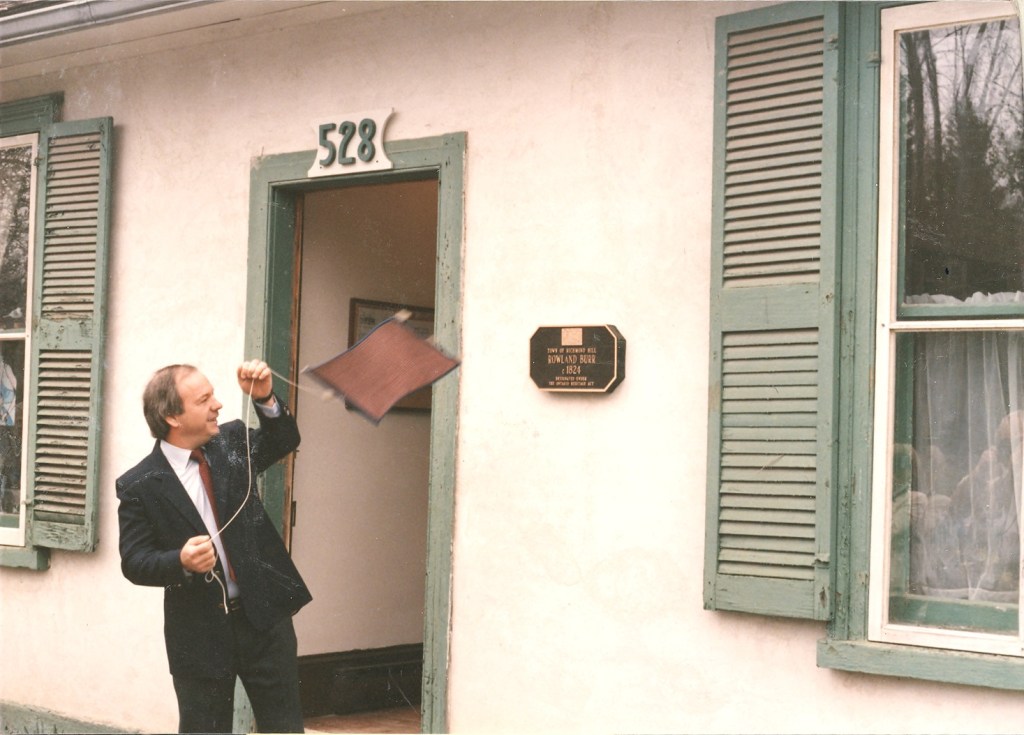
Today marks the anniversary of the unveiling of an historic plaque at Burr House by then Mayor Al Duffy in 1986.

Mayor Al Duffy unveils the historic plaque at Burr House on April 20, 1986

The first projects undertaken by the Society were to save and restore two buildings, Burr House and a second building, erected in 1857 as a church for the Canadian Conference of the Evangelical Associates in North America. It was moved in 1982 to the Burr House site from the corner of Carville Road and Bathurst Street.

From the Richmond Hill Liberal of October 25, 1973…

“The group expressed an interest in determining how the Wood home on Carville Road, built in 1813 (sic?) and now owned by the town, could best serve the community…Mrs. Hart suggested that it could be used for arts and crafts, but above all it should stay where it is so that children can be shown what a pioneer home looked like and how some pioneers lived.”

Countless fundraisers, educational and other events have been held at Burr House since it first opened as it continues to be an integral part of Richmond Hill.

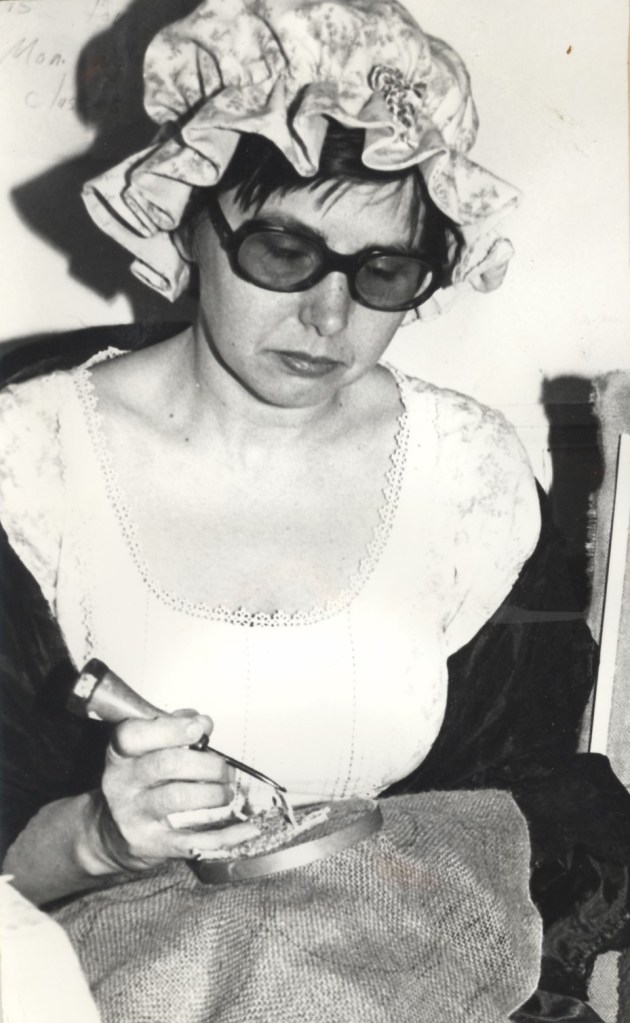
Richmond Hill Historical Society's Janet Fayle demonstrates early needlework at Burr House.
Richmond Hill Historical Society’s Janet Fayle demonstrates early needlework at Burr House.