The Richmond Hill Historical Society is pleased to announce the confirmation of their Executive for the 2024 year. They are as follows:
Jim Vollmershausen, President Andrea Kulesh, Treasurer Vera Tachtaul, Secretary Marion Vollmershausen, Membership Kevin Dark, Programming Barbara Di Mambro, Publicity
As we continue to celebrate the Society’s 50th Anniversary, we are sharing articles from past issues of our membership magazine. In honour of our anniversary, we look back to the Christmas 1994 issue of Heritage on the Hill and this article by Jim Monkman looking back to Christmas work at the post office from 1945-48.
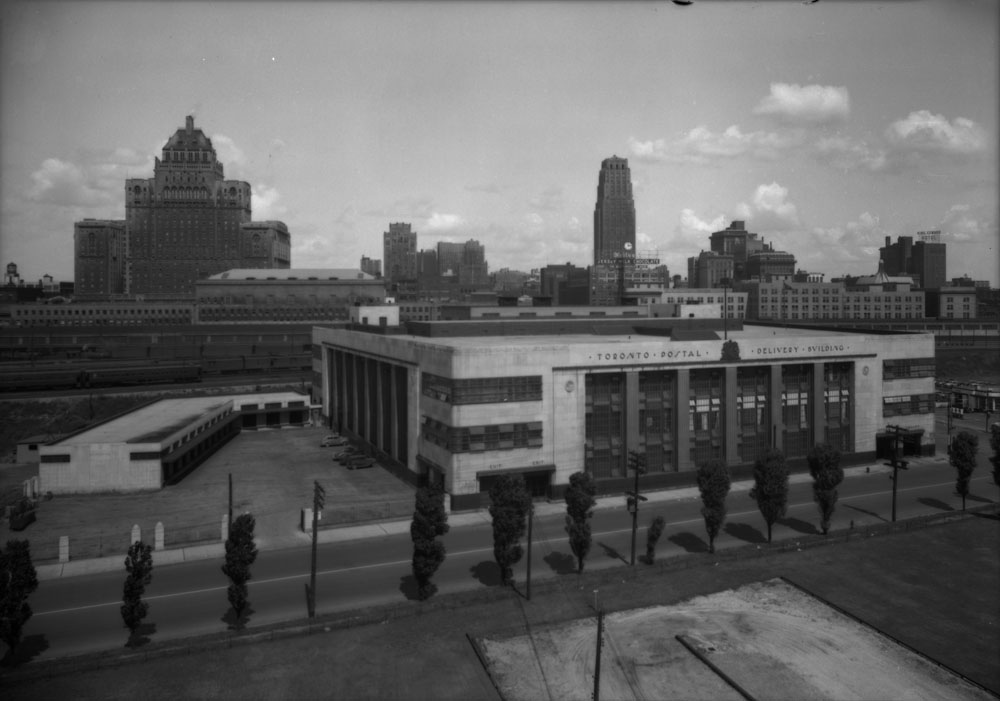
The Toronto Postal Delivery Building at Bay Street and Lake Shore Boulevard. It was commissioned by the Federal Government in 1938 and designed by architect Charles Dolphin. Completed in 1940, it was immediately taken over by the Department of National Defence. It was returned to Canada Post near the end of 1946 and was refitted for its intended use. Part of the building has been incorporated into the Air Canada Centre, home to the Toronto Maple Leafs and Toronto Raptors. (Photograph: Toronto Harbour Commissioners / Library and Archives Canada / PA-098562)
Recently Avonelle and I attended a Band Concert at Roy Thomson Hall with Nancy and Bill Price.
I insisted on driving to the concert because some years ago, when I retired, from work in downtown Toronto, I vowed that I would try and avoid ever using the subway system again- thus it was that we were all sitting in the car waiting for the traffic light at Lakeshore Boulevard and Bay Street to turn green. That was when Nancy pointed to a building on the north west corner and said ‘that looks like the building where I used to work sorting Christmas mail.’ I replied that indeed that must have been the building because that was where I had been similarly employed at Christmas when I was in High School.
I was a teenager in the middle to late 1940’s. Mail handling and sorting was done manually. No computer sorting and postal codes in those days. To handle the volume of mail at Christmas the Post Office would hire part time help.
As I recall in those days there wasn’t much part time work for students throughout the school year, except for paper routes and family businesses. None of my associates had part time jobs and any opportunity to make some money for Christmas was eagerly sought. When I was about fifteen my parents finally gave in to my pleas and agreed to let me try and get a Christmas job with the Post Office. The procedure to get such employment was simple. One went to Jack Smith’s Richmond Hill Liberal Newspaper Office, which was located in an old building on the east side of Yonge Street, immediately south of Bill Neal’s and opposite the Public School. The person at the front desk usually knew every one by name, often it was Jim Grainger, and you told him you would like a job at the Post Office on the midnight shift and your name would be put on the list.
For the next few weeks my parents never had to remind me to pick up the mail at the Post Office on the way home from school at noon. All who had applied for such work checked every day to see if a letter notifying them when to start had arrived. At last the notification for me and my compatriots came. Eagerly we checked the details of our employment. This was important to us as we had to attend our regular classes at school. The day shift was of no use to us and the 4:00 p.m. to 11:00 p.m. was no good because classes did not end ’till 3:30 which didn’t leave us enough travel time. We always applied for the 11:00 p.m to 7:00 a.m. shift which allowed us some time after school for study and sleep before leaving for work about. 10:00 p.m. and enough time to get back to Richmond Hill for school at 9:05 a.m. Classes commenced at 9:05 to enable students who travelled to school via the 9:00 a.m. street car to arrive in time.
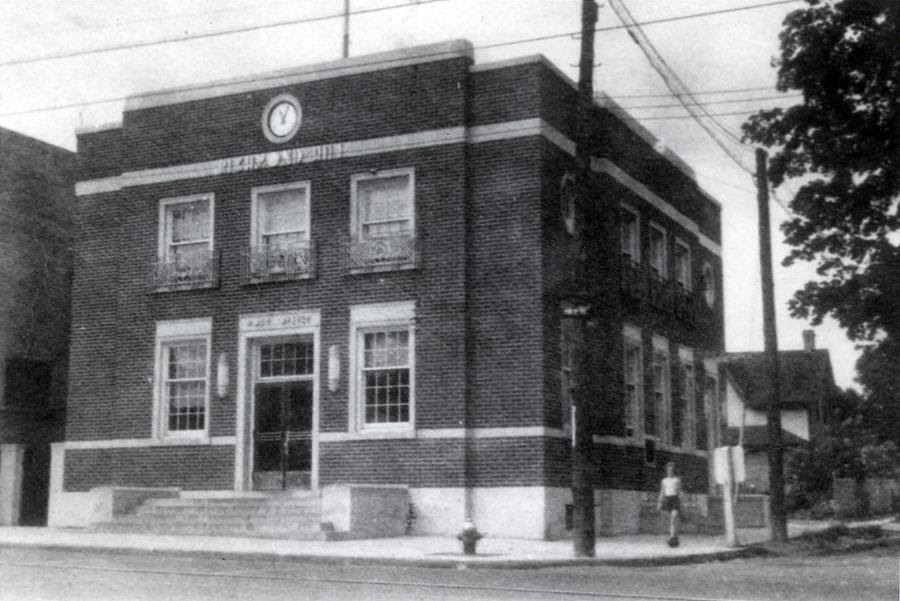
The Richmond Hill Post Office (ca. 1950) at the corner of Yonge and Centre Streets. The new building was officially opened December 6, 1936 by the Honourable Colonel William Mulock, M.P. for North York and Postmaster-General. It was designed by architects Forsey Page and Co. and built at a cost of $40,000. (Photograph courtesy of Richmond Hill Public Library, 102a)
Robert Hirtle and I always travelled together. We were, and still are the best of friends. Rob’s father, who was the Minister at the Presbyterian Church let Rob have, what seemed to me to be, unrestricted use of his car. Indeed he secured a driver’s licence for Rob when he was fifteen. It allowed him to drive only the one car which, if I remember correctly, was noted on the licence.
Rob, using his father’s 1941 Dodge sedan transported a carload of us to and from the Toronto Mail Sorting building at Bay and Lakeshore Boulevard. That first year, it was exciting to leave for work at what a short time before, was my curfew for getting home. Our route was down Yonge Street to the top of Hogg’s Hollow Hill. There we would swing off to the right over the viaduct where the road curved to the south to meet Avenue Road at about Wilson Avenue. Highway 401 and the Avenue Road cloverleaf approximately follows that stretch. We travelled Avenue Road to Front Street where we would turn left and then south on Bay Street to Lakeshore Boulevard. If my memory is correct there was ample free parking on the west side of the building. The trip was fairly quick as traffic was light and traffic lights were few. I believe the first one was at Sheppard Avenue and the next at Eglinton.
On reporting to work Robert and I and some of our friends, were given our time cards and assigned to sort mail for the streets of Toronto that began with the letter ‘L’. We each faced a wooden case divided into cubicles. Each cubicle was labelled with the name of an ‘L’ street. The labels were in alphabetical order starting at the top left hand corner of the case. The letters to be sorted were dumped onto the front part of the bench on which the cases rested. We spent the entire shift sorting an endless supply of letters into the appropriate cubicle. We could work standing up or sitting on the high stools provided. It was dangerous to sit on the stool too long because often one tended to go to sleep and fall off.
It didn’t take long for Rob to realize that some streets had more mail than others. Following this observation we moved the labels so that the streets which received the most mail were immediately in front of us and at the easiest height to pop the letters into their cubicle. This change made our work much easier. That it also helped us to sort letters faster was not of great concern to us because there was never an instant when the supply of letters on our bench ran out.
Every evening when we reported for work we found that the street labels on our cases had been put back in alphabetical order. Each shift, before we picked up a letter, we reorganized the street labels to make our work easier. Needless to say this did not give us a very high opinion as to the efficiency of the Post Office supervisors or the employees on the other shift. Maybe we were just lazier than the others.
Our employment ended the morning before Christmas. As school had usually closed a day or so before that, we had caught up on our sleep and were able to enjoy Christmas and following week of holidays. Our pay cheque would arrive, we could repay our parents the money they had advanced us for work expenses and the purchase of Christmas presents and still have some left over for ourselves.
We did this almost every Christmas during our high school years. Of course our teachers knew what we were doing, and thinking back I realize how much patience they exercised in dealing with a bunch of students, who if not falling asleep in class were exceedingly dopey from lack of it. For most of us it was our first experience working in Toronto for people who did not know us and our families. I’m sure it helped prepare us for our future careers away from the secure environment of the Village of Richmond Hill.
A reminder that our Annual General Meeting will be held on Tuesday, January 16, 2024 at 7:00 pm in Meeting Room A at Central Branch of the Richmond Hill Public Library.
This is an important meeting when you will hear from your current Executive members about their various activities during 2023. You also have an opportunity to elect the Executive for the 2024 year.
Once again our annual bring and brag will follow the AGM. This is chance for you to showcase interesting objects and stories to other RHHS members.
We are excited to welcome our own Cameron Telch to the next regular meeting of the Richmond Hill Historical Society. Cam will be presenting Breaking the Silences of the Archives: Humanizing the Shell Shock Experience of the Great War at 7:00 pm in the Event Room on the 3rd Floor of Central Library at 1 Atkinson Street, Richmond Hill.
We look forward to seeing you there.
Free to RHHS members, but we welcome anyone interested in this fascinating topic. There is a guest fee of $5.00.
As we continue to celebrate the Society’s 50th Anniversary, we are sharing articles from past issues of our membership magazine. In honour of our anniversary, we look back to the September/October 1998 issue of Heritage on the Hill and this article by Jim Monkman looking back at 25 years of the RHHS. Article edited by Janet Fayle and Doris Leno.
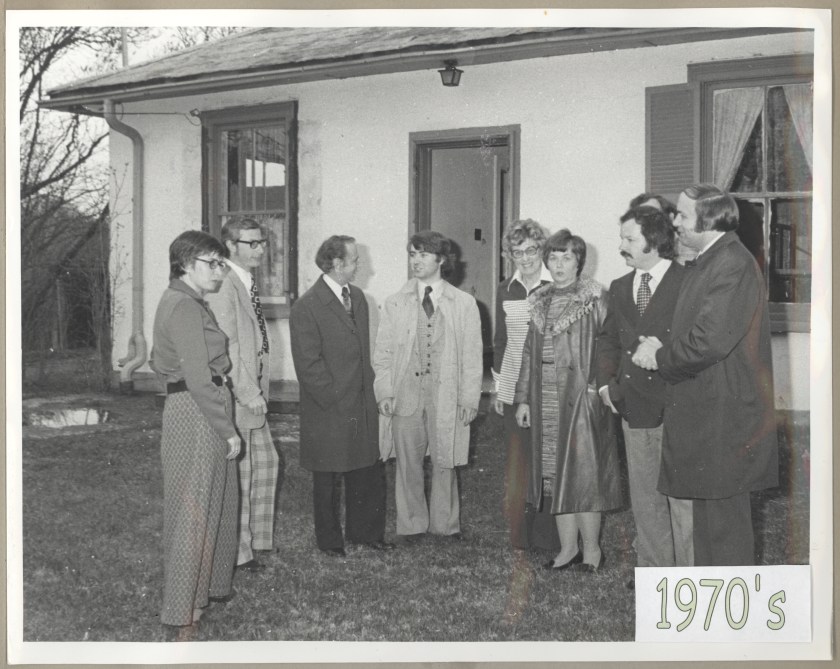
In 1974, members of Richmond Hill Council visited Rowland Burr House and are pictured with Historical Society President Janet Fayle, Acting Clerk William Rice, Society member Malcolm Jardine, Chief Librarian Patricia Hart.
On October 18th 1973, at a meeting held at St. Mary’s Anglican Church, The Richmond Hill Historical Society was founded. Its objective “To Preserve In Our Present Community An Awareness Of The Culture Of Our Forefathers ”
On January 18th 1974, at the first annual meeting, an election of officers installed Mrs. Donna Bales as President., Mrs. Dorothy Gummersall as 1st Vice President, Mr. John LeClaire as 2nd Vice President, Mrs. Janet Fayle as Secretary, and Mr. Brian Cowan as Treasurer.
The first project undertaken by the newly organized Society was the restoration of Burr House, saved from demolition at the insistence of Mrs. Patricia Hart, Chief Librarian and historian. In June of 1974 The Society urged the Town to acquire Burr House and advised that they were prepared to lease and restore it. The Town was receptive to the Society’s proposal. While the legal technicalities and paper work were in progress restoration work was begun.
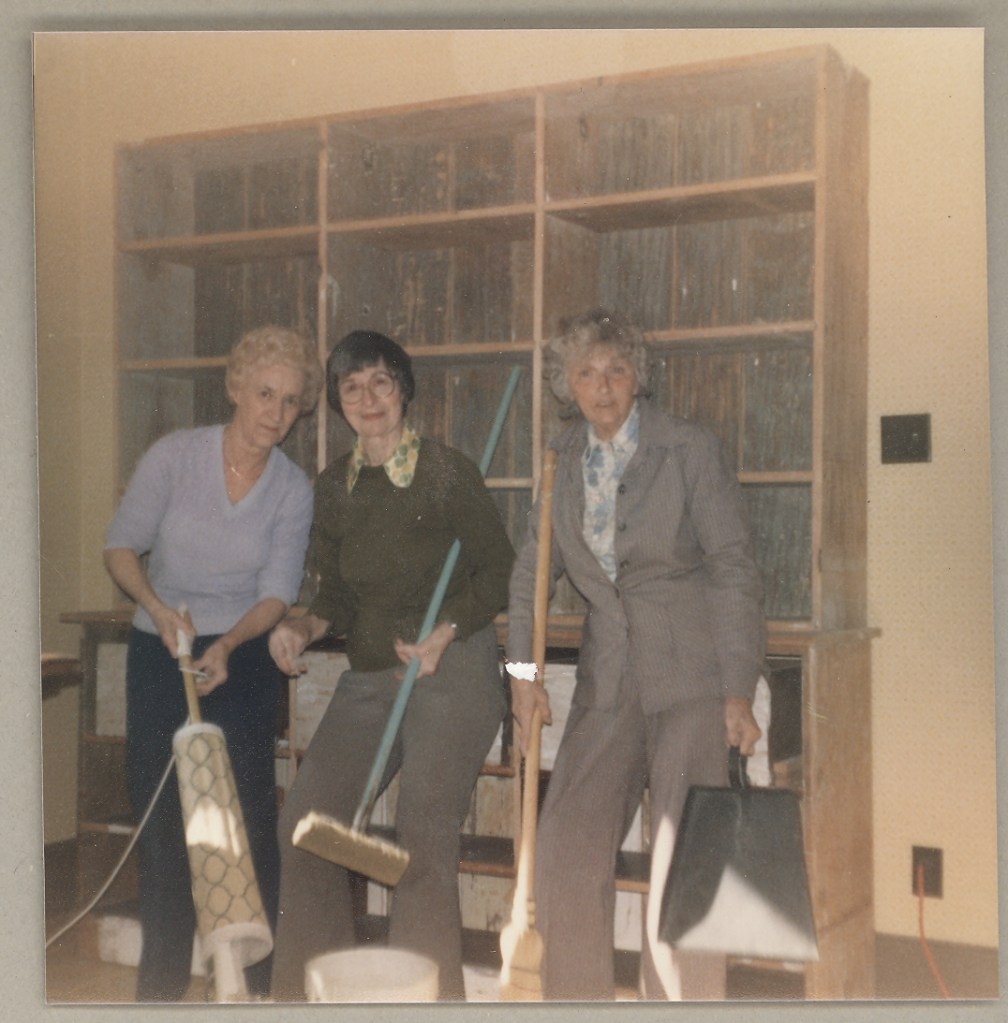
Richmond Hill Historical Society members Alice Dewsbury, Helen Barclay and Doris Leno during the early Burr House renovation.
In February 1975 The Society was incorporated as “The Richmond Hill Historical Society” and also was designated as a Charitable Organization for tax purposes. In May 1975 the Society entered into a lease agreement with the Town for a period of five years. The terms of the lease required the Society to pay an annual rental fee of $1.00 per year; to restore the said house, at its own expense to a structurally habitable condition before the sixteenth day of May 1976; and to carry out a restoration program of the house, with furnishings appropriate to the period when it was constructed, as funds become available to the Lessee.
By May of 1976 when Richmond Hill established a “Local Architectural Conservation Advisory Committee (LACAC)” the task of restoring Burr House was well underway.
The Society applied for and obtained a Wintario Grant. With the assistance of the Hill Potters Guild, the Burr House Spinners & Weavers, and helped by annual financial grants from the Town, Burr House was soon made structurally habitable. Occupancy of the premises was then shared by the Hill Potters, the Spinners & Weavers, and the Society.
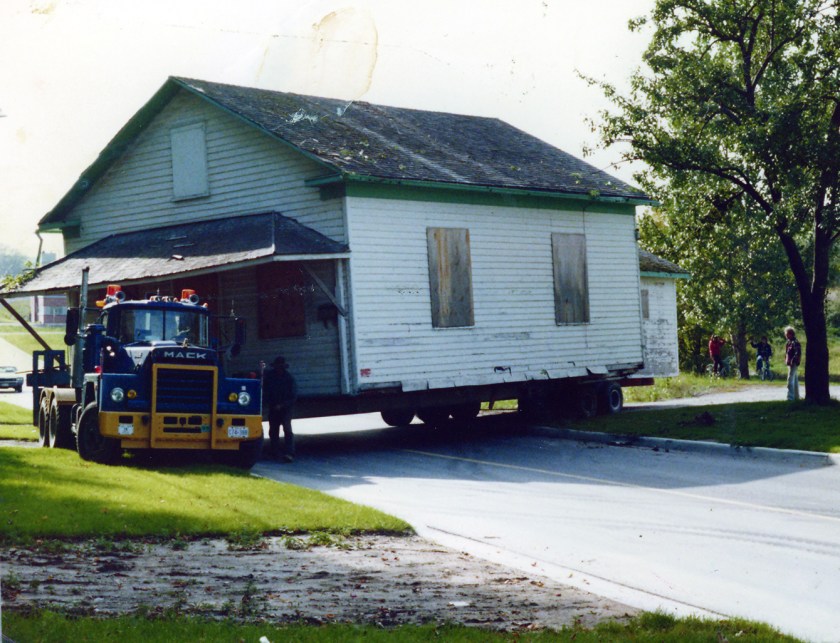
Moving the Evangelical Church to the Burr House site, September 1978
By 1978 the Town had acquired the Church of the Evangelical Association in North America, now known as the Guild Hall, but at that time located at the comer of Bathurst Street and Carrville Road. In July of 1978 the Society entered into an agreement with the Town to lease it under terms similar to the Burr House lease. With the assistance of the two Guilds they proceeded to relocate the building to Woods Park and to restore the building. Restoration work on Bun- House was temporally suspended and all efforts were directed to completing the Guild Hall so that the Guilds could vacate Burr House.
To obtain a Wintario Grant for the restoration of Guild Hall, the Society pledged financial funding to the project in the amount of nine thousand nine hundred and fifty-four dollars and the Potters pledged one thousand five hundred dollars. It is interesting to note that although only fifteen hundred and forty dollars worth of donated labour was pledged four thousand eight hundred and eighty-five dollars worth of labour was donated by the three groups.
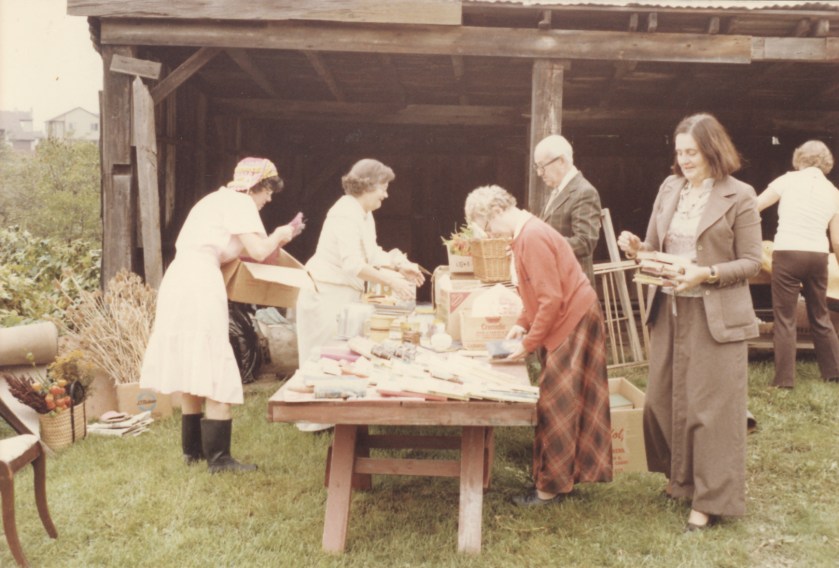
Fundraising came in various forms for Burr House like this 1978 Stuff ‘n Such sale.
The Guilds potted, spun and wove and as fundraising endeavors conducted craft classes. The Society promoted fund raising projects – Quilt Raffles, Stuff & Such Yard Sales, selling souvenir plates, post cards, hastinotes and ink and water colour drawings of Burr House at Mall displays and at the Richmond Hill Fair. Tea and scones were served regularly at Burr House and classes were offered in such crafts as chair caning, and quilting. Revenue from all fund raising projects was dedicated to the restorations as required by the terms of the Wintario Grants. The Society’s operating expenditures were limited to rental of meeting space at the Richmond Hill Library, an occasional speaker’s honorarium, and publication of a one page newsletter. When the Guild Hall was completed the Potters and Spinners & Weavers moved. At long last Burr House was vacant, restoration work was immediately resumed. It was a formidable task and took many hours of labour in dusty dirty surroundings.
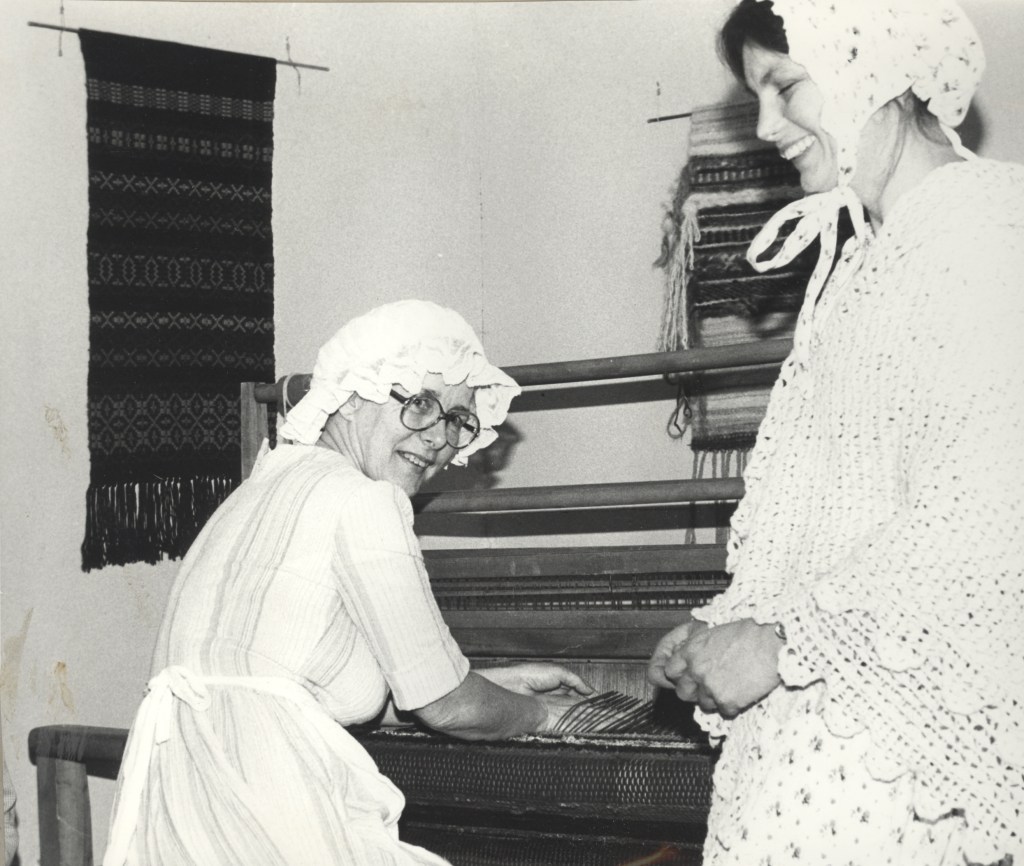
Weaving at Burr House
During the restoration of Burr House the Society sponsored Archeological digs in the yard and under the floor of the Kitchen. “Dig” sessions for students were arranged and over 500 students participated.. Many artifacts were recovered and were added to the Society’s growing collection of histone items which had been donated by local residents. As there was no available storage space Society member’s stored the collection in their homes.
When restoration work was completed and the terms of the Wintario Grants satisfied, fund raising was continued and the money raised used to rent space in the new McConaghy Centre. The artifacts were inventoried, cleaned and placed on shelves and tables which had been donated for this purpose. The rental charge for this facility was $2000.00 per year and when we could no longer afford to pay this amount the Town provided a smaller storage space without charge. When the Heritage Centre opened the entire collection was donated to the Town.
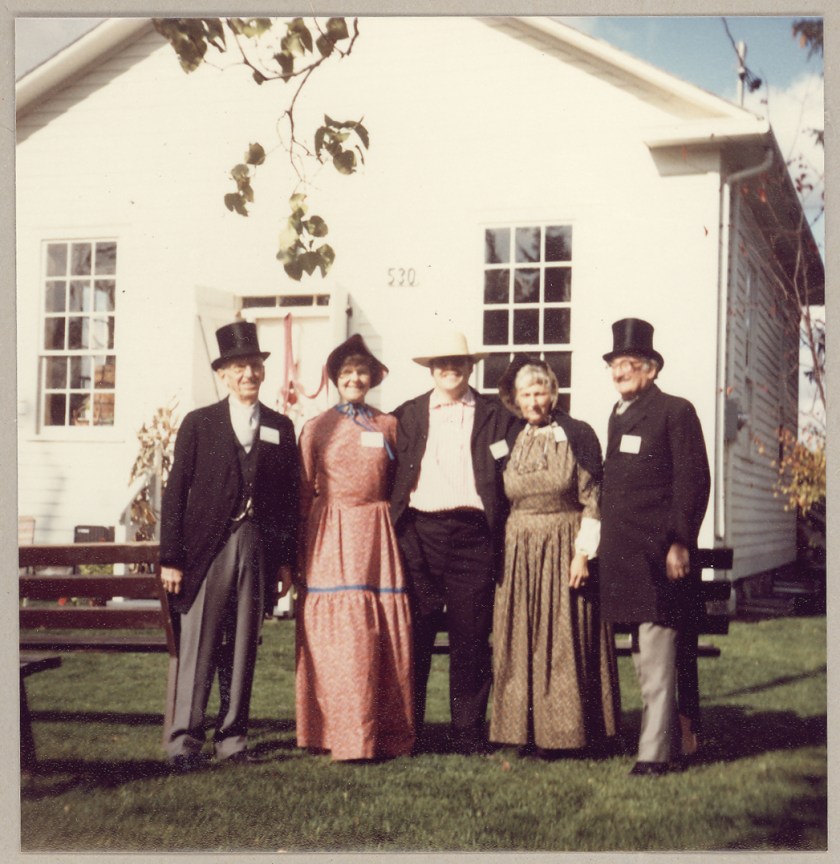
Official opening of the Guild Hall, October 23, 1982
In 1982, while restoration work was still in progress, the Society opened a craft shop and tea room in Burr House. The Shop was very successful and in 1985 the Potters and Spinners & Weavers entered into a partnership with the Society and the Craft Shop became The Burr House Craft Gallery and Tea Room, Much has been accomplished since that first meeting in October 1973. As well as restoring two houses and operating a craft shop, the Society published a book that is now in its second printing. Lectured on local history in schools, taped some oral history, expanded the one page newsletter into a media in which members and non-members can publish their memories of old Richmond Hill. We have participated in many projects and unforgettable fund raising and social events. Strawberry Socials, Christmas Parties held in members homes, Picnics at such far away places as the Museum at Midhurst, Stuff and Such Sales on the lawn at Burr House, a Fall Festival complete with costumes and cider making. Our float in the Christmas Parade; Founders Day Service in the cemetery; and Quilt Raffles! Remember what happened the year the prize quilt was stored in a green garbage bag?
Society members should be proud of these accomplishments and celebrate the 25th anniversary of our founding with glee.
Postscript I regret that in this brief backward glance I was unable to include all of the events and accomplishments of our Society or to mention the names of the many many members who so freely gave of their time and talents to make things happen. Perhaps we should begin our next quarter century by compiling a history of our past. – Jim Monkman
by Vera Tachtaul Originally published online with the Richmond Hill Liberal, September 21, 2023
With the start of another school year, it is interesting to look back at our school history, as Richmond Hill celebrates 150 years.
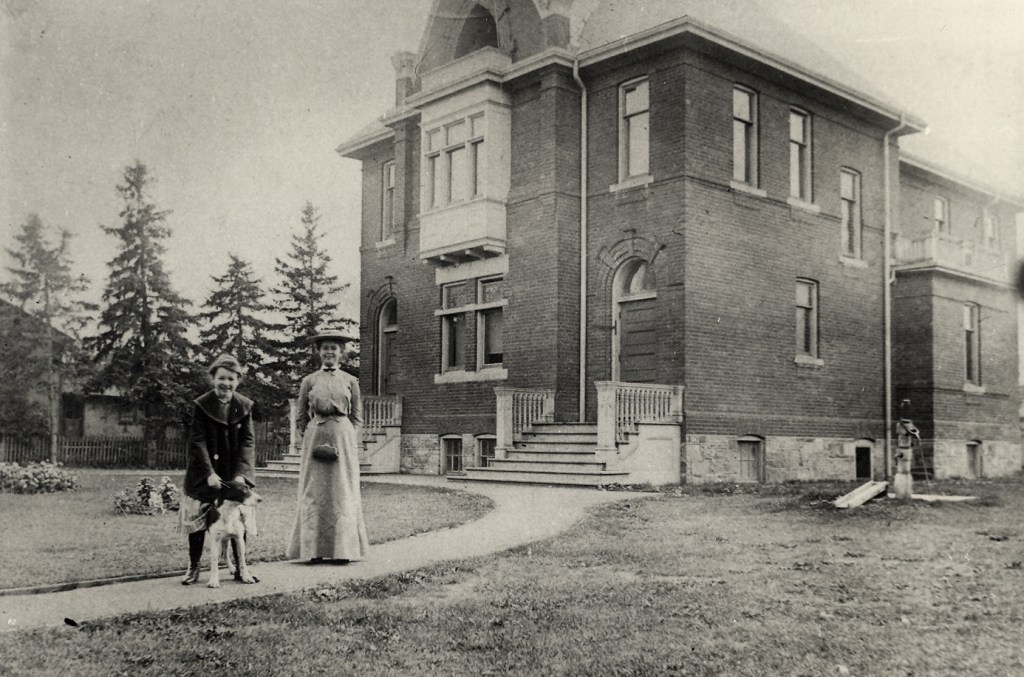
Richmond Hill High School at the corner of Yonge and Wright Streets, circa late-1890s (photograph courtesy of Richmond Hill Public Library, PA-90-004B)
Richmond Hill High School is one of the oldest schools in York Region, and has moved several times in its long history. After Richmond Hill was incorporated in 1873, a school was built behind M.L. McConaghy Seniors’ Centre (as we know it today) that served the community for 23 years until it was destroyed by fire in 1896. The Board of Education set up a makeshift school at Temperance Hall, located at 11 Centre St. W., and rented it for $6 a month. Sixty desks with seats were purchased for $2.95 each from Newmarket Novelty Works.
was marginal compared with today’s standards, and the dilemma of where this new school would be built became the concern. In a letter to the editor of the Liberal, one resident voiced his concerns over the location and the style of this new school, stating that communities were judged by the appearances of the schools that were built there and that the school grounds were just as important for satisfactory educational results.
When the education committee met with the village council to discuss the situation further, three possible locations for the new high school were discussed. One was at the site where the school had burned down, and the other was at Village Park. The third option was at the Richardson estate at the north edge of town, but since no vote was taken, a committee was established to consider the purchase of half an acre of property from the Powell family for $800. Another was to purchase the Hopkins property, which was located at the corner of Yonge and Wright Streets.
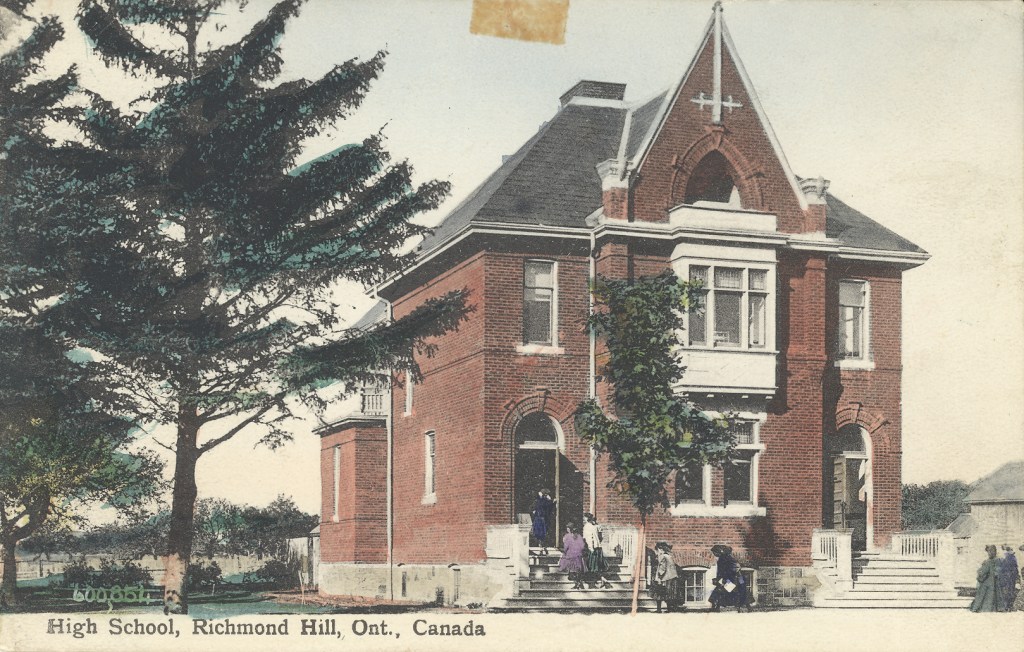
Postcard depicting the Richmond Hill High School, circa. 1910 (photograph courtesy Richmond Hill Public Library, Lynett Collection, card-09)
By April of that year, several letters were received by the Liberal from readers distraught about the length of time it was taking to build the new high school. The Liberal’s editor realized that there was enough interest for a regular column from readers who could vent their frustrations to the public. Some wrote in with full lists of disapproving facts. One petition that had been circulated throughout the village claimed that the board had made a mistake in its selection of the Hopkins property site. The board decided to take its plans to the Ministry of Education, where the petition was disallowed. Those named in the petition who had favoured the Yonge Street site saw the old grammar school of 1851 get torn down, which was donated by Abraham Law, who became the first reeve of Richmond Hill.
The board had already approved the first site, had received the $3,000 needed to build the school and had asked for the $1,500 for costs associated with the planning and design of the building from John Harris.
In May, it was again suggested that the Hopkins property be purchased at Yonge and Wright Streets. The board, which met weekly, had also considered six other locations, but it was Mr. McConaghy who pointed out to the board that Chapter 57 of Section 46 of the High School Act precluded Mr. McNair from selling the Hopkins property to the board, since he was also the executor. He was also not allowed to vote. It was moved that the chair and secretary act as a committee and buy the Hopkins one-and-a-quarter-acre lot for $1,000.
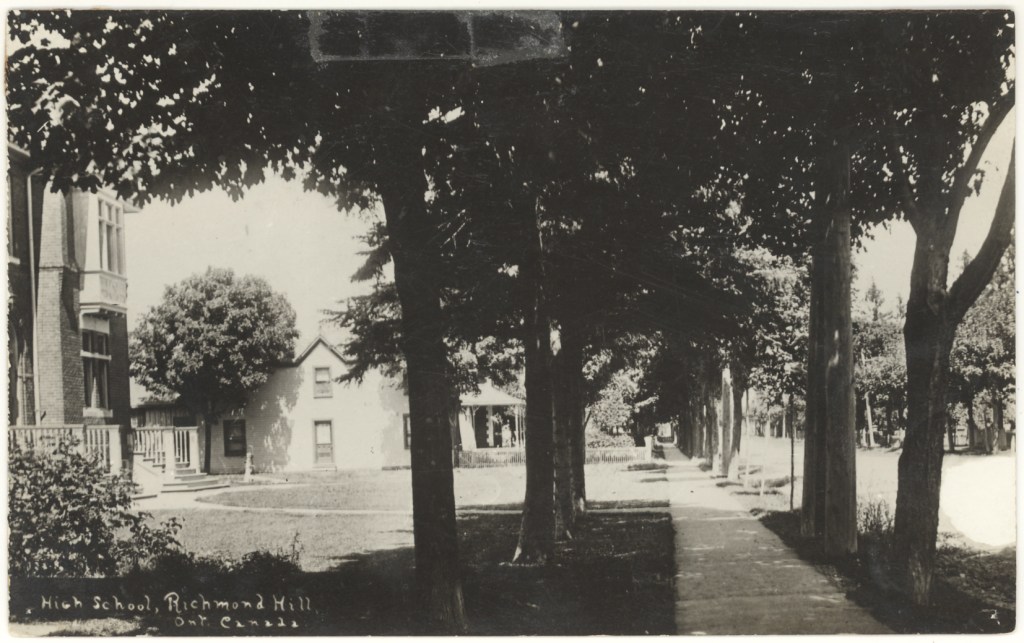
Sidewalk in front of the Richmond Hill High School, circa. 1920s (photograph courtesy Richmond Hill Public Library, Lynett Collection, card-19)
Construction of the brand-new high school officially began at the corner of Yonge and Wright streets in June 1897, just a few weeks before village residents celebrated Queen Victoria’s Diamond Jubilee. Masonry work was completed by J. Kelly and the lumber work by L. Innes and Sons. J. Francis Brown, who was a leading and remarkably prolific architect in the industry at the time, was the architect for the project.
The new school was officially opened on December 30, 1897, just one year from the time the former one had been burned down. There was a great pride of accomplishment felt in the community when the new high school was finally completed. It was referred to as a “monument” to both its builders and architects. Its exterior laid out in red brick with grey stone foundation accommodated two entrances, as well as a rear entrance to the basement sitting neatly on the Mill Street lot.
With well-lit classrooms and a science room “supplied with every apparatus for practical work,” the entire building was heated in the winter and ventilated in the summer, and was perfectly modern for its time.
Postcard depicting the Richmond Hill High School (photograph courtesy of Richmond Hill Public Library, Lynett Collection, card-02)
Today, the building still stands proudly at the corner of Yonge and Wright Streets, and it’s worth remembering its history because it recognizes the hard work and effort of the many people involved with this project.
The Bert Hunt Heritage Award acknowledges outstanding contributions to the preservation of Richmond Hill’s past and efforts to raise awareness about the value of that past to the community and its citizens.
Richmond Hill Historical Society President Jim Vollmershausen (right) presents the 2023 Bert Hunt Heritage Award to David Hunt of the Archives Committee of St. Mary’s Anglican Church on September 10, 2023. (photograph by Chris Robart)
The award also acknowledges the contributions made by the late Bert Hunt to heritage conservation efforts in Richmond Hill over many years. Bert Hunt was recognized as a community volunteer and Citizen of the Year by both the Town of Richmond Hill and the Province of Ontario. His advocacy for a new museum in Richmond Hill was instrumental in launching a Museum Feasibility Study that saw widespread consultations and a final report that was accepted by Town council and now forms the basis of ongoing efforts to move towards the reality of a new Richmond Hill museum. Bert was also a leader in a project to preserve individual peoples’ stories of Richmond Hill, and his personal efforts to capture this invaluable historic resource were fundamental to its success. Bert Hunt was a tireless advocate for preserving Richmond Hill’s heritage and his contributions have been recognized on many occasions. The Bert Hunt Heritage Award is an attempt to acknowledge the legacy that is Bert Hunt’s lasting gift to our City.
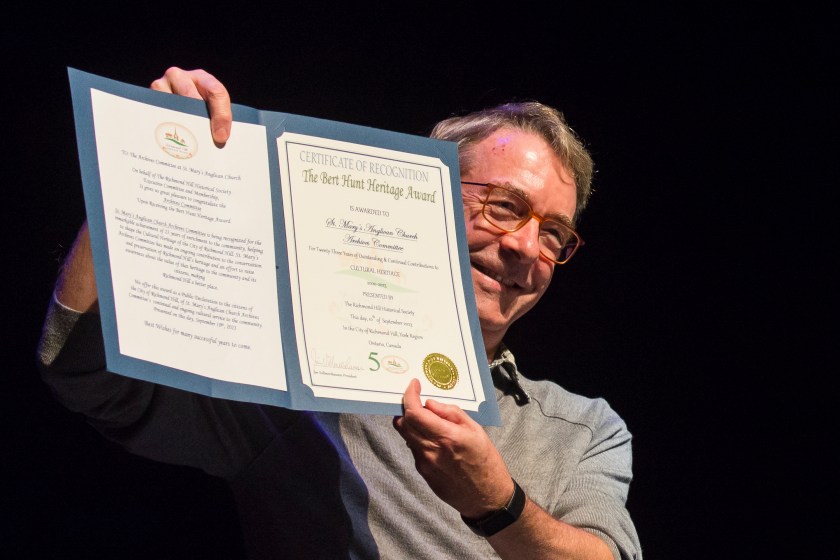
The 2023 annual Bert Hunt Heritage award has been presented to the Archive Committee at St. Mary’s Anglican Church. The award was presented to David Hunt of the Archives Committee during the Richmond Hill Heritage Summit at the Richmond Hill Centre for the Performing Arts on September 10, 2023.
David Hunt of the Archives Committee displays the 2023 Bert Hunt Heritage Award during the presentation on September 10, 2023. (photograph by Chris Robart)
The Archives Committee was established in 2000 to organize, preserve, and maintain materials related to the history and heritage of the Parish. The Committee recognizes that the Archives collection may be of value to historians and genealogists and attempts to educate and enrich Parishioners and the community through tours, displays, talks and programs. Over the years, the Committee has participated in numerous activities within and beyond the parish, such as Doors Open, themed presentations for Sunday School children and in-depth tours and special events for community groups.
The Committee has become the “custodian” of the historic Arnold Plot and were active participants on their Chapel restoration Committee. In addition, the Committee has also published two works: Gladdening Light: A Walk Around Guide to Our Heritage In Stained Glass, as well as St. Mary’s Anglican Church: 50th Anniversary of the New Sanctuary – 1964-2014.
Sunday, September 10, 2023 • 1:00 – 4:00 pm & 7:00 – 9:30 pm Richmond Hill Centre for the Performing Arts
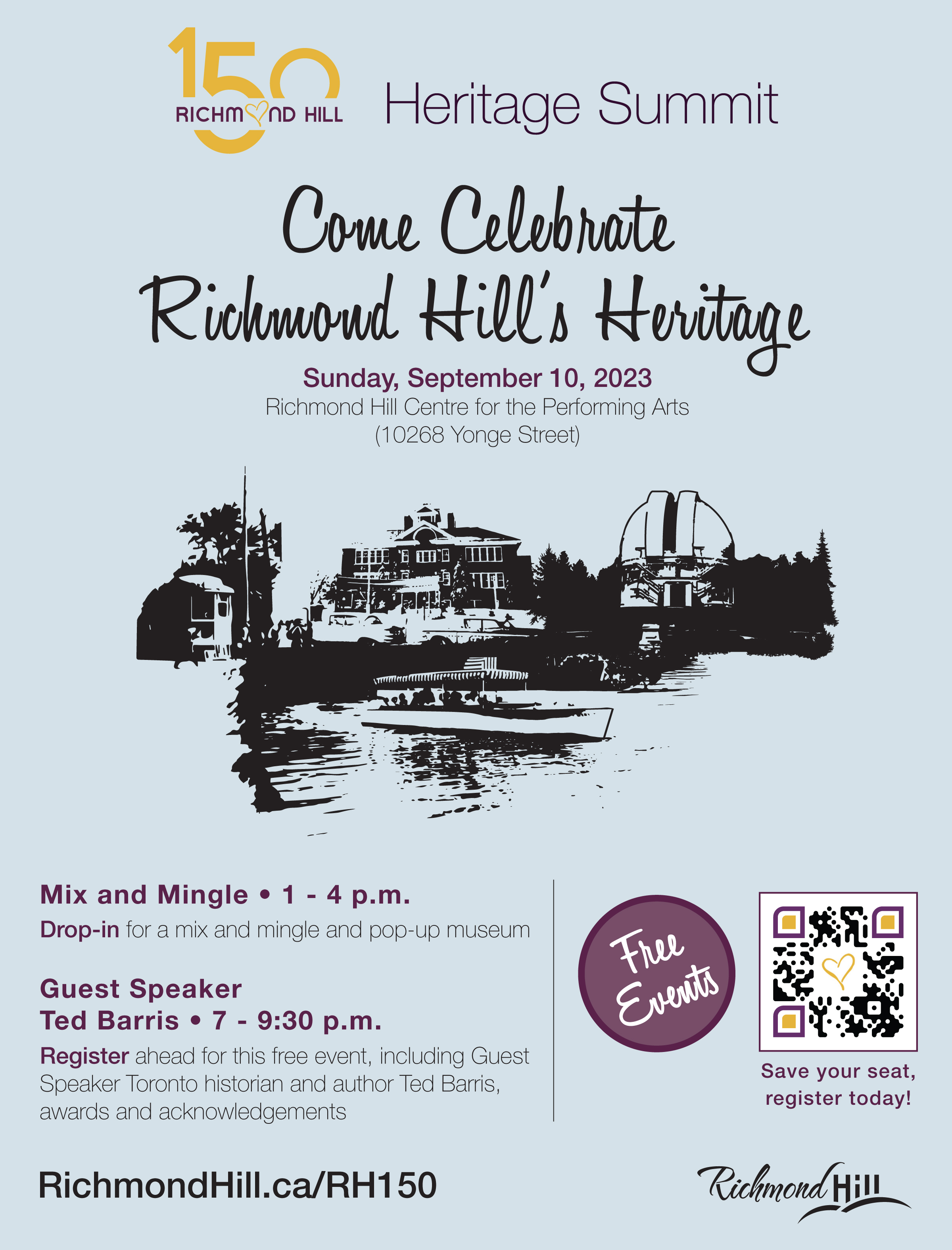
The Richmond Hill Historical Society is excited to partner with the City of Richmond Hill to celebrate heritage in our community with the Richmond Hill Heritage Summit at the Richmond Hill Centre for the Performing Arts on Sunday, September 10, 2023. In addition to helping celebrate Richmond Hill’s 150th Anniversary, the Summit aims to bring together a diverse collection of organizations from around Richmond Hill that will showcase to the people of the city how our heritage is nurtured and celebrated. The hope is that those who attend the summit will have a better appreciation of the breadth and value of the heritage we have inherited from the past and that we will leave for future generations.
Heritage can be defined as the full range of our inherited traditions, monuments, objects and culture. It is much more than preserving, excavating, displaying or restoring a collection of old things. In addition to that tangible evidence of our past, our heritage also includes our natural world (waterways, landscapes, wildlife) and more intangible elements such as our customs, traditions, sports, music, dance, folklore, and crafts. Taken together we can begin to perceive the scope and fullness of the heritage that we have inherited.
There are two components to the Summit, an afternoon session (1:00 – 4:00 pm) to appreciate Richmond Hill’s heritage with a meet and greet with representatives of over 25 local organizations where you can learn more about them and how they contribute to our heritage in a number of ways:
They are involved in outreach – to inform, to entertain, to educate;
They provide a forum for learning, conversation and socializing – meetings, workshops, seminars;
They advocate for a variety of issues and goals – heritage and natural conservation;
They help protect important community assets such as sites, parks, waterways – cleanups, public campaigns ;
They carry on and celebrate customs, traditions and crafts from the past;
They undertake or support projects that add to the community such as commemorative projects, benches, gardens, shelters, or fundraising.
Organizations scheduled to participate in the afternoon session include:
There will also be a “pop up” museum featuring items from the City’s artifact collection!
The evening session (7:00 – 9:30 pm) will feature a talk by noted historian, journalist and author Ted Barris as he shares with us stories from his book Rush to Danger: Medics in the Line of Fire.
While the Heritage Summit is free to attend, those wishing to attend the evening session with Ted Barris’ must register for their free tickets in advance through the Richmond Hill Centre for the Performing Arts Centre website.
The evening will also include guest speakers and awards presentations, including the Society’s Bert Hunt Heritage Award.
We are excited to be bringing you this important event in Richmond Hill in conjunction with the city and look forward to seeing you at the Summit!
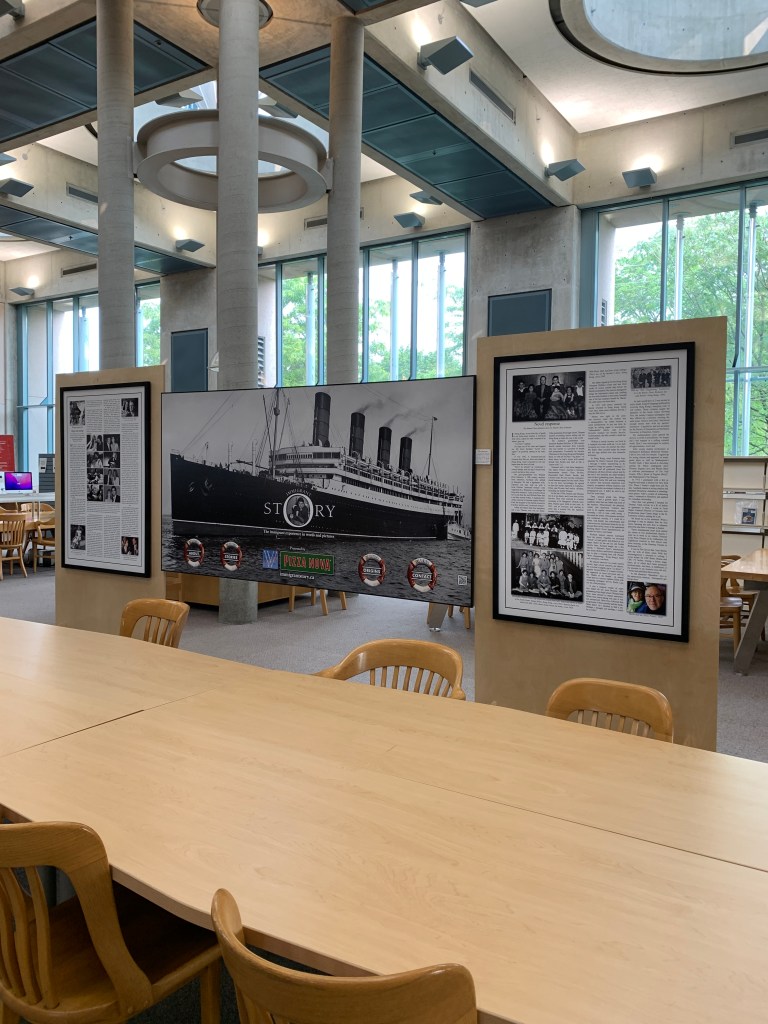
A new inspirational art installation at Central Branch that delves into the immigrant experience with stories of strength, courage, sacrifice, and hope.
The Immigrant Story Exhibit runs from June 27 – August 23, 2023 at the Central Branch of Richmond Hill Public Library (photo by Peter Wilson)
Richmond Hill is an incredibly diverse City of individuals from all over the world that help contribute to our community in so many ways. Immigrants play a vital role in the development of our country and in the broadening of our lived experiences. Come and immerse yourself in these compelling stories.
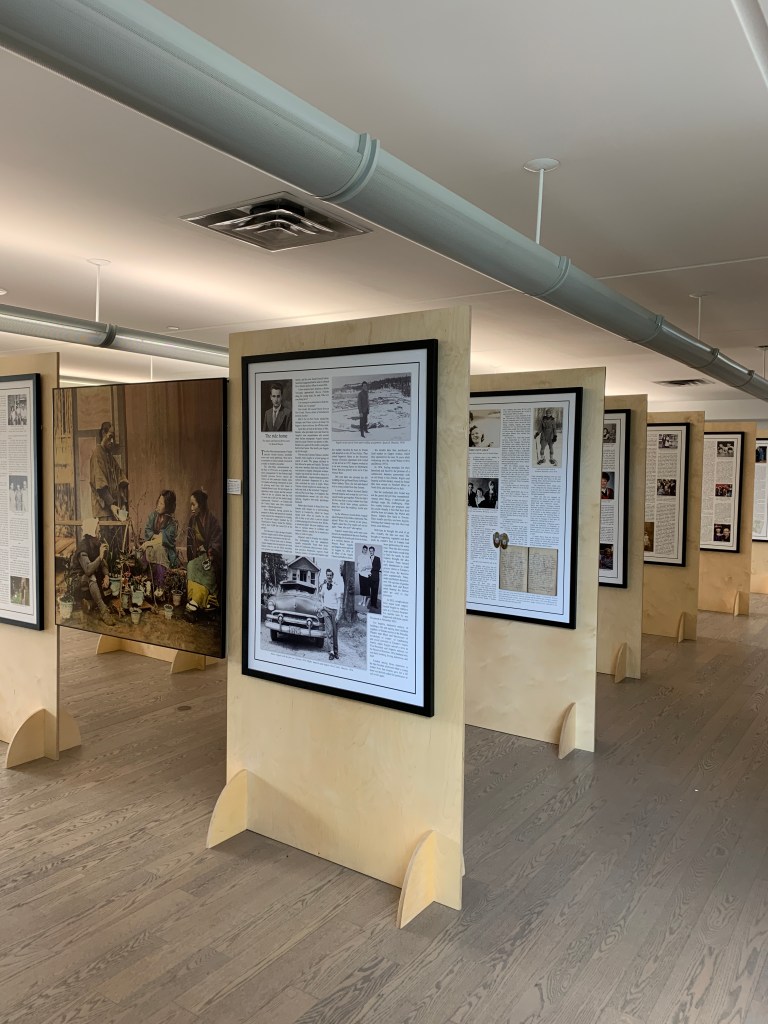
A sampling of the large display panels located in the 3rd Floor Event Room at Central Library (photo by Peter Wilson)
Sholom Wargon developed the art installation through large-print story panels in a newspaper-style layout. The rich diversity of immigrant stories from various perspectives and cultural backgrounds will resonate with many in the York Region community.
The exhibition at Central Branch runs until August 23. Central Branch is located at 1 Atkinson Street (near the corner of Yonge Street and Major Mackenzie Drive).
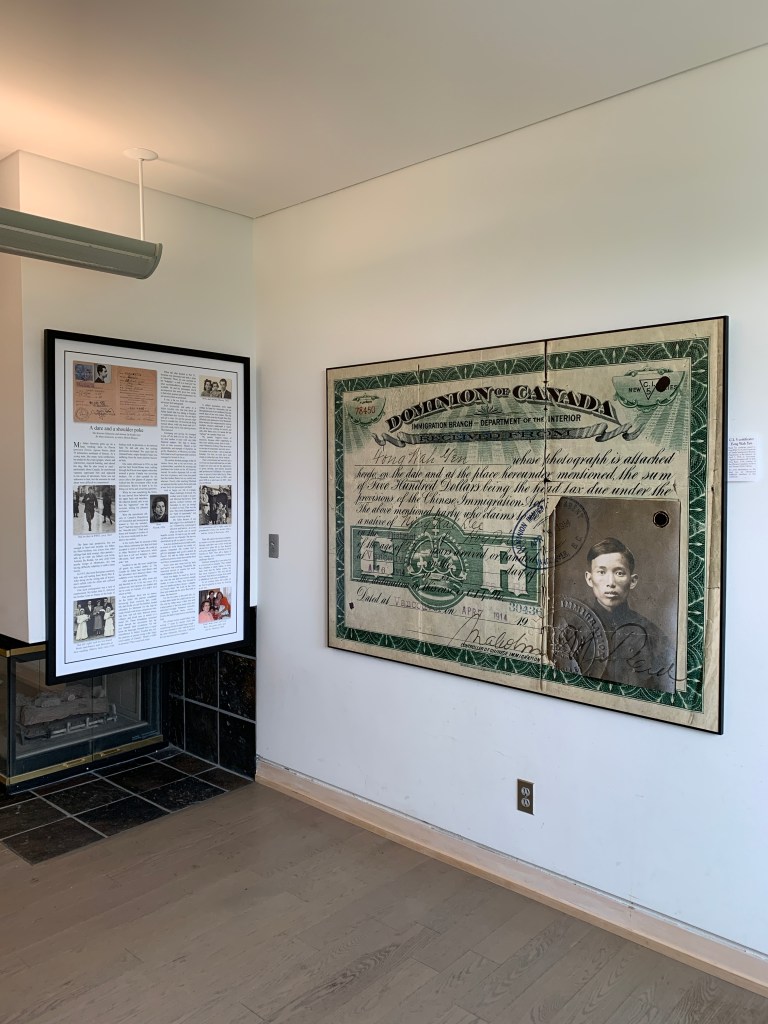
The exhibit contains a large variety of photographs and documents that help tell these amazing stories. (photo by Peter Wilson
Learn more about The Immigrant Story and its creator, Sholom Wargon by visiting the exhibit’s official site at https://immigrantstory.ca/.
This is an exhibit worth multiple visits so stop by today.
How Has Richmond Hill Changed Since 1914? Speaker: Cynthia Bettio, Our Lady Queen of the World Catholic Academy
Cynthia Bettio, Department Head of Canadian and World Studies at Our Lady Queen of the World Catholic Academy will be joining us with students from her Grade 10 history class to discuss the findings of their term-long project: How has Richmond Hill changed since 1914?
This is a project that came out of a keen interest in micro-history. Typically, students are instructed in the mega-narratives of this country’s history. When students are only instructed in these mega-narratives, they can sometimes miss out on the nuanced stories that impact regular, everyday citizens. This project focuses on the importance of place and how these places change over time. Through intense research and a key partnership with the Local History Room at the RHPL, students have been working on tracking how a lot in Richmond Hill has changed over time, throughout the turbulent 20th Century and into the early 21st Century. Students are using the RHPL Local Library Room with the support of Peter Wilson, Local History Librarian, in conducting their research.
Ms. Bettio will talk about the project and will be joined by her students to discuss their findings.
NOTE: This meeting will be starting at 6:30 pm and will also include an opportunity for everyone to mingle and enjoy a variety of refreshments and treats.
Join us for what promises to be a great meeting. Guest fee is $5 at the door, or consider joining the Society for $25 for the entire year. For more details, visit our Membership page.



 Richmond Hill Historical Society