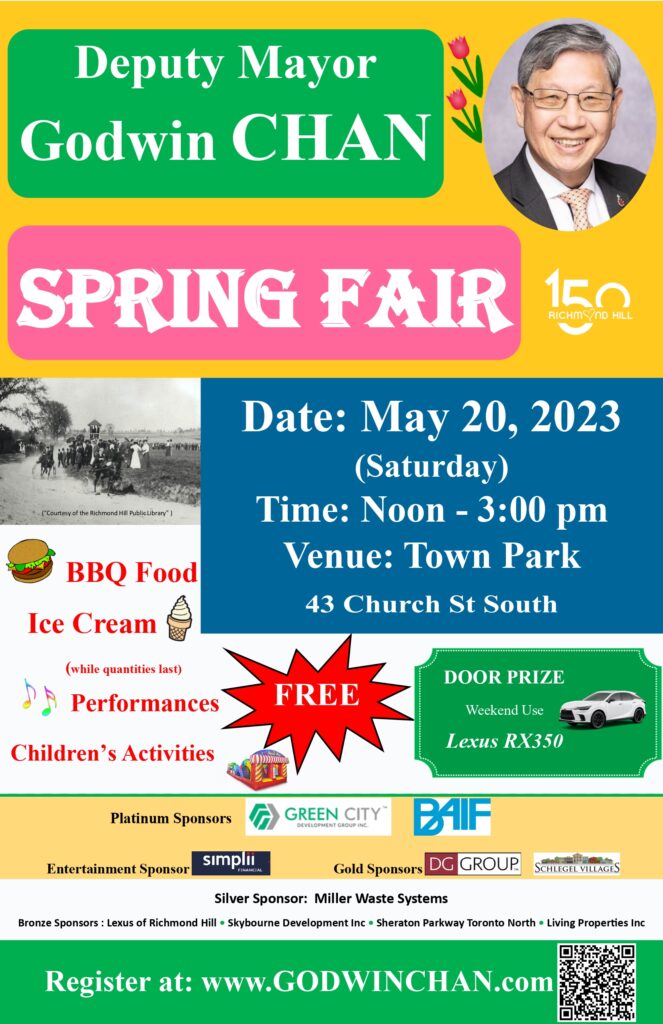
In the year we celebrate the 150th anniversary in Richmond Hill, the “Spring Fair,” an annual tradition in the Richmond Hill community for 147 years will be back at Town Park on Saturday, May 20, 2023; the same location where the historic annual celebration of spring was held until 1985. The Fair moved to Richmond Green before ending in 1996. Deputy Mayor Godwin Chan invites you to join him from noon to 3 pm on May 20th at Town Park, 43 Church Street South.
Complimentary BBQ food (burgers and hot dogs) and ice cream cones will be served while quantities last. Richmond Hill’s antique 1924 fire truck will be on display. The family-oriented community event includes children’s activities, public and community services booths, and a live band performance. While Spring Fair in the earlier days listed prizes for horses and other livestock, the 2023 event has a door prize of a free weekend use of 2023 Lexus RX350.
Peter Wilson, Local History Librarian at Richmond Hill Public Library, will showcase their historic Spring Fair collections. In addition, the Ukrainian community will participate in the 2023 Spring Fair to perform and share their culture and welcome support to help newcomers who are in need. As well, St. John Ambulance will have their Community Food Truck to collect donations for the Richmond Hill Community Food Bank.
Bring along your family and friends along with non-perishable food items for donation to our local food bank and enjoy the community celebration of Spring 2023.
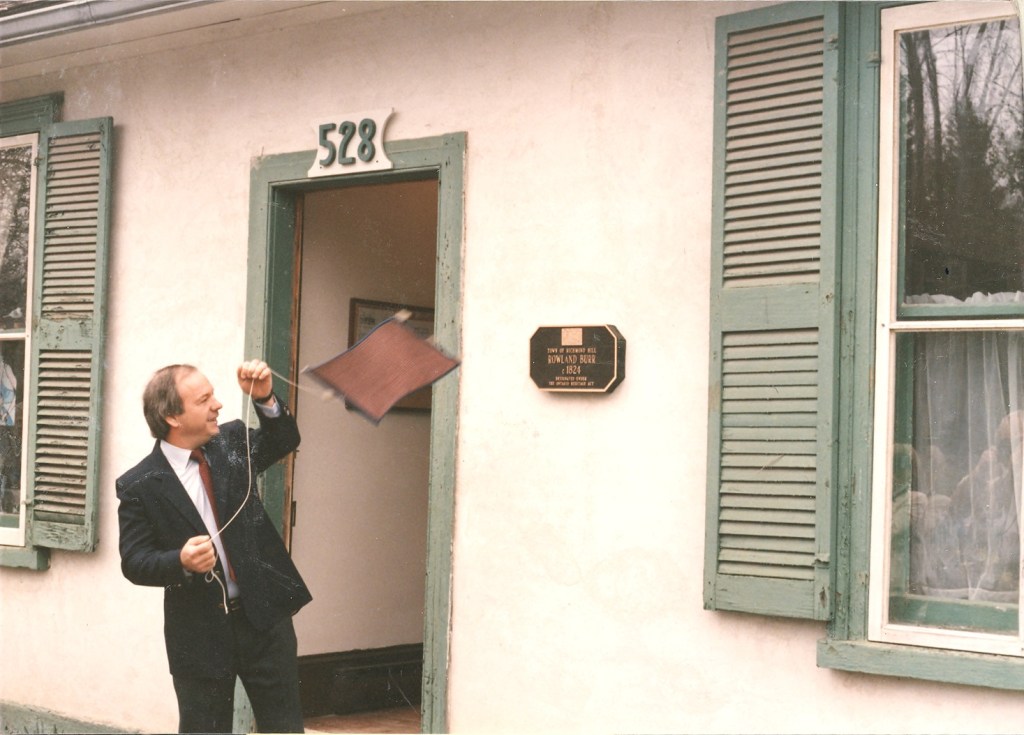
Today marks the anniversary of the unveiling of an historic plaque at Burr House by then Mayor Al Duffy in 1986.
Mayor Al Duffy unveils the historic plaque at Burr House on April 20, 1986
The first projects undertaken by the Society were to save and restore two buildings, Burr House and a second building, erected in 1857 as a church for the Canadian Conference of the Evangelical Associates in North America. It was moved in 1982 to the Burr House site from the corner of Carville Road and Bathurst Street.
From the Richmond Hill Liberal of October 25, 1973…
“The group expressed an interest in determining how the Wood home on Carville Road, built in 1813 (sic?) and now owned by the town, could best serve the community…Mrs. Hart suggested that it could be used for arts and crafts, but above all it should stay where it is so that children can be shown what a pioneer home looked like and how some pioneers lived.”
Countless fundraisers, educational and other events have been held at Burr House since it first opened as it continues to be an integral part of Richmond Hill.
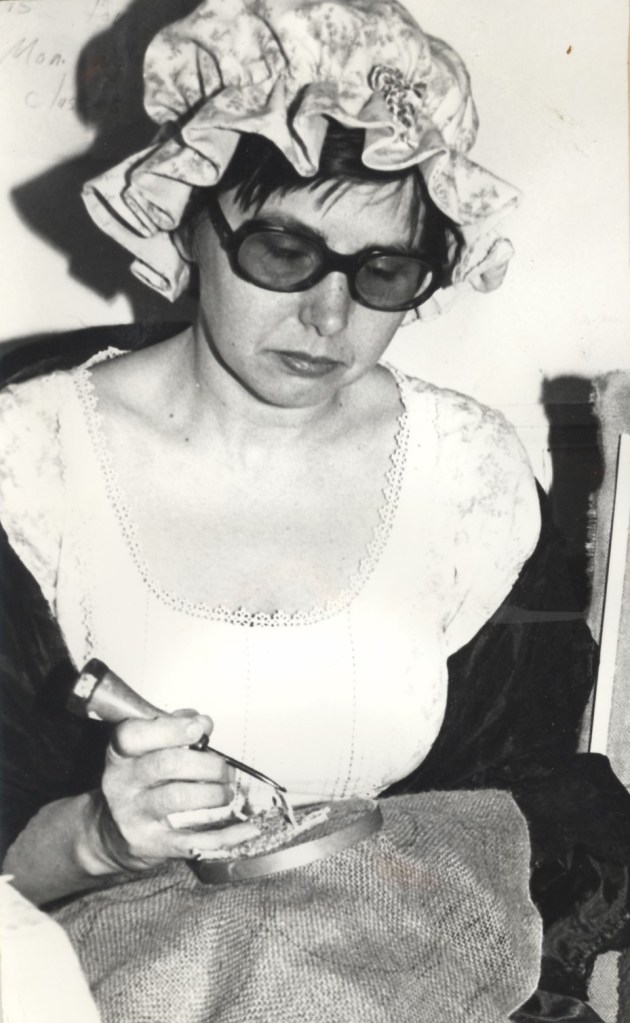
Richmond Hill Historical Society’s Janet Fayle demonstrates early needlework at Burr House.
As we continue to celebrate the Society’s 50th Anniversary, we are sharing articles from past issues of our membership magazine. As the City of Richmond Hill celebrates its 150th Anniversary, we will post some articles that share recollections of Richmond Hill of the past. Here we look back to the September/October 1996 issue of Heritage on the Hill and part 2 of an article by Harry Sayers. Read part 1 here.
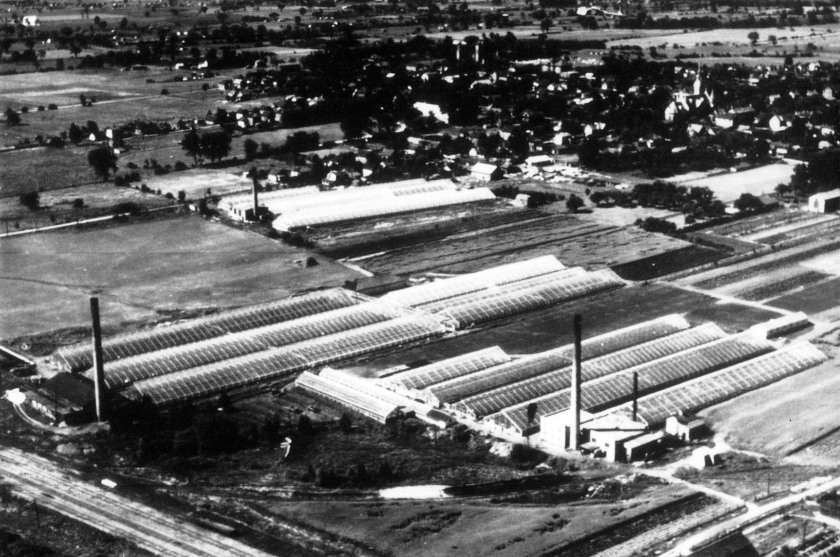
Having previously covered (more or less) the east side of Yonge, we begin on the west side at Major Mac (then Vaughan or Maple Road, in the 1920’s) where the McGibbon house was on the southwest comer while on the north was the sign proclaiming “Richmond Hill – Toronto’s Highest and Healthiest Suburb -762 feet above sea level – the Rose Growing Centre of Canada.”
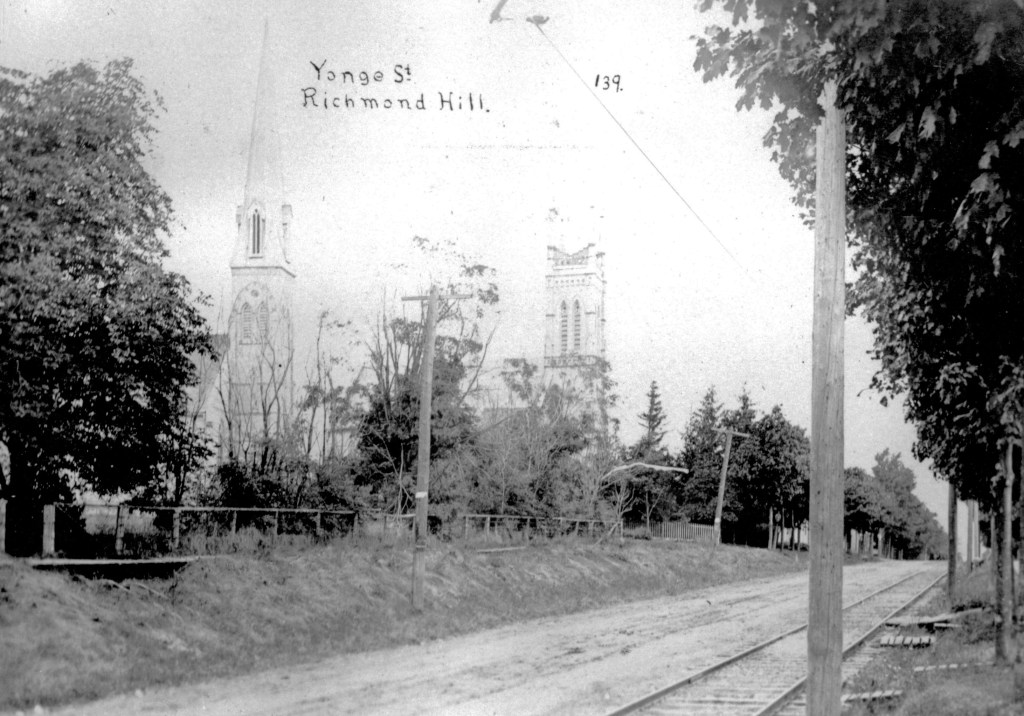
Further north came the Anglican Church of St. Mary, the Presbyterian Manse and Church with the original frame manse still on the front corner of the Presbyterian property on the south side of the lane leading to the Presbyterian cemetery. That manse is now at Black Creek Pioneer Village.
Yonge Street from Major Mackenzie Drive showing St. Mary’s Anglican Church and the Richmond Hill Presbyterian Church, ca. 1915. (Photograph courtesy Richmond Hill Public Library, PA91-005)
Soon, we come to the home and shop of renowned watchmaker Jerry Smith,(daughter Audrey Koning can tell you more), then the Public School, later the McConaghy Centre named after Mrs. L. M. McConaghy who was my first teacher on our arrival in the Hill in 1924 and Walter Scott was the Principal.
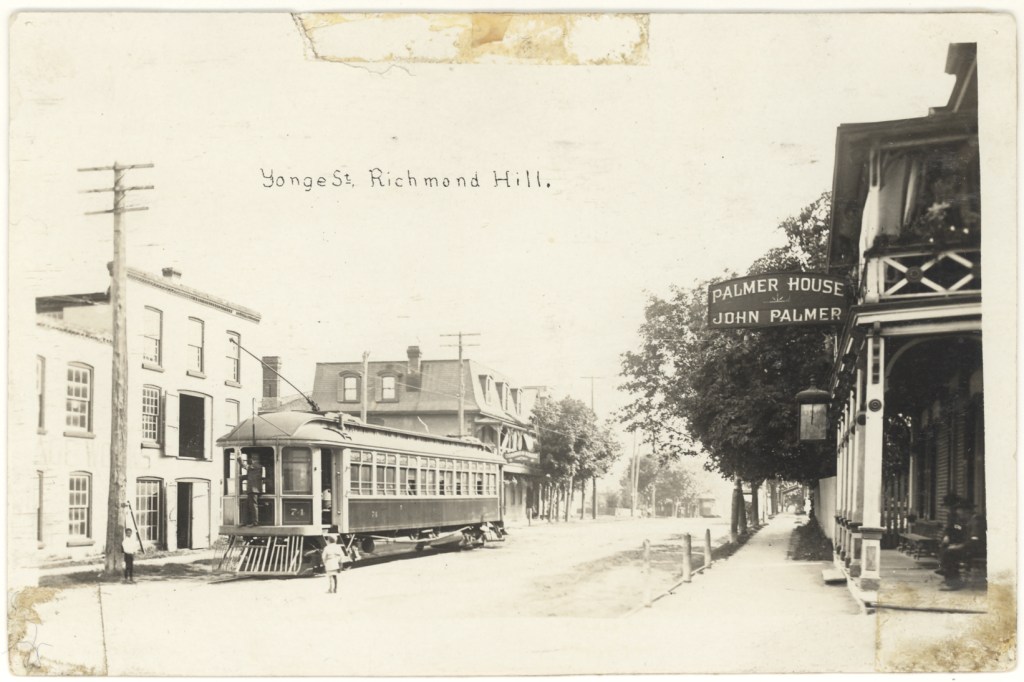
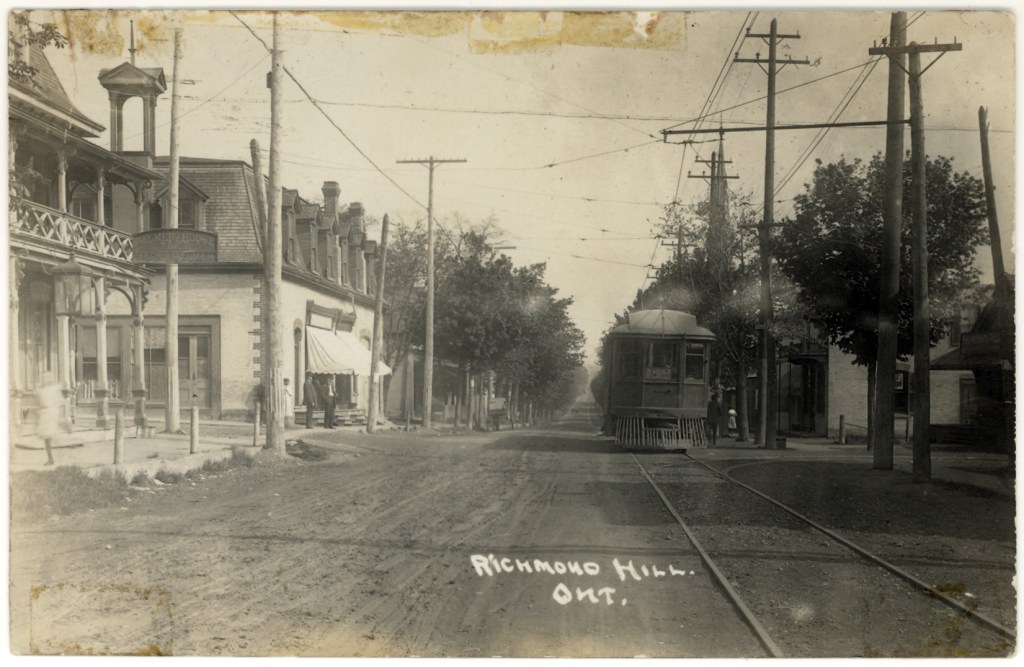
Next we come to the Palmer House later the Greenholme Apts, and recently torn down. Across Arnold St., the Palmer Brick Block, later called the Lorne Block, which housed, at various times a bank, shoe store, barber shop, etc. while the north end housed the fire house with the Council Chambers on the second floor.
The Palmer House Hotel beside the Palmer Block, later the Lorne Block, ca. 1910s. (Photograph courtesy of the Richmond Hill Public Library, card-33)
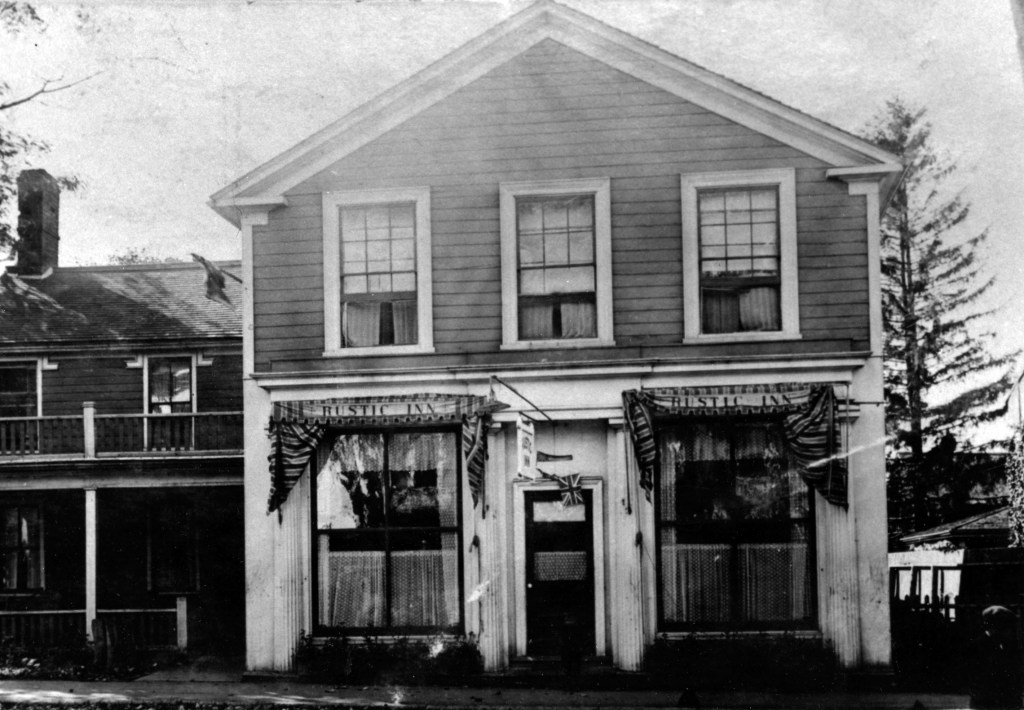
Along this block were Glass’ Meat Market, Green’s Tailor Shop, the Rustic Inn, Bruno’s Fruit Market later the Fisher General Store, Bill Davies house and dry goods store with the Ontario Hydro office on the second floor.
The Rustic Inn, ca. 1920s. (Photograph courtesy Richmond Hill Public Library, RH12-20)
Adjacent was the first (?) Dominion Store where I earned 15 cents for each order I delivered on my wagon! Then came Stein’s Store at Centre Street. Further north was the home of A. G. Savage with the Post Office in the South wing. Following were such stores as Isobel Hewitt’s Wool Shop, the Chinese Laundry and Wellman’s Men’s Wear at Richmond Street.
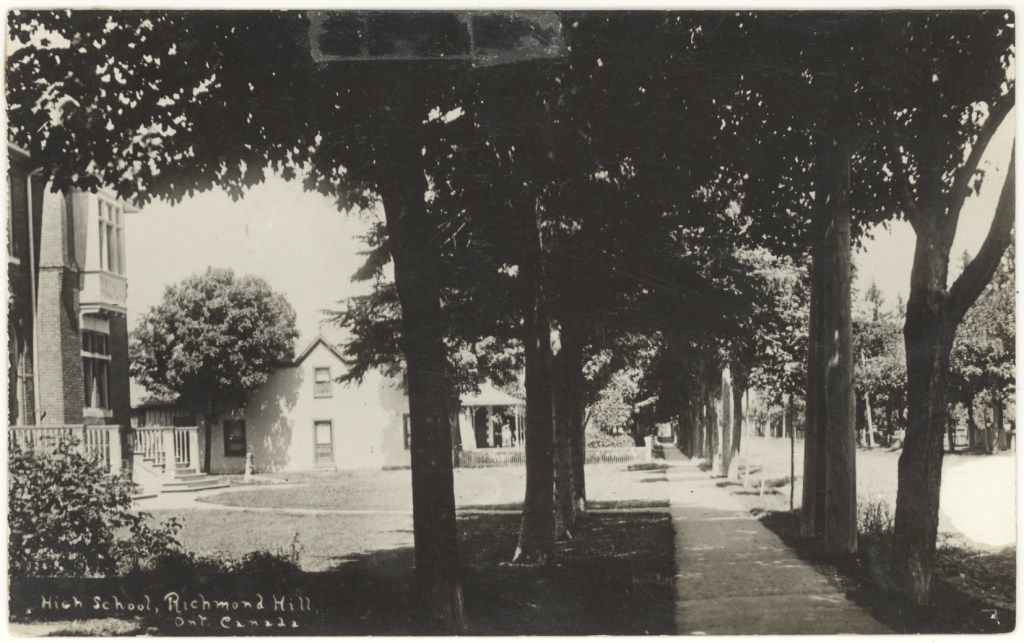
Across the street was Abraham Law’s house (later the Wright house) torn down to make way for a Sunoco service station. Close by was Carl Swanson’s garage with the gas pumps right at the curb. Then came the Anglican rectory, later Bettie’s Restaurant and it’s neighbour, the old High School (later the Municipal Hall).
Halfway up the next block was the Richmond Hill Dairy, Cowie’s (later Hunt’s) blacksmith’s shop and next door the property of Dr. Rolph and Lillian Langstaff, whose house was later moved by Dr. Jim to the rear of the property to face on Hall Street.
Further north, we come to Wright & Taylor’s Funeral Home (now Marshall’s), with the B. A. service station, operated at one time by A. White and Wilt Young, while across Benson Ave. was Cec Mabley’s White Rose station. Then came Little’s Ford agency and nearby Harold Reid’s service station. That brings us to just about the north limits of the village on that side of Yonge Street.
Here’s hoping that these reminders of the past, will recall to your minds memories of the “good old days” – they were, weren’t they ?????????
As we continue to celebrate the Society’s 50th Anniversary, we are sharing articles from past issues of our membership magazine. As the City of Richmond Hill celebrates its 150th Anniversary, we will post some articles that share recollections of Richmond Hill of the past. Here we look back to the May/June 1996 issue of Heritage on the Hill and this article by Harry Sayers.
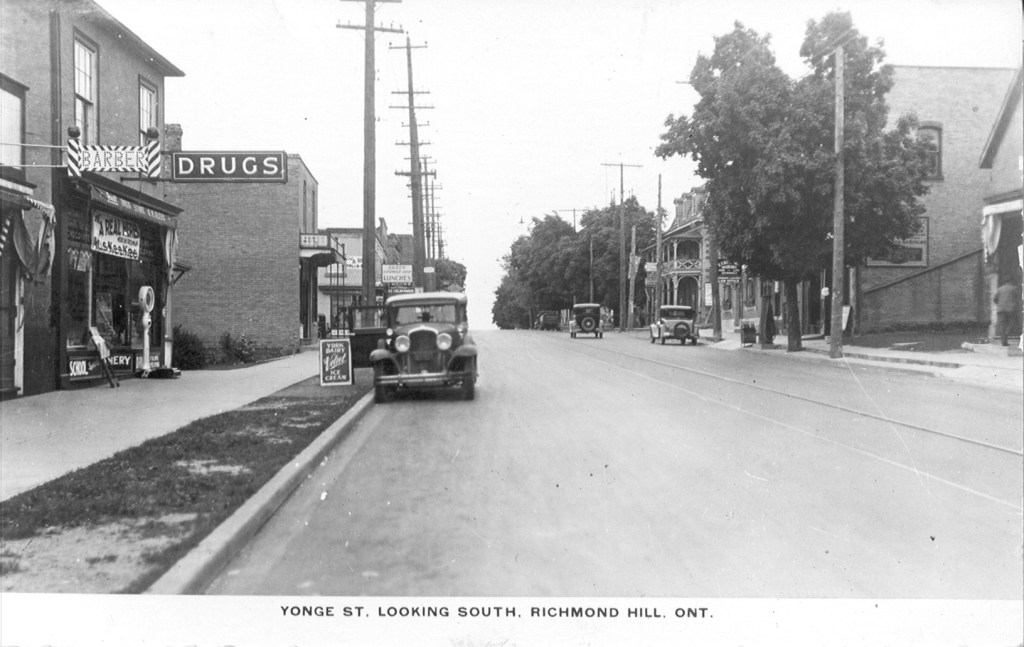
Yonge Street looking south taken around 1930. The Palmer House Hotel is on the right side of the road by the two cars. (photo courtesy of Richmond Hill Public Library, PA92-005)
Recalling memories of Yonge Street when I was young (quite a bit younger than today) is quite a challenge. It’s hard to be accurate as to dates etc. but memories do exist so I’ll give it a try.
Let’s start with the east side and since I’m recalling the 20’s, I’ll keep mainly to the village as it was then.
South of Major Mac, then the Markham Rd., were the Harding and Palmer farms whose names live on in street names. The Palmer house at the corner of Yonge and Major Mac is now a real estate office.
Further north we come to a series of brick houses, some now replaced by service stations, etc. One exception was the Stanford Nursing Home, now an office building.
Across from the Presbyterian Church was a tenement block, later the home of the Liberal, then the Richmond Inn with the Liberal Office, bowling alley and theatre. Of course the Standard Bank now a computer store. Almost forgot, the Cities Service garage, just to the south of the bank.
Then came the Trench Block with hardware, grocery and drug stores in turn up to Lorne Ave.
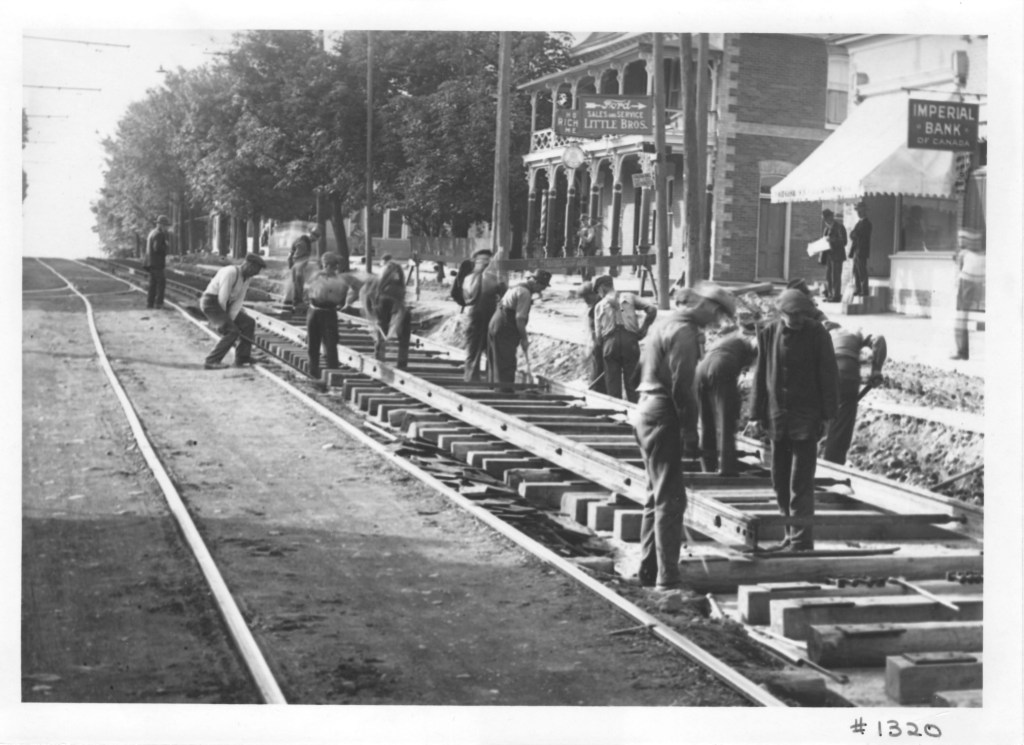
On the north east corner of Lorne/Yonge was the old Radial Station with the spur running beside the loading platform. Here one bought tickets for the radial cars which at this time ran from North Toronto to Lake Simcoe via Aurora and Newmarket with a branch line to Schomberg. Oak Ridges was known as Schomberg Junction in those days. Roses from our several greenhouses were shipped to Toronto from the radial station while we newsboys picked up our Toronto newspapers which arrived by the radial cars.
Moving the radial railway tracks from the east side of Yonge Street to the centre of the road for the first paving of Yonge Street in October 1927 (photo courtesy of Richmond Hill Public Library, RH12-26)
The next block saw several stores over the years, such as Glenn’s Drug Store, Morley’s groceries, Mansbridge’s Meats, Skeele’s house and store, Braithwaite (Charlton’s) Hardware, the telephone exchange in the house at the southeast corner of Yonge/Centre E.
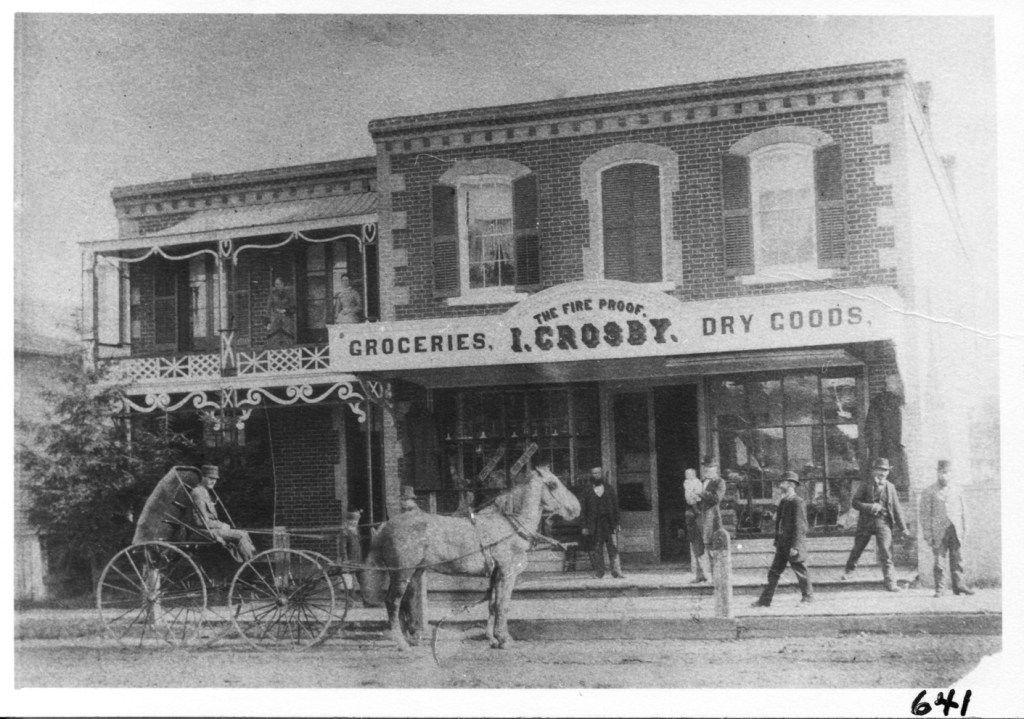
To the north of the United Church, came the Masonic Temple, and close by the “Fireproof Store” which was the location of David Hill’s wholesale tobacco and confectionary business, to become in 1940 our first Canadian Tire Store (still operated by a member of the Hill family at Yonge/16th Ave.).
The Fire Proof, rebuilt by Parker Crosby after the great fire of 1866, shown circa. 1880s. (photograph courtesy of Richmond Hill Public Library, PA89-033)
Further north was Hopper’s Meat Market, later to be operated by the Kerr Brothers. At Dufferin St. (now Dunlop St.) was the Hill Bakery but I remember it as Eden’s Grocery and Bakery. Just to the north was then St. Mary’s Catholic Church and rectory.
Although set well back from Yonge St. and these days blocked off by houses on the south side of Bedford Park Ave. was Crosby Hall with it’s magnificent pine trees and lawn stretching to Yonge Street. Later the home of the Angle family (Mr. Angle being the general manager of Bedford Park greenhouses). The huge lawn was often the site of strawberry festivals and the like.
At the edge of the then north village boundary was the home of Col. Moodie who died while trying to reach Toronto to warn of the 1837 rebellion. Then there was the Burr Feed Mill, a great attraction to many young residents of the village.
Granted there are other places of interest, such as Ransom’s Barber Shop and other establishments but space forbids mention of them even if my memory permitted.
Hopefully these comments will stir some happy memories and perhaps the future will permit memories of the west side of Yonge Street in the 20’s to be recalled.
The Richmond Hill Historical Society was saddened to learn of the passing of former Society member Roy Horner on March 21, 2023. Father of Russ, Susanne, Karen and Robert, he died after a short illness. Learn more about Roy’s life at https://memorials.marshallfuneralhome.com/roy-horner/5162324/index.php.
We are very excited to welcome John Jefkins from Home Children Canada to our next meeting on April 17, 2023 at 7:30 pm. The meeting will be held in Wallace Hall at the Richmond Hill Presbyterian Church, 10066 Yonge Street.
John Jefkins is a Director at Home Children Canada. John Jefkins is a first-generation descendant of a British Home Child. His father came to Canada through the Barnardo organization. In 2015, John through the assistance of the British Home Children Advocacy & Research Association found his father’s descendants in England.
Be sure to join us and bring a friend or two. Guests can attend for $5.00 or even better, join the Society for $25 for individual and $40 for families.
Maple Syrup from Carrick Bros. for sale at the Richmond Hill Historical Society booth (photograph courtesy Chris Robart)
by Andrea Kulesh
The Society joined in with Mayor West for his very first maple syrup festival as the Mayor on April 1, 2023. We have previously been involved for 3 years running pre-pandemic. Maple syrup was ordered from Carrick Bros. who generously donated all of the syrup for the pancake breakfast. Numbers were estimated for the event but no one really knew how many would come.
Estimations were made at 1,500 – 3,000 attendees. There were free pancakes and syrup and self serve coffee on hand. The tables were set up in front of the RHHS so we were in a great position to sell maple syrup to those who had just sampled the Carrick Bros. delicious maple syrup.
The doors opened at 10:00 a.m. and there were people literally running to get their pancakes! There were a lot of families and the plan had been for a lot of the children’s activities to be outside but unfortunately the weather didn’t fully cooperate. Although it was a sunny day, the wind prevented some of the activities planned to go ahead. Our member Marj Andre was “Ma Maple” demonstrating the old method of reducing the sap collected to make maple syrup. Unfortunately, the wind did stop some of the activities and they were brought inside. There was music ongoing, speeches for the official opening, lots and lots of vendors and a general and noisy hubbub with a very well attended and successful event.
Richmond Hill Historical Society booth highlighting our 50th Anniversary in 2023 (photo courtesy of Vera Tachtaul)
The RHHS was busy for the entire 4 hours. Fortunately, we were very organized to begin with. Member volunteers set up on Friday night with a very nice display of the syrup, our pamphlets and a table display about the Maple Leaf. Vera Tachtaul, immediately posted photos to our FB page with the latest images of our booth. Volunteers were on hand very early on site, to look after everything before the doors opened. We priced everything and waited until our first customer. The maple syrup started to be sold almost right away and it was evident people were interested in buying but also to learn a little about maple syrup. We had “Quik Facts” on hand and were able to answer knowledgeably about the products we were selling. Some people made the mistake of saying they would come back later to pick something up, but for those people who hesitated, they were sadly disappointed when we sold out around 1:30 p.m. We did receive a few more bottles of syrup from city staff and we sold some just before the event closed.
Denise Hughes, Andrea Kulesh, Agnes Parr, Alison Hughes and Linda Clark at the Richmond Hill Historical Society table. (photograph courtesy Chris Robart)
A special thank you to all of the volunteers who helped to make this the success it was! Vera Tachtaul, Chuck Fraser, Elinor Charters, Agnes Parr, Joan Lund, Barbara Di Mambro, Alison Hughes, Denise Hughes and Linda Clark. We could not have done it without you!
What a great success for the Society! Selling out the entire order! Of course we do have to pay for the maple syrup once we receive the invoice but this will be our main fundraiser for this year after three years of no activity….. We have to thank Mayor West for including us once again in this event. The city event staff were wonderful and worked so hard to put this event on. It was Mayor West’s first Mayor’s event and it was a wonderful day!
The Richmond Hill Historical Society is pleased to be participating in Mayor David West’s Maple Syrup Festival on Saturday, April 1, 2023 from 10:00 am – 2:00 pm at the Richmond Green Sports Complex. We will be on hand, selling maple syrup, so be sure to stop buy to get some syrup and chat with us about the Society.
Help support the work of the Society and take advantage of the benefits of membership. Simply print and complete our membership form (pdf). Bring the completed form to a meeting or mail with payment to:
Membership Richmond Hill Historical Society P. O. Box 61527, 9350 Yonge Street Richmond Hill, ON L4C 0C9
Membership Fees by e-Transfer
Did you know that you can pay your RHHS membership via e-transfer? You will need our email address – r.hillhistsoc at gmail.com, and it would be really helpful to include information about the year the dues are for, as well as your address, email address and telephone number – all information that will help us stay in touch.
Benefits of Membership
Attend 8 public meetings with guest speakers
Enjoy two social evening meetings with entertainment
Learn about the history of Richmond Hill and support it’s preservation
Receive RHHS newsletters delivered directly to you
Have the right to vote at the Annual General Meeting (January), and the right to hold office on the Executive Committee as a Director
Keeping abreast of current events through representatives of the Society who report on local City of Richmond Hill heritage initiatives.
and of course…
Join in a society to meet people who enjoy the same interests as yourself!
Fees
Individual $25 This membership provides you with all the benefits of the Society
Family $40 (2 adults and2 children) Only one copy of the mailings is sent to the Family; otherwise Family members have the same privileges as an Individual.
The arena at Church Street and Lorne Avenue as it appeared in the 1950s. (photograph courtesy Gerry Roy/Richmond Hill Public Library from Later Days in Richmond Hill: A Portrait of the Community from 1930-1999 by Marney Beck Robinson and Joan Clark)
March 19 commemorates 68 years since the official unveiling of artificial ice at the Richmond Hill Arena. The arena, originally built in 1923, frequently had problems with its natural ice surface resulting in many disappointments for residents eager to skate. In fact, in his Sports column in the Richmond Hill Liberal of April 29, 1954, Bill Ellis wrote:
That “No Skating” sign operates on a hinge with a sign that says “Skating.” The affair is locked by a padlock in either position. You might as well lock the “No Skating” portion in place and throw away the key because that’s what it reads 99 and 44/100 per cent of the time.”
Enter the Richmond Hill Arena Association!
In 1954, this not-for-profit organization was formed, whose primary mandate was to raise funds to outfit the arena with artificial ice. The community members that originally spearheaded this effort included: Craig Bowden, Jack Hart, Bill Savage, Alec Clarke, Al White, Jack Hollowell, Bill Gilchrist, Ralph Paris, Morley Hall, Alex Baird, Elgin Barrow, Cec Mabley, Walt Smith, Harry Bawden, Art Gibson, Morley Williams, Floyd Pratt, Norm Todd and Bill Ellis. The group formed subcommittees, including a Campaign Committee led by Ralph Paris and a Technical Committee led by Alex Baird.
Bill Ellis, Elgin Barrow, Bill Hall, Walter Smith and Hugh Mackay during the construction. (Richmond Hill Public Library, Bert Hunt fonds, 2012.5.1)
On May 10, 1954, the Arena Association launched a $50,000 fundraising campaign. They were quickly helped along by a quick first donation of $1,000 by Bing Lew, owner of the Town Inn and one of our community’s most notable philanthropists. He would later fund the building of a pool at the Loyal True Blue and Orange Home on Yonge Street, near Elgin Mills. These are just two of many contributions that Mr. Lew made, often to the benefit of local children.
While the campaign did not realize its $50,000 goal, the Association was ultimately successful in bringing artificial ice to the arena. Their Fall campaign in 1954 brought in a respectable $24,000 and saw membership in the Association total approximately 600.
In February 1955, Walter Smith and Elgin Barrow signed a 15-year lease on the arena for $1 per year.
Then, on March 19, 1955, a record-breaking crowd of 1,500 people, paid to attend the official opening of the new ice surface. Municipal and Provincial representatives attended the event, officially opened by “Timmy” of the Easter Seals Campaign. Jack Passmore served as master of ceremonies with the Town represented by Reeve W. J. Taylor.
A full program of activities were showcased at the opening, including solo figure skating performances by Richmond Hill’s own Mary MacKay and later Louis Stong. Ede Butlin called a square dance on the ice, with additional performances given by members of the Toronto and Unionville Skating Clubs. The local association was assisted in the preparation of the ice by Bert Kent, the icemaker for the Toronto Skating Club.
Not surprisingly, the introduction of a more reliable ice surface saw the popularity of skating and organized hockey grow, beginning in the mid-1950s. The arena’s importance to the community grew immensely and has seen many important events over the past 68 years of artificial ice, including the old annual midget hockey tournament. Organized by Royal Canadian Legion Branch 375, this hallmark tournament began in 1968 and saw many future NHL stars hit that artificial ice.
So as you lace up your skates for a turn around the ice at the Elgin Barrow Arena, think back with appreciation to those members of our community who worked so tirelessly and hard to make the arena such an important part of Richmond Hill’s history and put the Skating/No Skating sign onto the trash heap for good.
Further Reading:
“And Away We Go” Sports column by Bill Ellis, Richmond Hill Liberal, 15 April 1954, p. 6
Richmond Hill Public Library has digitized the local newspapers from 1857-1979 and they can be searched and browsed for free by visiting https://history.rhpl.richmondhill.on.ca/search.