The Richmond Hill Historical Society is pleased to have been invited to participate in Mayor David West’s Levee on Saturday, January 11, 2025. The event will be held, from 10 to 11:30 a.m. at Langstaff Community Centre on Red Maple Road (https://maps.app.goo.gl/xGeRf4LtN8R1nWNY7).
Come out to chat with us and get the chance to meet and talk with councillors, local MPs, MPPs, executives of the Richmond Hill Fire and Emergency Services and York Regional Police representatives.
No registration is required for this informal event; the perfect way to kick of 2025!
Thanks to the generosity of The Curtain Club Theatre, the Richmond Hill Historical Society has been given a really great opportunity to fundraise. They have approved our request to be part of their Charity Night Program and offered us 25 tickets for their play All My Sons on January 23, 2025.
The play description:
During the Second World War, Joe Keller and Herbert Deever ran a machine shop making airplane parts. Deever was sent to prison because the firm turned out defective parts while Keller went free and made a lot of money. The twin shadows of this catastrophe lead to an unforgettable conclusion to a play electrifying in its intensity.
The doors open at 7:15 PM and showtime is 8:00 PM.
The tickets are $20.00 each.
If you are interested, or if you have friends or family that might be interested, please contact Andrea Kulesh at andrea-kulesh at hotmail.com, or (905) 884-2789 as soon as possible and we will hold your seats for you. Your tickets will be available when you arrive at the theatre.
Our deep gratitude to The Curtain Club and our thanks for your support.
A reminder that our Annual General Meeting will be held on Tuesday, January 21, 2025 at 7:00 pm in Meeting Room B at Central Branch of the Richmond Hill Public Library.
This is an important meeting when you will hear from your current Executive members about their various activities during 2024. You also have an opportunity to elect the Executive for the 2025 year.
Once again our annual bring and brag will follow the AGM. This is chance for you to showcase interesting objects and stories to other RHHS members.
Join us on Tuesday, December 5, 2024 at 6:30 pm for our annual holiday social. Note the new date and time for this meeting. We will be celebrating in Rooms A & B on the 2nd Floor of Central Library at 1 Atkinson Street.
We will have refreshments and entertainment for the evening. Come out and have the chance to mingle with other Society members as we kick off the holiday season!
Cameron is a third-year doctoral candidate in Educational Studies at Mount Saint Vincent University. His dissertation is on the underrepresentation of shell shock in Canadian war museums within the frameworks of critical theory and difficult knowledge. He is also the Managing Editor of the Journal of Veterans Studies.
The Richmond Hill Historical Society is pleased to announce a new partnership with the City of Richmond Hill’s Heritage Services for their Walk and Learn Tours.
Enjoy fresh air, exercise and a healthy walk through a historic building, neighbourhood or park while discovering Richmond Hill community heritage with a knowledgeable guide. Tours run rain or shine. Wear appropriate attire for walking outdoors. Duration 1.5 – 2 hours. No registration required. Free admission.
Upcoming Fall tours include:
North Yonge Street – A Vibrant Village! Sunday, September 22, 1 p.m.
Meet up Location: Richmond Hill Centre for the Performing Arts – 10268 Yonge Street, Richmond Hill
North Yonge Street in the village core is a unique part of the city. Enjoy this tour featuring a history of politics, education, medicine and the arts!
Arrive at the Richmond Hill Centre for the Performing Arts (10268 Yonge Street) and look for the Walk and Learn sandwich board.
Sports History Sunday, October 6, 1 p.m.
Meet up Location: Elgin Barrow Arena – 43 Church Street South, Richmond Hill
Sports and recreation have played an integral part of Richmond Hill’s history. From the annual Spring Fair to organized sports, this walk will focus on the historic locations, celebrated championships, athletes, teams, and supporters who have shaped the sports community in our City. Includes a guided tour of the Richmond Hill Sports Hall of Fame.
Arrive at the Elgin Barrow Arena (43 Church Street South) and look for the Walk and Learn sandwich board.
Mill Pond Industry and Commerce Sunday, October 20, 1 p.m.
Meet up Location: Mill Pond Park Gazebo – 321 Mill Street, Richmond Hill
Mill Pond, named for the sawmill operation that used the pond for power. Today’s Mill Pond is a place of recreation, but did you know when it was first created in the mid-1830s, it was a hub of industry and commerce and an important component of Richmond Hill’s culture heritage.
On this walk, participants will explore a place of natural beauty while learning about the many industries that made the heart of Richmond Hill an attractive place to settle in the early 19th century.
Arrive at Mill Pond Park Gazebo (321 Mill Street) and look for the Walk and Learn sandwich board.
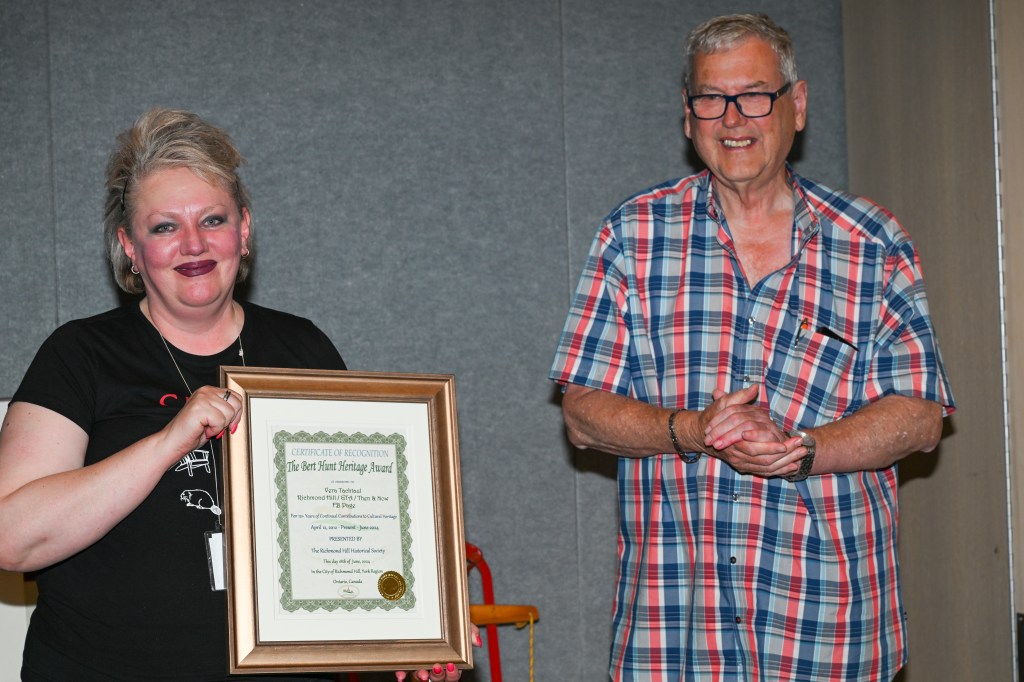
RHHS President Jim Vollmershausen awarding the Bert Hunt Heritage Award to Vera Tachtaul at the Society’s June 2024 meeting. (photograph by Chris Robart)
Each year the Richmond Hill Historical Society acknowledges the outstanding contributions of an individual or group in preserving and raising awareness of the value of Richmond Hill’s history, through the Bert Hunt Heritage Award.
During his lifetime, Bert Hunt made active contributions to heritage conservation efforts in Richmond Hill. As a leader in a project to preserve individual peoples’ Richmond Hill stories and his personal efforts to capture them in the hopes of creating a Richmond Hill Museum, he was an outstanding resident. He was recognized as a community volunteer and Citizen of the Year by the City of Richmond Hill and the Province of Ontario.
The Richmond Hill Historical Society is pleased to announce that the 2024 award has been bestowed on Vera Tachtaul, who began and continues to administer the highly successful and engaging Richmond Hill/GTA – Then and Now Facebook page.
In our modern world where social media has become the norm, Vera has reached out to Richmond Hill residents, past and present, for the last 12 years. With over 6,700 followers and climbing, the site has an array of historical and nostalgic stories about people, places and events occurring in Richmond Hill over many decades. Initially Vera started with her own photos, but as interest grew, contributions are regularly received by community members.
Photos, ideas, brochures, class pictures, business memorabilia and many other items are provided by previous residents, as well as those living in the area. Stories are shared and the comments serve to enrich our history even further. The page is such an incredible opportunity to learn about the history, heritage, and the famous and not so famous people who have lived in Richmond Hill.
The Richmond Hill Historical Society posts on this page to promote all its endeavors such as monthly meetings, articles about heritage and other items of interest to the community. Meeting the criteria of tangible and intangible heritage it demonstrates all the reasons worthy of the Bert Hunt Heritage Award.
Vera Tachtaul, with her enthusiasm for history and heritage, as well as encouraging the nostalgia of family, friends and acquaintances, maintains a vibrant, versatile place where Richmond Hill can be seen as a positive, fun and lifelong home, while providing information for so many people.
The Richmond Hill Historical Society is pleased and humbled by the work and effort by Vera. Giving her the Bert Hunt Heritage Award has been our pleasure and honour.
Previous winners: RH Presbyterian Church; RH Lawn Bowling Club; Burr House; and the Archives Committee at St. Mary’s Anglican Church.
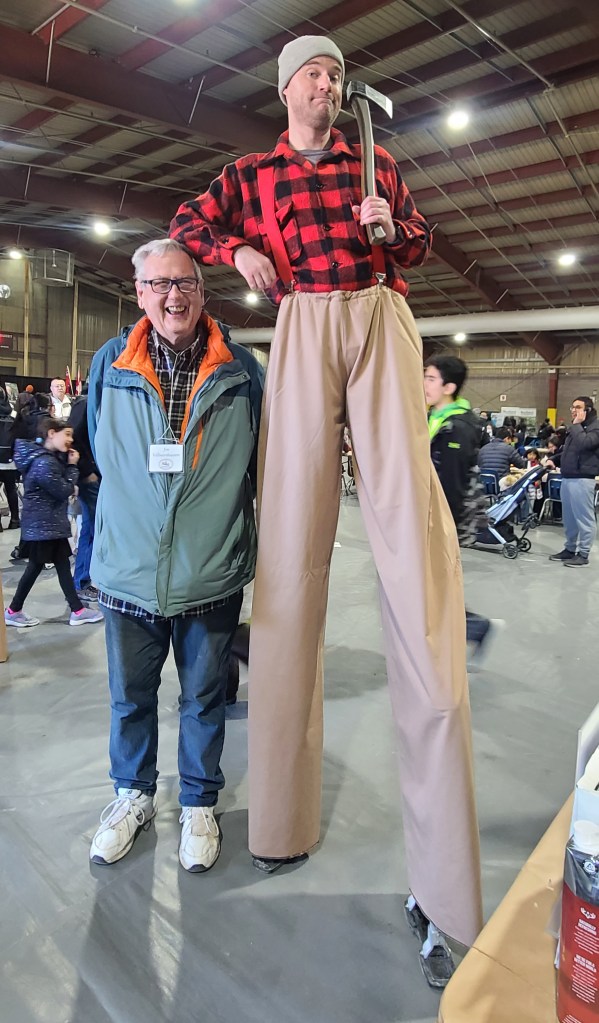
Richmond Hill Historical Society President Jim Vollmershausen with the world’s tallest lumberjack? (Photograph by Vera Tachtaul)
Another year and another successful Mayor West’s Maple syrup Festival. On Saturday April 6th, the Richmond Hill Historical Society joined in with this annual event at Richmond Green. Weather is always a consideration for outside activities and this year we were able to enjoy the day both inside and out. The event began at 10:00 a.m., continued through to 3:00 p.m. and was very well attended. The activities were expanded including wagon rides, taffy tasting and demonstrations for everyone to enjoy seeing how maple syrup is made. There was great entertainment, raffles and pancakes served with delicious maple syrup. Carrick Bros supplied the maple products we were selling this year for our annual fundraiser. They expanded their product list to include yummy maple cream, maple sugar and flavored syrup aged in bourbon, cherry brandy, apple brandy and even tequila barrels!
My personal favorite was the fellow on stilts dressed as a lumberjack. He was very entertaining, performed throughout the event, and was popular with young and old.
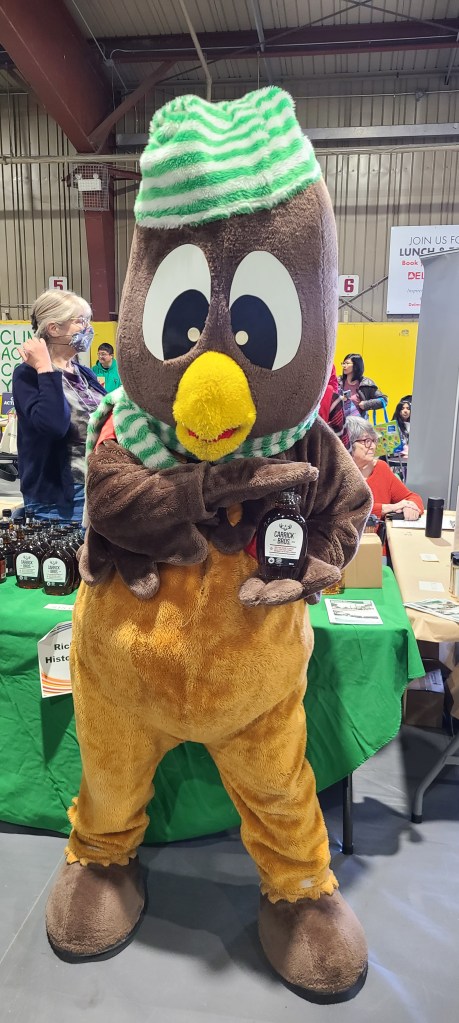
A special cameo appearance by the Winter Carnival’s own mascot Ookpik (Photograph by Vera Tachtaul)
At the planning committee, numbers were being estimated to be more than last year. It was hard to tell this year with the surges of people entering the event but there were lots and lots of families enjoying the free pancakes and learning about how to make maple syrup. There will be a tally at our follow-up meeting but I’m sure it was well over 2000 people.
Our booth was very busy, and we were selling all day long. We had a bit of inventory returned at the end, but we did very well in a 5-hour fundraising effort. Jim will make a report when we get the final numbers tallied.
Thank you to members who attended and supported the Society and thank you to all of our wonderful member volunteers who made the day such a success! We thank Mayor West and his great team once again for including us as part of the event.
Tuesday, March 19, 2024, 7:00 pm The Knights of Columbus Council 14411 Speaker: Francis Gabriel, Knights of Columbus Room B, 2nd Floor, Central Branch, Richmond Hill Public Library 1 Atkinson Street
Join us as Gabriel talks about the history of the Knights of Columbus in general and about Our Lady Queen of the World Council 14411 in particular, including present-day activities of the council.
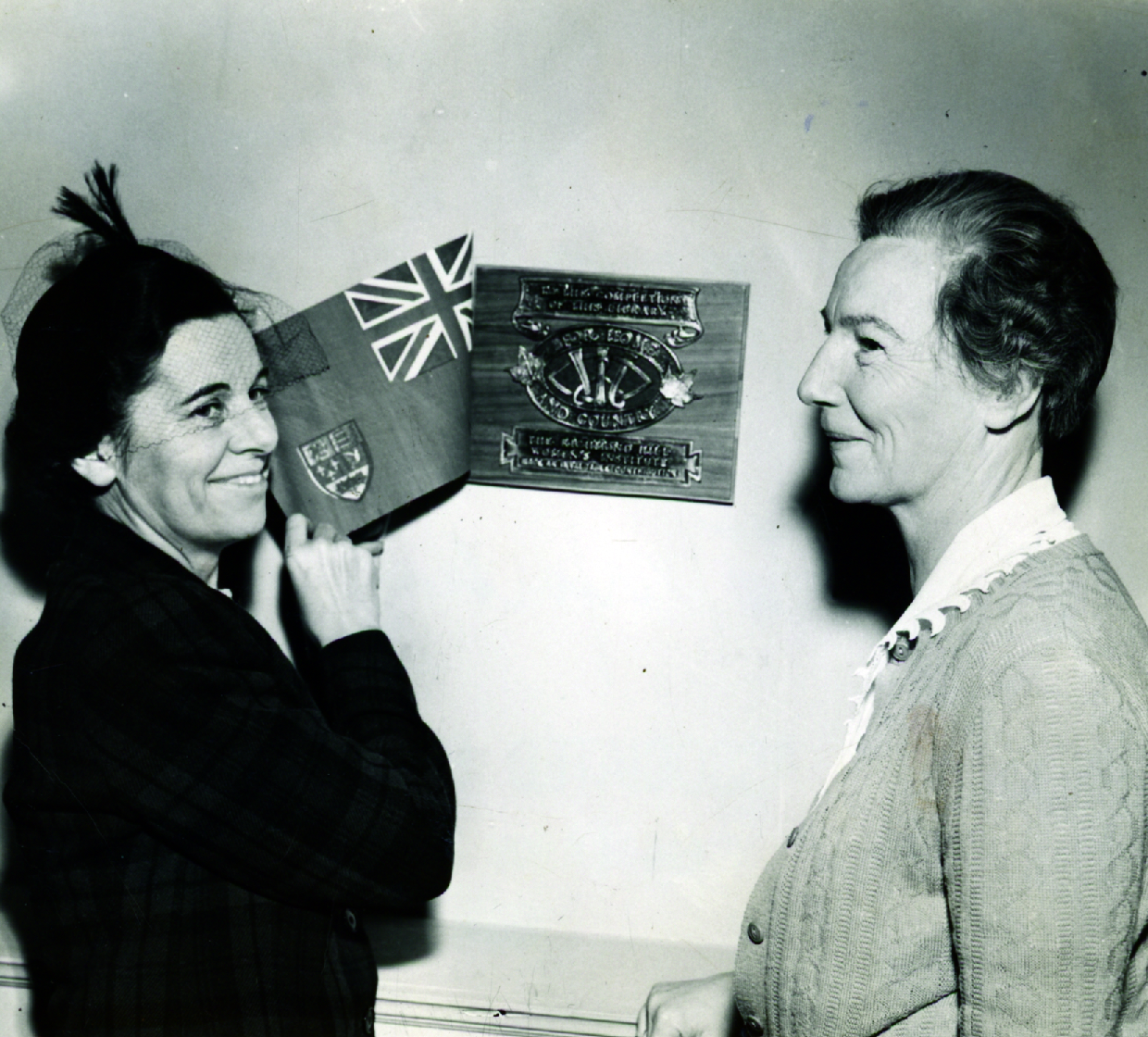
Mrs. H. H. MacKay unveiling the Women’s Institute plaque with Edna Izzard representing the Library Board. The plaque commemorates the Institute’s contribution to the library in 1949. (Richmond Hill Public Library, Tweedsmuir History Fonds)
The first Women’s Institute (WI) was formed in Stoney Creek, Ontario on February 19, 1897 by Erland and Janet Lee, who invited approximately 100 women to hear educational reformer Adelaide Hoodless. Ms. Hoodless turned the personal tragedy of the death of her 14 month old son into a movement that encouraged women to see the importance of domestic science education and to be advocates in areas of health, education and community service. Since its inception, there have been upwards of 1,500 branches of the WI across the province of Ontario. While most have disbanded over the years, the Institute continues with 220 active branches across the province. Their motto “For Home and Country” was adopted by the Institute around 1904.
RICHMOND HILL WOMEN’S INSTITUTE
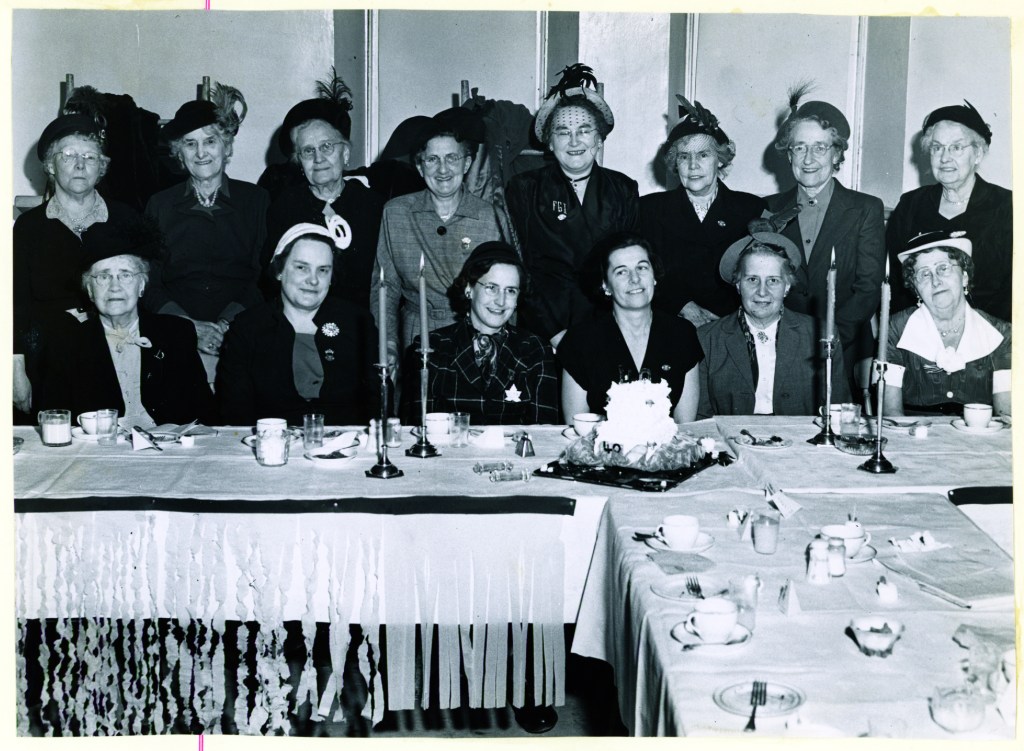
Head table at the 40th Anniversary of the Richmond Hill Women’s Institute, January 8, 1953. (Richmond Hill Public Library, Tweedsmuir History Fonds, 079a)
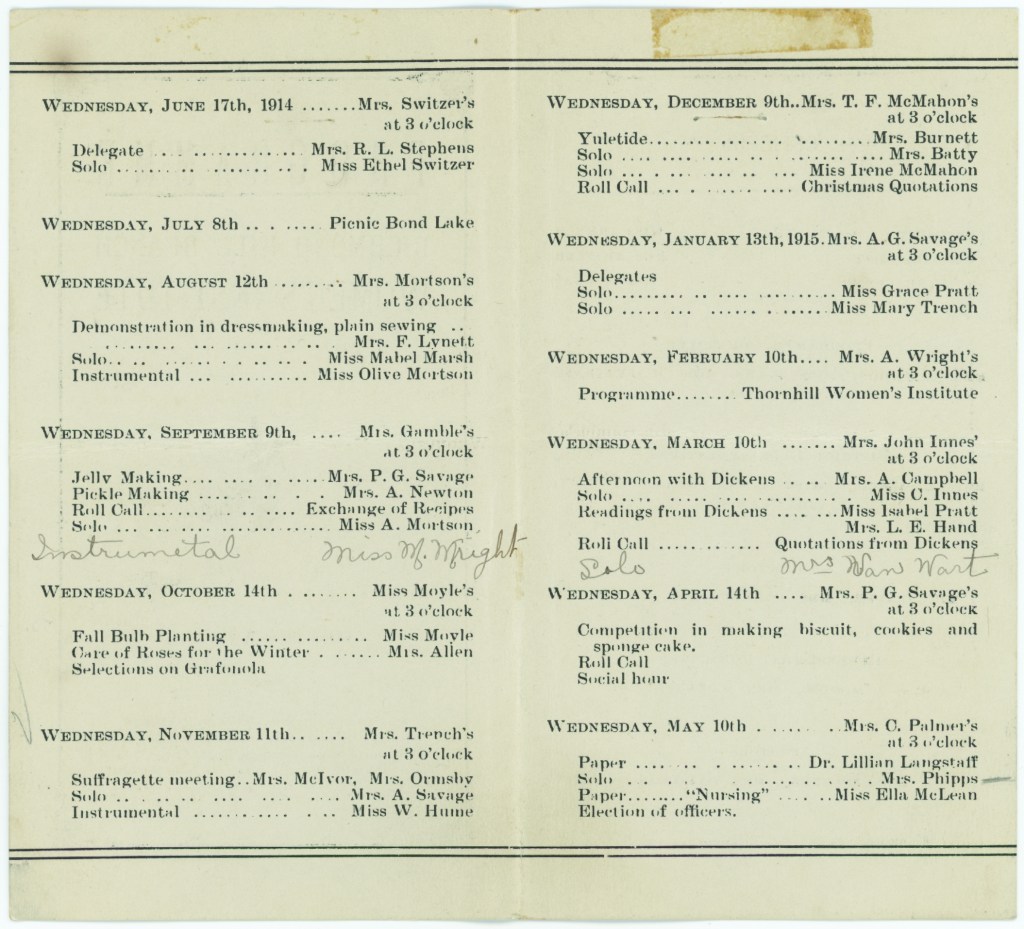
The Richmond Hill branch of the Women’s Institute (RHWI) was formed in 1913 and held its organizational meeting on January 27th at the Masonic Hall on Yonge Street. The first keynote presentation was delivered by Dr. Lillian Langstaff, who spoke on the topic of “Facts about Flies,” beginning a long history of talks on home economics and health. Presentations and demonstrations included sewing and dressmaking, baking, canning and preserving, flower arranging and more. Monthly meetings presented opportunities to socialize, learn and develop skills, pursue personal interests, but perhaps most importantly, to plan and carry out work to the benefit of the entire community.
Richmond Hill Women’s Institute Program for 1914-1915 (Richmond Hill Public Library, Tweedsmuir History Fonds, 075-01a)
The lasting impact of the RHWI was in their educational, charitable and civic-minded pursuits. Some key highlights included: the introduction of medical inspections in schools resulting in the appointment of school nurses; actively working towards obtaining the rights of women to vote; advocating for playgrounds for children; the introduction of litter receptacles on Richmond Hill streets and the beautification of village in cooperation with the Richmond Hill Garden and Horticultural Society; and the donation of pianos and other furnishings to our elementary and secondary schools. The Institute also undertook years of advocating and fundraising for a new public library building, which culminated in a donation in 1949 of over $1,700 dollars. That library would eventually be built on Wright Street in 1959.
The Women’s Institute also undertook war and relief work, which began in 1914 with the purchase of cloth to be rolled into bandages for a women’s hospital ship. In that same year, food was gathered for soldier’s families in need. Collections were undertaken for Belgian and Armenian relief. Members helped support the Red Cross as well as providing donations for war relief. During the Depression, they undertook relief work, in cooperation with teachers, for the unemployed.
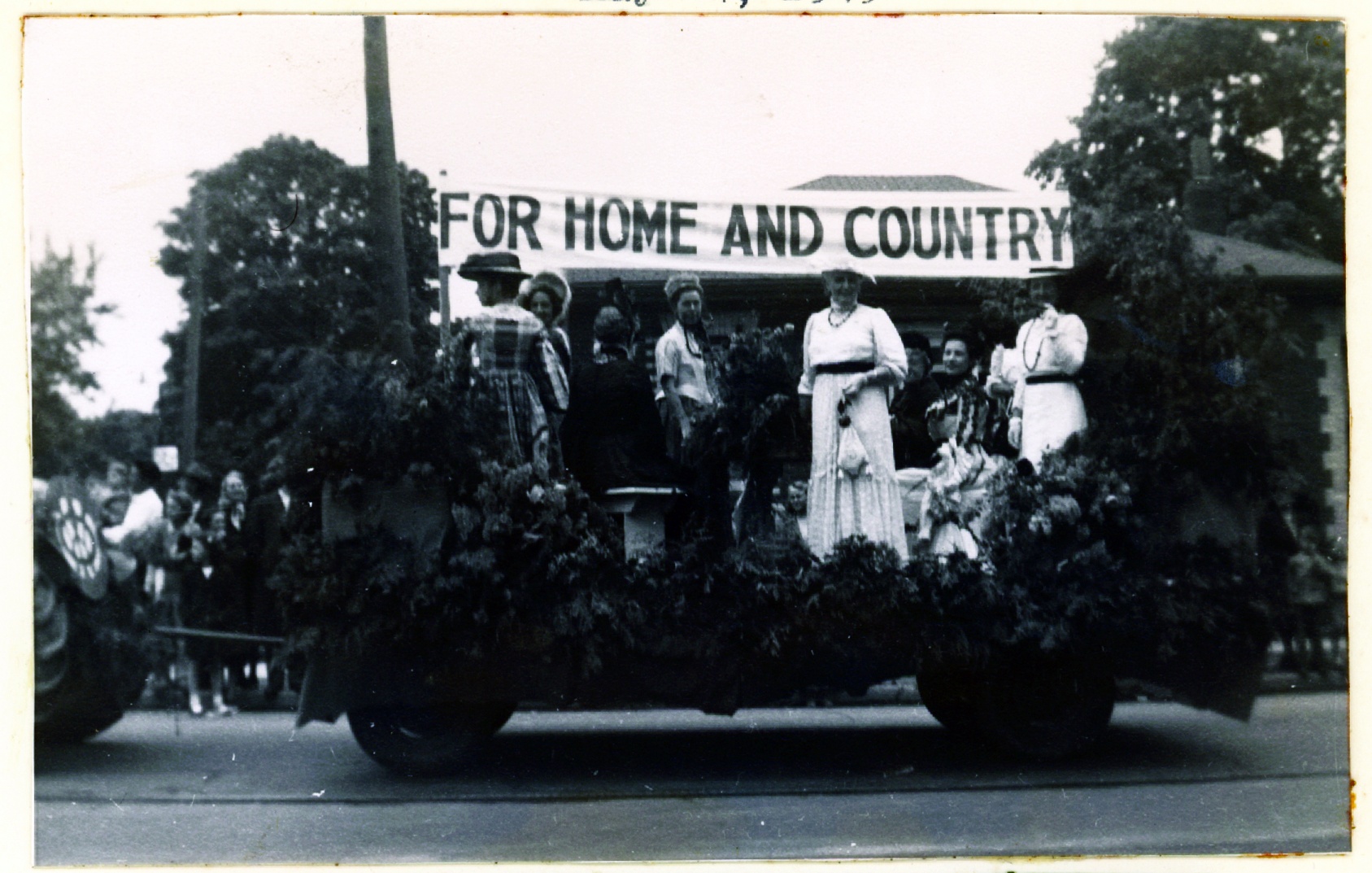
Richmond Hill Women’s Institute float during parade to commemorate the 100th anniversary of the Richmond Hill Agricultural Society, May 24, 1949. (Richmond Hill Public Library, Tweedsmuir History Fonds, 080a)
Representatives of the Richmond Hill WI were appointed to a number of boards across the community, where they were able to add an important voice to decisions being made for the benefit of all. Their focus on women’s issues and education positioned them well for having a profound and valuable impact to the lives of residents. Their spirit and drive helped them support many in need, not just in our community, but around the world. Their accomplishments and impact on people’s lives is impossible to fully articulate here.
TWEEDSMUIR HISTORY OF RICHMOND HILL
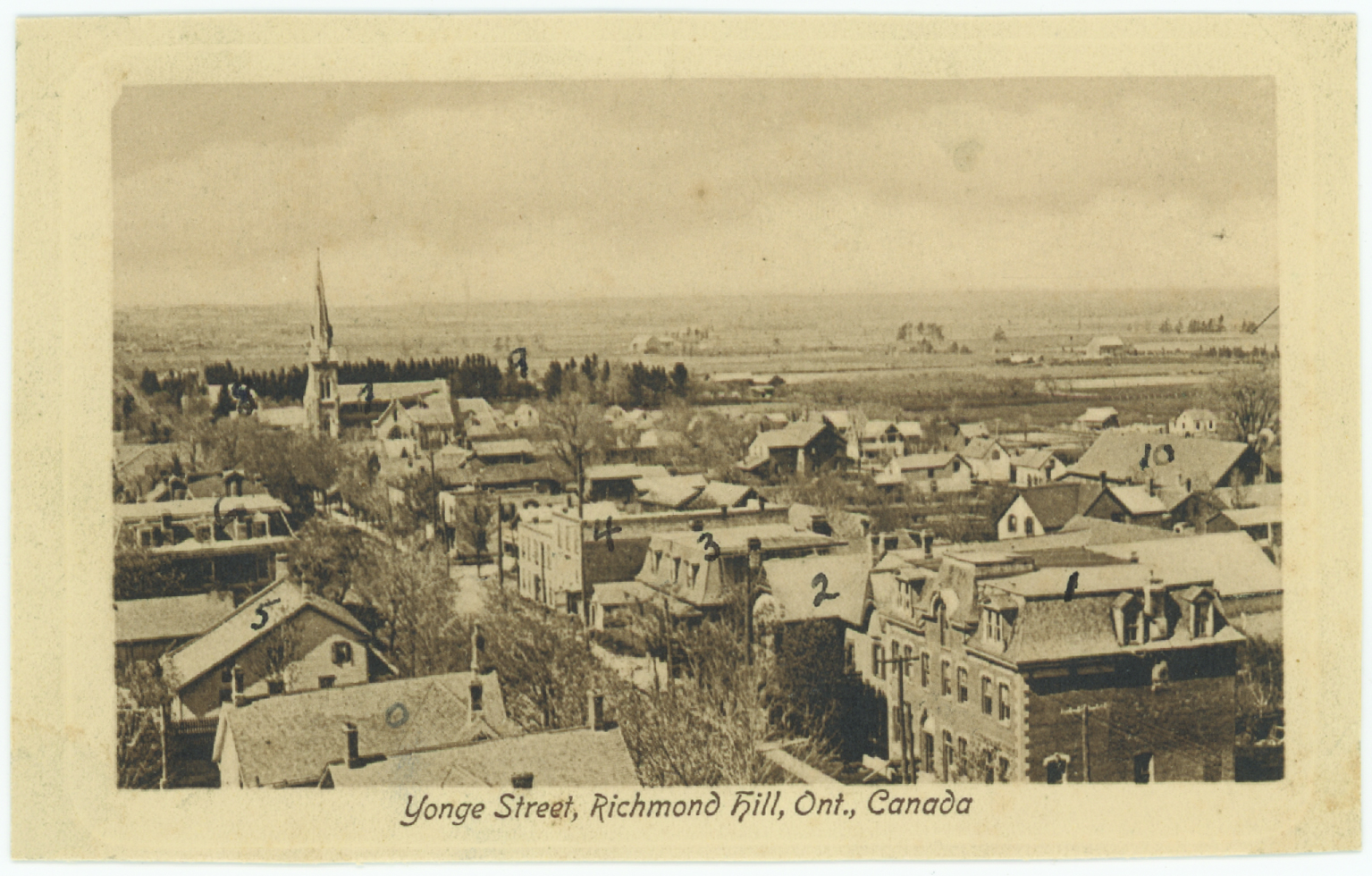
Postcard of Yonge Street looking north from the steeple of the Richmond Hill Presbyterian Church in 1908 from the Tweedsmuir History of Richmond Hill. (Richmond Hill Public Library, Tweedsmuir History Fonds)
One of the most valuable and enduring legacies of the RHWI is the Tweedsmuir History of Richmond Hill. The Richmond Hill Public Library holds the original and digitized copies. The Tweedsmuir History Books, chronicles of local history, were created all across Ontario in the name of John Buchan, The Right Honourable The Lord Tweedsmuir, Governor General of Canada from 1935-1940.
The Tweedsmuir History of Richmond Hill was begun in April 1949 and transferred into its final form in 1957. The work was coordinated by their Tweedsmuir History Committee and is in the form of a scrapbook with a mix of typed and scrapbook pages. It contains a number of photographs, newspaper clippings, postcards, letters, family histories, and other ephemera covering a wide variety of current events of the day, local individuals and families, and historically significant local events.
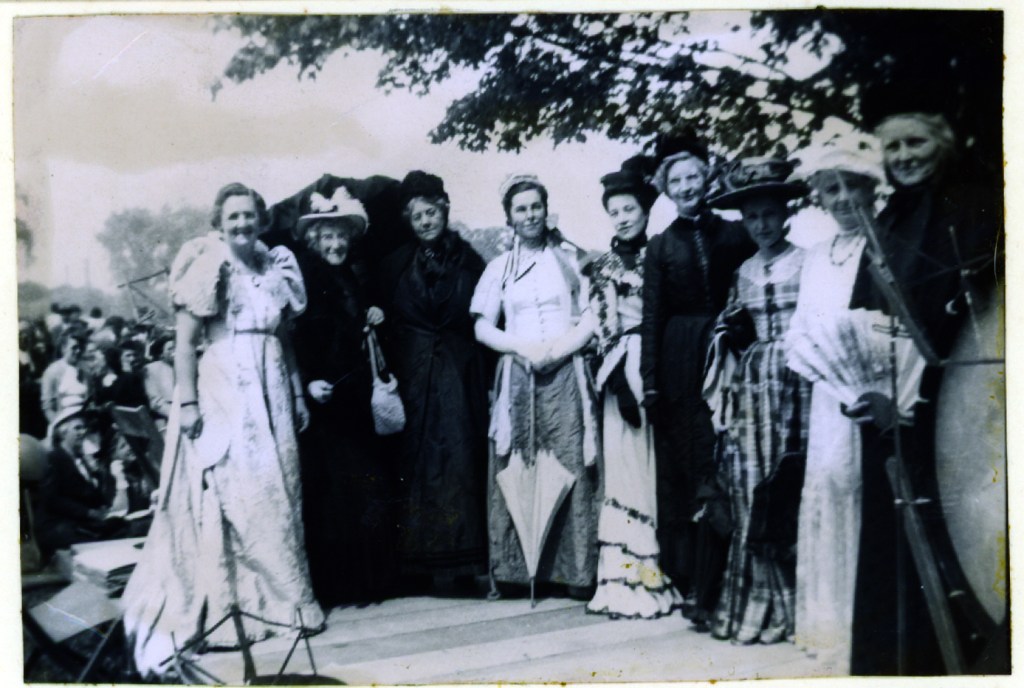
Members of the Richmond Hill Women’s Institute in costume to commemorate the 100th anniversary of the Richmond Hill Agricultural Society, May 24, 1949. Left to right: Mrs. W. Sayers, Mrs. O.L. Wright, Mrs. J.P. Wilson, Mrs. H.H. Mackay, Mrs. Rabinovitch, Mrs. Blanchard, Mrs. Pipher, Mrs. N. Glass, Miss Annie Stong. (Richmond Hill Public Library, Tweedsmuir History Fonds, 080b)
They say that all good things must come to an end and this is what transpired for the RHWI, officially disbanding in 1964. For a write up of the end of the Institute, see “Richmond Hill Women’s Institute,” in The Liberal, June 25, 1964, p. 2 (https://history.rhpl.ca/3216109/page/3). For home and country and for everything (and everyone) in between; our lives and communities have been made better from their enduring legacy.
Peter Wilson is a librarian at the Richmond Hill Public Library and editor of the Richmond Hill Historical Society’s newsletter and website.
• a history and records of achievement of the Institute
• recounting the early days in Richmond Hill
• biographies of early settlers: Abner Miles, Hugh Shaw, Col. Wilmot, John Stooks, Col. David Bridgford, James Miles, John Stegman, the de Puisaye settlers, Quetton St. George, Col. Robert Moodie, the Playters and the Langstaff family
• a history of Yonge Street
• a history of early mills in Richmond Hill
• biographical sketches of notable past residents: Amos Wright, William Wright, William Powell, Susannah Maxwell, Matthew Teefy, Alex Hume, Thomas McMahon, Nicholas Miller, William Trench, Francis Boyd, the Wilkie family, Robert Marsh, John Switzer, David Boyle, Samuel Thompson, John Coulter, Leslie Innes and Robert Hopper
• listing of the village residents of 1871
• listing of Reeves and Councillors
• school and church histories
• history of the mechanics’ institute and library
• unique historical documents related to Thomas Kinnear, murdered with Nancy Montgomery in 1843
• residents who served in First and Second World Wars
• histories of the Atkinson and Trench families
• reminiscences of Dr. Rolph Langstaff (1950s)
• extensive coverage of current events of the 1950s

 Richmond Hill Historical Society