Message from the President (Sep 1, 2020)

The last time you heard from me was in our May – August Newsletter, when I had the opportunity to reflect on the challenges we were all facing in the midst of a COVID-19 lockdown. When I look back on my comments at that time, I’m struck by how I was looking forward to getting back to some kind of normal, when we could have meetings, share our stories of how we coped with isolation and social distancing and generally carry on from where we left off – always the optimist.

Well, it’s now a few months later, and we are still faced with a lot of uncertainty. As much as Stage 3 has allowed us to experience a greater degree of normalcy, albeit with continued social distancing, the wearing of masks, and limits to social gatherings, we still don’t know when we might see the end of COVID-19 restrictions. We certainly don’t know when the Executive might be able to get together, or when we’ll be able to schedule our regular meetings. Even further, we don’t know what kind of decisions any of us will be making about how we live our lives. We all have our own circumstances to consider, which, in terms of the Society, will lead to very personal choices about whether or not we would even be comfortable in attending any kind of a meeting in the near future.

I thought it was important to let you know that, in spite of all the uncertainties, we have been thinking about how and when the Historical Society can get back into business. Based on discussions with the Church, we know that the earliest possible opportunity to use Wallace Hall for a meeting would be October, though we don’t know what limitations and protocols we might be faced with. I’m also concerned that circumstances might make any fall meetings unlikely.

Perhaps more importantly, we also don’t know what your views about attending a face-to-face meeting might be. This is something I would really appreciate your feedback on – how comfortable would you be to attend a meeting? Another option we have is to go high-tech and try a virtual meeting via ZOOM. I know that this is a very manageable option, and if you would prefer to give it a try rather than go to a meeting, I would be happy to set it up. My understanding is that it would be available to anyone with access to a computer.

So please get back to me on the question of whether you would prefer a face-to-face meeting or a virtual meeting via ZOOM. I will react accordingly.

In the meantime, we are looking to get an Executive Meeting organized soon (either face-to-face or virtual), where we will discuss such issues as budgets, fees, timing and scheduling, programming and speakers, and the format for a first meeting. When we have more information, I will let you know. Until we are back on a regular schedule, I intend to stay in touch with you through these messages – I hope you find them useful.

Thanks for your attention, and keep on staying safe – and please let me know what you prefer – real meetings or a ZOOM meeting.

Richmond Hill: Rose Capital of Canada

Originally published in the Richmond Hill Liberal, July 30, 2020
by Andrea Kulesh

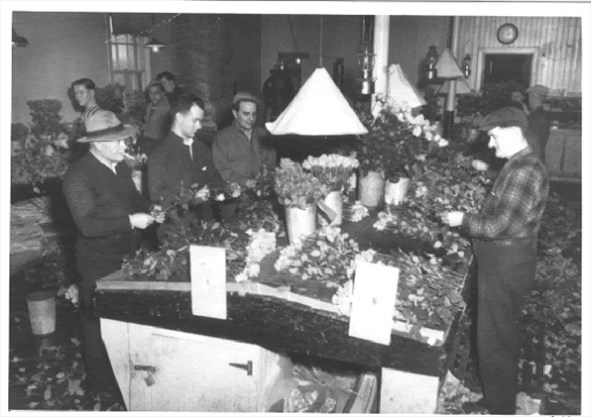
H.J. Mills florist operation in 1948. – Richmond Hill Public Library Archives

At the beginning of the 1900s, Richmond Hill hadn’t changed much since its incorporation as a village in 1873. The population had actually reduced in size and in response the village council met to discuss strategies to encourage industry to move to the “Hill”. The village offered easy transport for goods and people with the Metropolitan Radial Line on Yonge Street and the nearby CN railway.

In addition vacant land was ready to be developed. William Lawrence, known for building Lawrence Park, was one of the first to take advantage of the council’s invitation. He also ran a floral business in Toronto and wished to expand, and it turned out that the available land in Richmond Hill was perfect for building greenhouses.

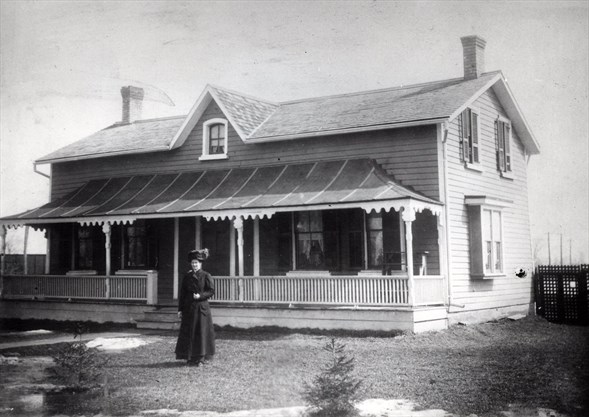
He moved his family to Richmond Hill in 1912, and built his first conservatory at the corner of Roseview and Pugsley Streets. He built his home at the west corner of the property where it remains today. John H. Dunlop (a former President of the Canadian Horticultural Society) was encouraged by his friend Lawrence to join him in order to expand his business. Dunlop was a keen horticulturalist who loved growing roses. The Bedford Park Floral Company soon followed, with Henry Arnold at the helm, and H.J. Mills built his first greenhouses in 1912, as well.

Dunlop won a first prize at the International Rose Show in New York City in 1914 with 50 of his “Richmond Roses” and repeated this success in Philadelphia, winning three first prize places. He developed rose varieties that were internationally acclaimed, helping to highlight this specialized industry that was “blooming” in the village. In 1914, the growers and a number of local residents founded the Richmond Hill Garden &Horticultural Society. The society worked to increase interest in all horticulture and to assist in beautifying the village, roles it continues to play today.

The industry flourished, and led to a rapid rise in population and a subsequent need for homes (27 new homes in 1918) in turn expanding existing businesses and encouraging others to move to Richmond Hill. Lawrence sold off unused portions of his greenhouse property, developing the “Roseview Gardens” subdivision. During these years, the greenhouses grew in number. The four largest growers covered several acres near the railway lines, north to Dunlop Street. Each had several buildings with huge chimneys for heating and exhaust and railway spurs to offload supplies and transport their products.

Roses were shipped across Canada at a time when there were no refrigerator cars. The flowers were individually wrapped in paper and boxed with ice to keep them fresh which allowed them to withstand a three-day trip to Edmonton. Mother’s Day was the biggest holiday and it would take every employee to be on hand to get the roses ready for transport. Often the companies would work together to fill large orders. By the 1930s Richmond Hill had attained its reputation as the Rose Capital of Canada.

As the floriculture industry grew, it became a more distinct part of the village’s identity and was even written into the village motto: “En la Rose Je Flouris”- “Like the Rose, I Flourish”. The industry thrived for many years but began to decline with global competition, local business taxes and poor economic conditions. Mills Roses was the last of this trade in the city, closing in June 1982.

Andrea Kulesh is the past president of the Richmond Hill Historical Society

We Will Remember

A brief history of the Richmond Hill Cenotaph by Peter Wilson

Originally published online by the Richmond Hill Liberal on April 14, 2020

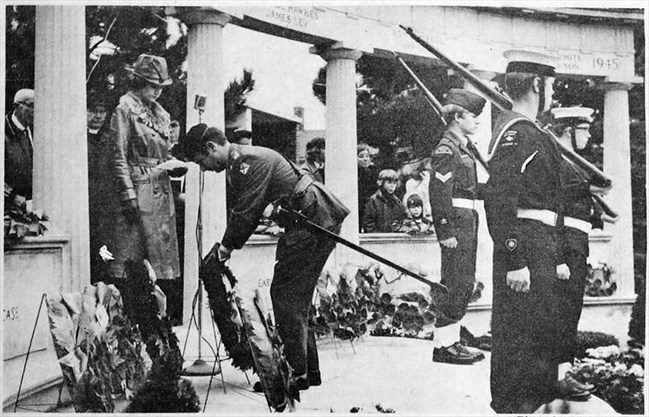
Coun. Lois Hancey reads the names of donors during the laying of wreaths at the Nov. 12, 1972 Remembrance Day Ceremony. – David Barbour/The Liberal

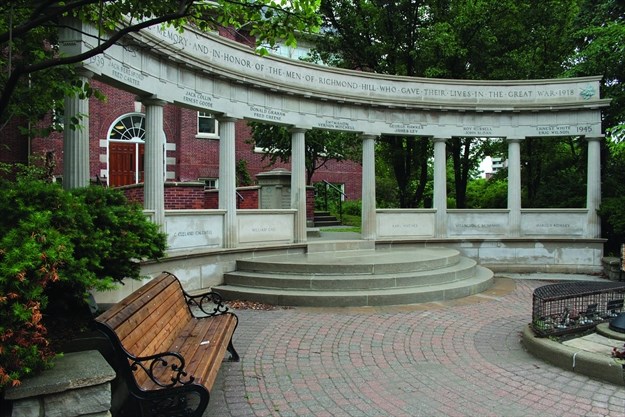
For nearly a century, the Richmond Hill Cenotaph has stood sentinel in the heart of the city. At the time of its 1923 unveiling, Col. William Nisbet Ponton declared: “Their names are engraved forevermore in the stone of remembrance.” He added that, “the situation of the monument, in the centre of the loyal county of York, before a schoolhouse, where it would inspire the generations of future citizens was also most appropriate.”

The Cenotaph’s origins date to a village council meeting of Feb. 13, 1918, where Reeve William Pugsley suggested something to honour the memory of “our boys who have fallen in the war.” The reeve and village clerk A.J. Hume were directed to research a suitable memorial, and within a month proposals were received from several marble dealers. At the council’s Dec. 16, 1918 meeting, a motion passed to commission a monument similar to a model by the Thomson Monument Company.

Reeve Thomas H. Trench organized a meeting for June 9, 1919 at the Masonic Hall to launch a fundraising campaign. In addition to a subscription scheme, a resolution was passed asking ratepayers to co-operate with council’s holding a Field Day on Aug. 4, 1919; the first of many with proceeds earmarked for the building of a monument.

Fundraising and planning took another four years, in which the future of the Cenotaph was put to question. At the Field Day meeting June 26, 1922, considerable interest was voiced over having a Memorial Hall instead. But the majority of returning soldiers preferred a monument, a point well-articulated in a heartfelt November 1922 letter by Louis Teetzel to The Liberal. He wrote, “(the soldiers) have won a place in the world’s history for all time to come … we express ourselves in favour of a permanent monument … that will keep alive in the people the sentimental side of the memorial.”

To settle the matter, a referendum was held during the municipal election on Jan. 1, 1923. It was resoundingly in favour of a monument: 170 votes to 55.

Finally, the Cenotaph was designed by Toronto architect Charles MacKay Willmott — and built at a cost of $4,960 by Nicholson and Curtis (stonework), J. Reynolds (lettering), J. Sheardown (foundation), J. T. Startup (levelling and sodding), and the Architectural Bronze Co. (lamps).

The Richmond Hill Cenotaph as it appeared in 2018, when we marked the centenary of the end of First World War. – Peter Wilson photo

It was dedicated on Aug. 5, 1923, during the Grand Reunion of the Old Boys and Girls. It originally honoured the six individuals etched on the bottom panels who lost their lives in the Great War. A seventh, Starr McMahon who died in 1918 with the Merchant Navy, was added later. And the five-sided stone recognizes 36 soldiers from the First World War, “who so nobly served and by the grace of God whose lives were spared.”

Sadly, the Second World War required the addition of 13 names along the top of the monument. Later plaques recognized those who died in the cause of peace in Hong Kong during the Second World War, as well as those who died in the Korean War and on deployment as peacekeepers.

We will remember.

—Peter Wilson is a member of the Richmond Hill Historical Society. He is also the Local History and Genealogy Librarian at Richmond Hill Public Library.

Names of the Fallen

The following heroes from our community made the ultimate sacrifice during the First World War and the Second World War. These are the brave men whose names are etched on the Richmond Hill Cenotaph.

The First World War

C. Cleland Caldwell

William Case

Arthur C. Cooper

Earl Hughes

Starr McMahon

Wellington C. Monkman

Harold Rowley

The Second World War

Jack Beresford

Fred Carter

Jack Collin

Ernest Goode

Donald Graham

Fred Greene

George Hawkes

James Ley

Vernon Mitchell

Roy Russell

John Sloan

Ernest White

Eric Wilson

RHHS Meeting Cancelled – Monday, April 20

Just a reminder that the Richmond Hill Historical Society has cancelled our monthly meetings until further notice. Our next meeting had been scheduled for April 20, 2020.

Protecting the health, safety, and well-being of our members and our community is our primary concern. This is the second consecutive meeting cancelled for the Society this year – this is in itself an historic moment – in our 46th year of our existence in the community.

We know that you all look forward to our great speakers each month and our Society’s fellowship. We will notify the membership when we will be able to return to Society meetings at Wallace Hall.

Stay safe.

RHHS Meeting Cancelled – Monday, March 16

With the ongoing and developing situation surrounding the Coronavirus disease (COVID-19), the Richmond Hill Historical Society has made the decision to cancel our regular meetings until further notice.

Our next meeting was scheduled for Monday, March 16, 2020 but will no longer be held.

We have made this decision out of an abundance of caution and will provide updates on future meetings as the situation continues to develop.

Jefferson School House Decision

Jefferson School House

The Richmond Hill Historical Society was pleased with the outcome of the Wednesday, February 12, 2020 City Council meeting, when Council voted unanimously to deny an application to demolish the Jefferson Schoolhouse. Council also passed a motion asking City staff to look at options for preserving and restoring the Schoolhouse, including the option of the City purchasing the property.

During their deliberations, Councilors discussed a few of those options, including one that would see the building restored and used, perhaps, as a new school, or one that would see the building restored and become part of a larger development on the site. The Historical Society was also pleased to have been part of the efforts to save the Schoolhouse. The Society was a delegate at Council’s meeting on January 22nd, when Council first discussed the application to demolish, and presented a petition to Council advocating for the Schoolhouse’s preservation. The Society also spoke to Council at the meeting on Wednesday, Feb. 12th, urging Councillors to save the building.

Needless to say, we were happy with the result.

I Read Canadian with Melanie Florence

Heritage Week and I Read Canadian Afternoon Tea at the Heritage Centre

Saturday, February 22, 2020

Two sittings to choose from: 1 p.m. or 2:30 p.m.

  • Sip some warmth into winter with an afternoon tea at the Heritage Centre
  • Enjoy sweet treats, scones with cream and jam and signature tea, coffee or hot chocolate
  • Celebrate Ontario Trust Heritage Week with a reading by celebrated author Melanie Florence

Cost: $12.50 per person tax included

The City of Richmond Hill’s Heritage Centre is located at 19 Church Street North. To learn more and to make your reservation, visit the Heritage Centre website’s Afternoon Tea page or call 905.780.3802.

There will also be a free Open House on the same day from 2:00 to 4:00 pm. Come and discover what is happening at the Centre as part of Ontario Heritage Week. Visit the current exhibit Coming Up Roses and learn about the history of the rose growing industry that put Richmond Hill on the map as the “rose capital of Canada.” Melanie will give deliver another reading at 2:15 pm.

The Milk Bag Project

We are very excited to be welcoming Sharon Gusz, an active volunteer and trainer for MILKBAGSunlimited to the Society Meeting on Monday, February 17, 2020.

MILKBAGSunlimited was launched by Angela Kesthely in Toronto, Ontario following the devastating Haitian Earthquake of 2010. Their objective is to providing finished milk mats mattresses made by volunteers to people who have nothing but bare earth or cardboard to sleep on. While saving the planet from discarded, non-recyclable milk bags, the team headed by Angela realized that by giving people the tools and the coaching, income opportunities could be created.

Our speaker, Sharon, is a retired teacher who taught in York Region for over 33 years, including 7 right here in Richmond Hill. Since her retirement in 2013, she has become an active volunteer and trainer for MILKBagsunlimited. She has trained students in over 50 schools in York Region and hosts 3 monthly weaving groups with adults.

Join us as Sharon shares more about this wonderful organization and shows us how we can not only save the environment…but also empower people!

Sharon is encouraging attendees to bring milk bags that can then be given to volunteers for use.

York-Sutton Railway History

Discovery what it was like to ride the rails in the 1850s and 1900s.

On January 4, 2020, the Canadian Railway Preservation and Restoration Society (CRPRA) will be holding an event at the Richmond Hill Public Library Central Branch on a history of the York-Sutton railway. You have a choice of two 1 hour sessions on January 4th, either from 10:15 am – 11:15 am OR 11:45 am – 12:45 pm. The cost is $5.00.

Games, trivia, hands-on with rails…fun for the entire family.

Register online by visiting the CRPRA website at https://www.crpra.org/community.php.

The Canadian Railway Preservation and Restoration Association, is a federally incorporated non-profit organization that strives to protect, preserve, and restore railroad tracks. We also promote rail safety and educate future engineers.

Still Time to Reserve Your Holiday Party Tickets!

Just a reminder that if you would would like to buy a ticket for the upcoming dinner on Monday December 9th, 2019, there are still some available. The evening begins at 6:30 p.m. one hour before our usual meeting time. The tickets are $30.00 which includes dinner, door prizes, entertainment (CHORUS YORK) and we have raffle items.

Monday December 9th, 2019 – 6:30p.m
CHRISTMAS DINNER AND PARTY

The Executive Committee of the Richmond Hill Historical Society would like to extend a special invitation to the annual Christmas Dinner & Party.
Join us for a good old fashioned Christmas Dinner and celebration of the season. A delicious dinner will be catered by “3 Sisters Catering Company” with all the trimmings and dessert. There will be Door Prizes, Raffles, Entertainment and Caroling to complete the evening. Lots of fun for the festive holiday season. Invitation is now open to friends and family.
(previously a Members-Only event).

Tickets – $30.00 per person
(Cash or Cheque)

Please call Andrea Kulesh at 905-884-2789.

ONLY Reservations can be taken at this time. Pay at the door.

Call Andrea or email r.hillhistsoc at hotmail.ca. Please let us know no later than Friday December 6th, 2019. The caterers require final numbers to assist them in their arrangements.
** This Event Begins 1 hour earlier than monthly meetings !!

Thank you everyone. We hope you can make it on Monday. It’s always fun to gather and enjoy each other’s company for what remains of the year in 2018!!! The next time we see each other will be New Year 2019!

All the best for the coming Holiday Season!