As we continue to celebrate the Society’s 50th Anniversary, we are sharing articles from past issues of our membership magazine. In honour of our anniversary, we look back to the Christmas 1994 issue of Heritage on the Hill and this article by Jim Monkman looking back to Christmas work at the post office from 1945-48.
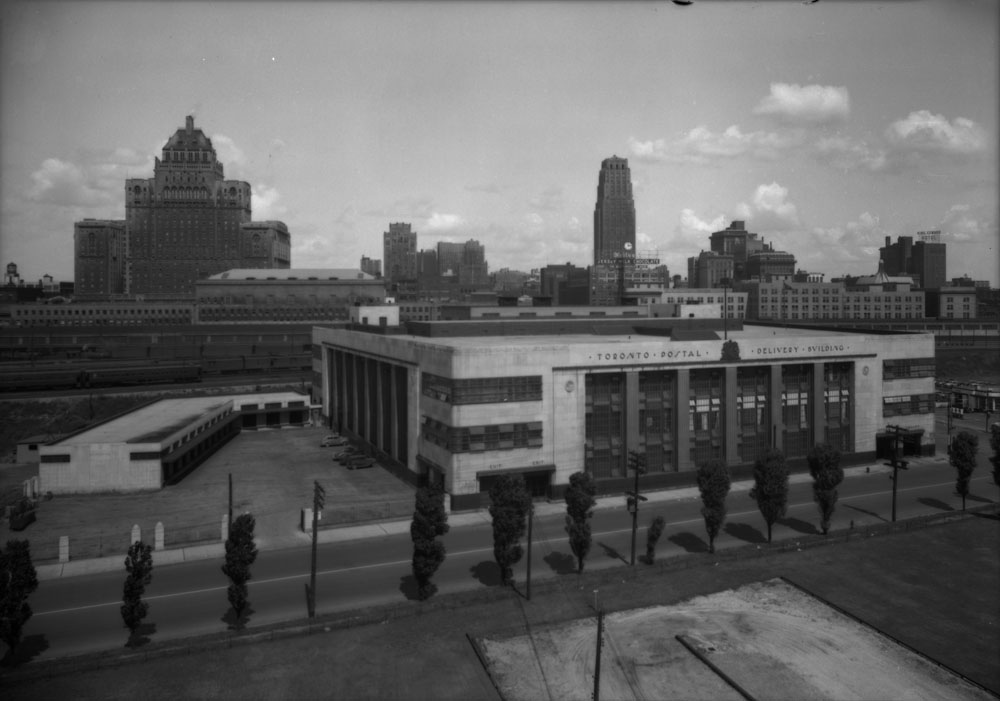
Recently Avonelle and I attended a Band Concert at Roy Thomson Hall with Nancy and Bill Price.
I insisted on driving to the concert because some years ago, when I retired, from work in downtown Toronto, I vowed that I would try and avoid ever using the subway system again- thus it was that we were all sitting in the car waiting for the traffic light at Lakeshore Boulevard and Bay Street to turn green. That was when Nancy pointed to a building on the north west corner and said ‘that looks like the building where I used to work sorting Christmas mail.’ I replied that indeed that must have been the building because that was where I had been similarly employed at Christmas when I was in High School.
I was a teenager in the middle to late 1940’s. Mail handling and sorting was done manually. No computer sorting and postal codes in those days. To handle the volume of mail at Christmas the Post Office would hire part time help.
As I recall in those days there wasn’t much part time work for students throughout the school year, except for paper routes and family businesses. None of my associates had part time jobs and any opportunity to make some money for Christmas was eagerly sought. When I was about fifteen my parents finally gave in to my pleas and agreed to let me try and get a Christmas job with the Post Office. The procedure to get such employment was simple. One went to Jack Smith’s Richmond Hill Liberal Newspaper Office, which was located in an old building on the east side of Yonge Street, immediately south of Bill Neal’s and opposite the Public School. The person at the front desk usually knew every one by name, often it was Jim Grainger, and you told him you would like a job at the Post Office on the midnight shift and your name would be put on the list.
For the next few weeks my parents never had to remind me to pick up the mail at the Post Office on the way home from school at noon. All who had applied for such work checked every day to see if a letter notifying them when to start had arrived. At last the notification for me and my compatriots came. Eagerly we checked the details of our employment. This was important to us as we had to attend our regular classes at school. The day shift was of no use to us and the 4:00 p.m. to 11:00 p.m. was no good because classes did not end ’till 3:30 which didn’t leave us enough travel time. We always applied for the 11:00 p.m to 7:00 a.m. shift which allowed us some time after school for study and sleep before leaving for work about. 10:00 p.m. and enough time to get back to Richmond Hill for school at 9:05 a.m. Classes commenced at 9:05 to enable students who travelled to school via the 9:00 a.m. street car to arrive in time.
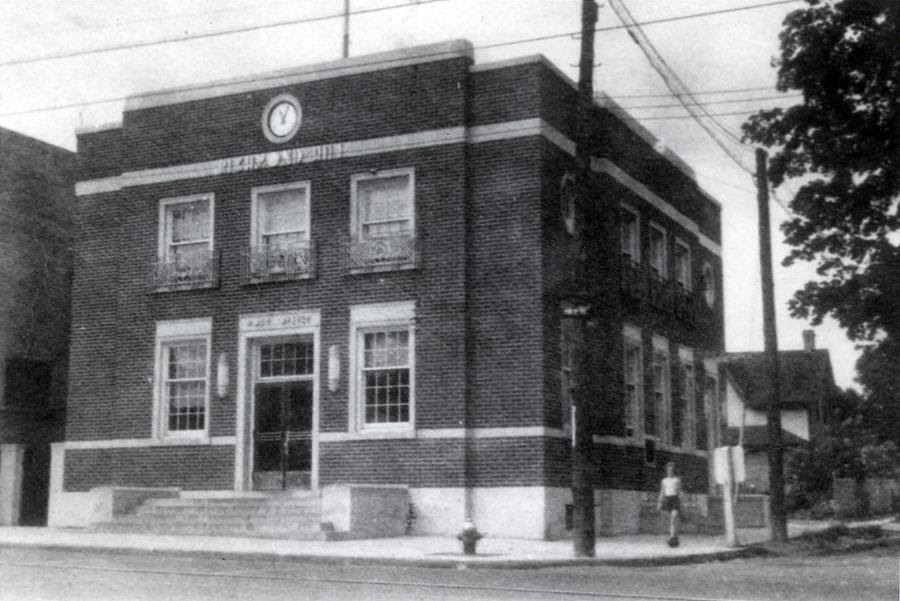
Robert Hirtle and I always travelled together. We were, and still are the best of friends. Rob’s father, who was the Minister at the Presbyterian Church let Rob have, what seemed to me to be, unrestricted use of his car. Indeed he secured a driver’s licence for Rob when he was fifteen. It allowed him to drive only the one car which, if I remember correctly, was noted on the licence.
Rob, using his father’s 1941 Dodge sedan transported a carload of us to and from the Toronto Mail Sorting building at Bay and Lakeshore Boulevard. That first year, it was exciting to leave for work at what a short time before, was my curfew for getting home. Our route was down Yonge Street to the top of Hogg’s Hollow Hill. There we would swing off to the right over the viaduct where the road curved to the south to meet Avenue Road at about Wilson Avenue. Highway 401 and the Avenue Road cloverleaf approximately follows that stretch. We travelled Avenue Road to Front Street where we would turn left and then south on Bay Street to Lakeshore Boulevard. If my memory is correct there was ample free parking on the west side of the building. The trip was fairly quick as traffic was light and traffic lights were few. I believe the first one was at Sheppard Avenue and the next at Eglinton.
On reporting to work Robert and I and some of our friends, were given our time cards and assigned to sort mail for the streets of Toronto that began with the letter ‘L’. We each faced a wooden case divided into cubicles. Each cubicle was labelled with the name of an ‘L’ street. The labels were in alphabetical order starting at the top left hand corner of the case. The letters to be sorted were dumped onto the front part of the bench on which the cases rested. We spent the entire shift sorting an endless supply of letters into the appropriate cubicle. We could work standing up or sitting on the high stools provided. It was dangerous to sit on the stool too long because often one tended to go to sleep and fall off.
It didn’t take long for Rob to realize that some streets had more mail than others. Following this observation we moved the labels so that the streets which received the most mail were immediately in front of us and at the easiest height to pop the letters into their cubicle. This change made our work much easier. That it also helped us to sort letters faster was not of great concern to us because there was never an instant when the supply of letters on our bench ran out.
Every evening when we reported for work we found that the street labels on our cases had been put back in alphabetical order. Each shift, before we picked up a letter, we reorganized the street labels to make our work easier. Needless to say this did not give us a very high opinion as to the efficiency of the Post Office supervisors or the employees on the other shift. Maybe we were just lazier than the others.
Our employment ended the morning before Christmas. As school had usually closed a day or so before that, we had caught up on our sleep and were able to enjoy Christmas and following week of holidays. Our pay cheque would arrive, we could repay our parents the money they had advanced us for work expenses and the purchase of Christmas presents and still have some left over for ourselves.
We did this almost every Christmas during our high school years. Of course our teachers knew what we were doing, and thinking back I realize how much patience they exercised in dealing with a bunch of students, who if not falling asleep in class were exceedingly dopey from lack of it. For most of us it was our first experience working in Toronto for people who did not know us and our families. I’m sure it helped prepare us for our future careers away from the secure environment of the Village of Richmond Hill.
 Richmond Hill Historical Society