(1920s) Yonge Street Remembered [Part 2]

As we continue to celebrate the Society’s 50th Anniversary, we are sharing articles from past issues of our membership magazine. As the City of Richmond Hill celebrates its 150th Anniversary, we will post some articles that share recollections of Richmond Hill of the past. Here we look back to the September/October 1996 issue of Heritage on the Hill and part 2 of an article by Harry Sayers. Read part 1 here.

Having previously covered (more or less) the east side of Yonge, we begin on the west side at Major Mac (then Vaughan or Maple Road, in the 1920’s) where the McGibbon house was on the southwest comer while on the north was the sign proclaiming “Richmond Hill – Toronto’s Highest and Healthiest Suburb -762 feet above sea level – the Rose Growing Centre of Canada.”

Further north came the Anglican Church of St. Mary, the Presbyterian Manse and Church with the original frame manse still on the front corner of the Presbyterian property on the south side of the lane leading to the Presbyterian cemetery. That manse is now at Black Creek Pioneer Village.
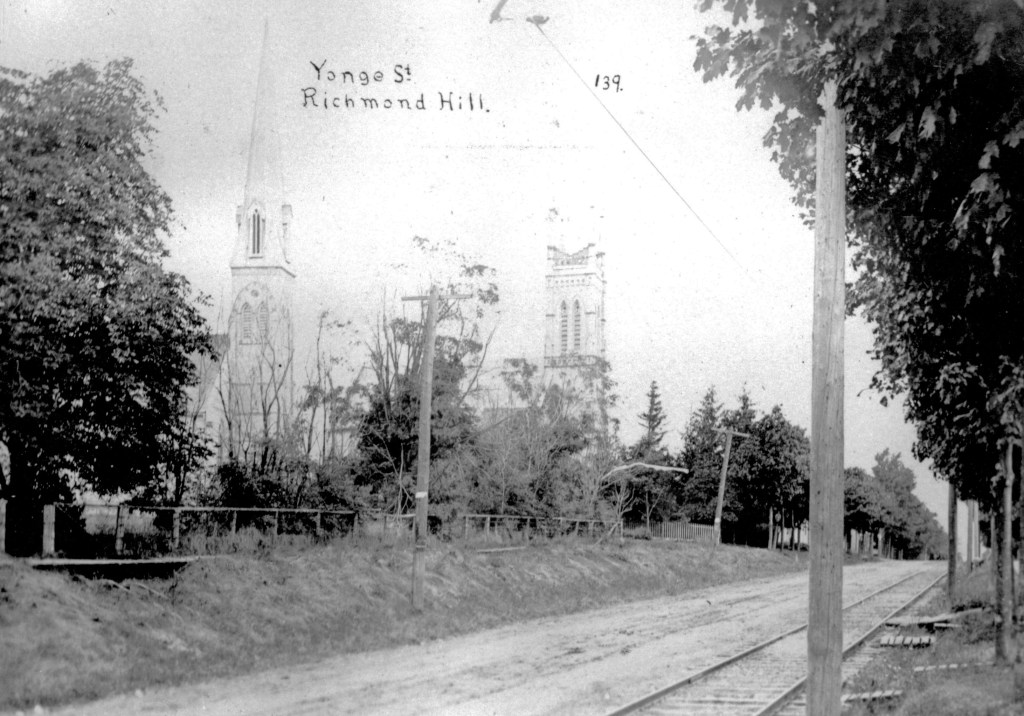
Yonge Street from Major Mackenzie Drive showing St. Mary's Anglican Church and the Richmond Hill Presbyterian Church, ca. 1915. (Photograph courtesy Richmond Hill Public Library, PA91-005)
Yonge Street from Major Mackenzie Drive showing St. Mary’s Anglican Church and the Richmond Hill Presbyterian Church, ca. 1915. (Photograph courtesy Richmond Hill Public Library, PA91-005)

Soon, we come to the home and shop of renowned watchmaker Jerry Smith,(daughter Audrey Koning can tell you more), then the Public School, later the McConaghy Centre named after Mrs. L. M. McConaghy who was my first teacher on our arrival in the Hill in 1924 and Walter Scott was the Principal.

Next we come to the Palmer House later the Greenholme Apts, and recently torn down. Across Arnold St., the Palmer Brick Block, later called the Lorne Block, which housed, at various times a bank, shoe store, barber shop, etc. while the north end housed the fire house with the Council Chambers on the second floor.
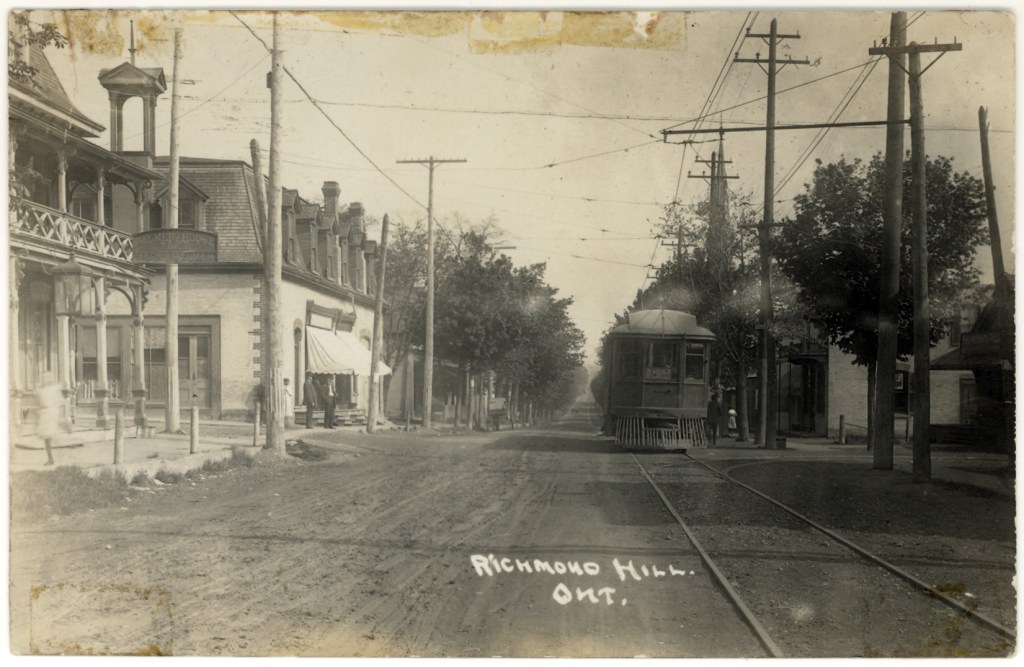
The Palmer House Hotel beside the Palmer Block, later the Lorne Block, ca. 1910s. (Photograph courtesy of the Richmond Hill Public Library, card-33)

Along this block were Glass’ Meat Market, Green’s Tailor Shop, the Rustic Inn, Bruno’s Fruit Market later the Fisher General Store, Bill Davies house and dry goods store with the Ontario Hydro office on the second floor.
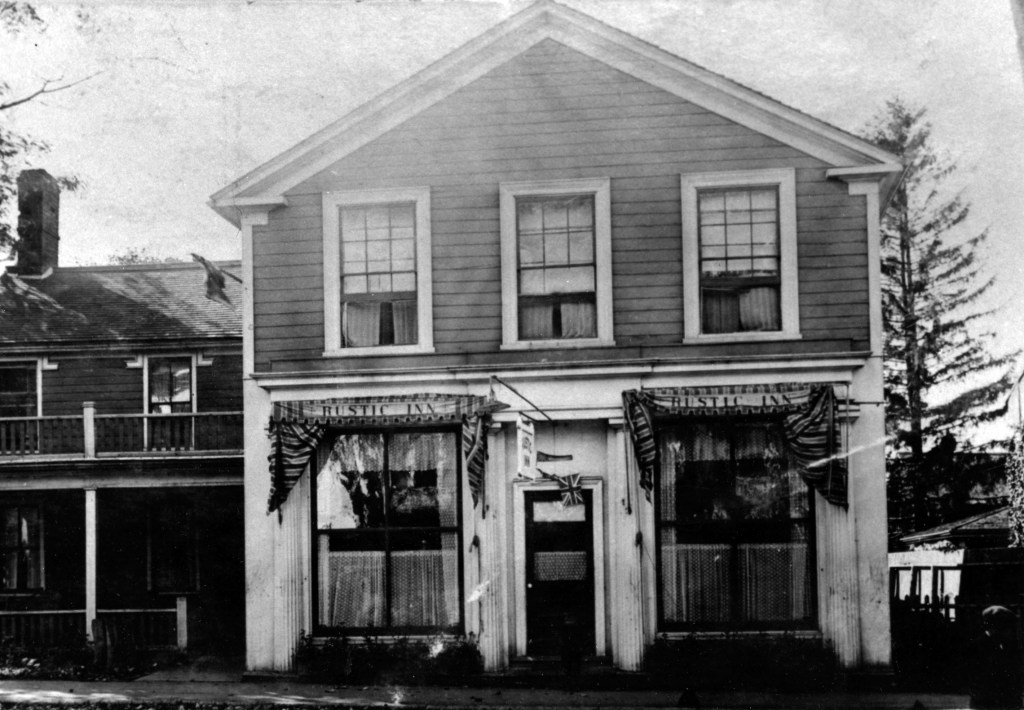
The Rustic Inn, ca.  1920s. (Photograph courtesy Richmond Hill Public Library, RH12-20)
The Rustic Inn, ca. 1920s. (Photograph courtesy Richmond Hill Public Library, RH12-20)

Adjacent was the first (?) Dominion Store where I earned 15 cents for each order I delivered on my wagon! Then came Stein’s Store at Centre Street. Further north was the home of A. G. Savage with the Post Office in the South wing. Following were such stores as Isobel Hewitt’s Wool Shop, the Chinese Laundry and Wellman’s Men’s Wear at Richmond Street.

Across the street was Abraham Law’s house (later the Wright house) torn down to make way for a Sunoco service station. Close by was Carl Swanson’s garage with the gas pumps right at the curb. Then came the Anglican rectory, later Bettie’s Restaurant and it’s neighbour, the old High School (later the Municipal Hall).

Halfway up the next block was the Richmond Hill Dairy, Cowie’s (later Hunt’s) blacksmith’s shop and next door the property of Dr. Rolph and Lillian Langstaff, whose house was later moved by Dr. Jim to the rear of the property to face on Hall Street.

Further north, we come to Wright & Taylor’s Funeral Home (now Marshall’s), with the B. A. service station, operated at one time by A. White and Wilt Young, while across Benson Ave. was Cec Mabley’s White Rose station. Then came Little’s Ford agency and nearby Harold Reid’s service station. That brings us to just about the north limits of the village on that side of Yonge Street.

Here’s hoping that these reminders of the past, will recall to your minds memories of the “good old days” – they were, weren’t they ?????????
(1920s) Yonge Street Remembered [Part 1]

As we continue to celebrate the Society’s 50th Anniversary, we are sharing articles from past issues of our membership magazine. As the City of Richmond Hill celebrates its 150th Anniversary, we will post some articles that share recollections of Richmond Hill of the past. Here we look back to the May/June 1996 issue of Heritage on the Hill and this article by Harry Sayers.

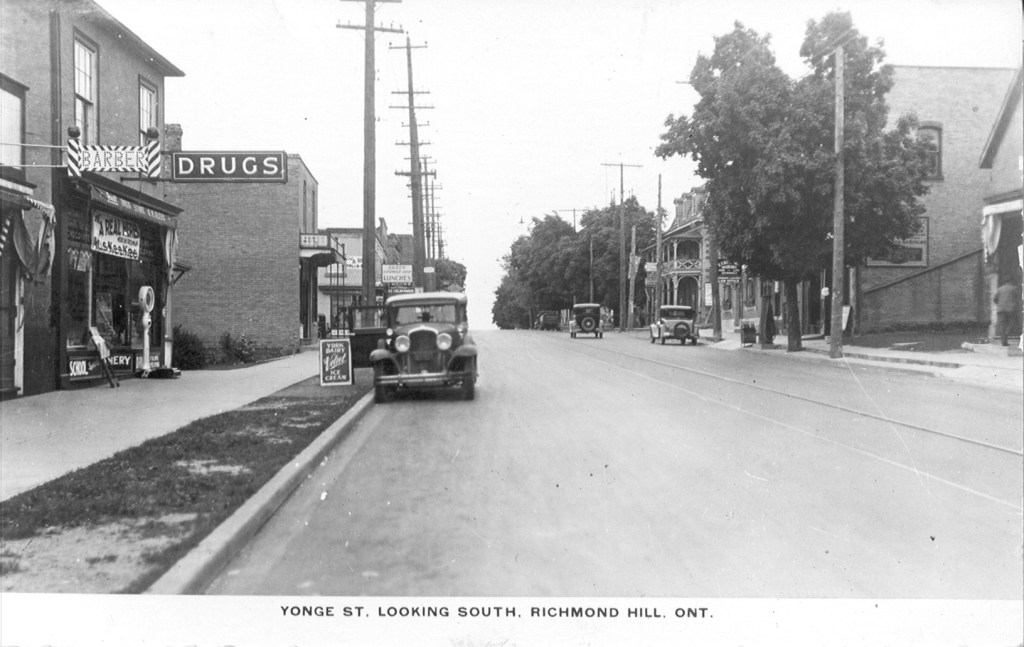
Yonge Street looking south taken around 1930. The Palmer House Hotel is on the right side of the road by the two cars. (photo courtesy of Richmond Hill Public Library, PA92-005)
Yonge Street looking south taken around 1930. The Palmer House Hotel is on the 
right side of the road by the two cars. (photo courtesy of Richmond Hill Public Library, PA92-005)

Recalling memories of Yonge Street when I was young (quite a bit younger than today) is quite a challenge. It’s hard to be accurate as to dates etc. but memories do exist so I’ll give it a try.

Let’s start with the east side and since I’m recalling the 20’s, I’ll keep mainly to the village as it was then.

South of Major Mac, then the Markham Rd., were the Harding and Palmer farms whose names live on in street names. The Palmer house at the corner of Yonge and Major Mac is now a real estate office.

Further north we come to a series of brick houses, some now replaced by service stations, etc. One exception was the Stanford Nursing Home, now an office building.

Across from the Presbyterian Church was a tenement block, later the home of the Liberal, then the Richmond Inn with the Liberal Office, bowling alley and theatre. Of course the Standard Bank now a computer store. Almost forgot, the Cities Service garage, just to the south of the bank.

Then came the Trench Block with hardware, grocery and drug stores in turn up to Lorne Ave.

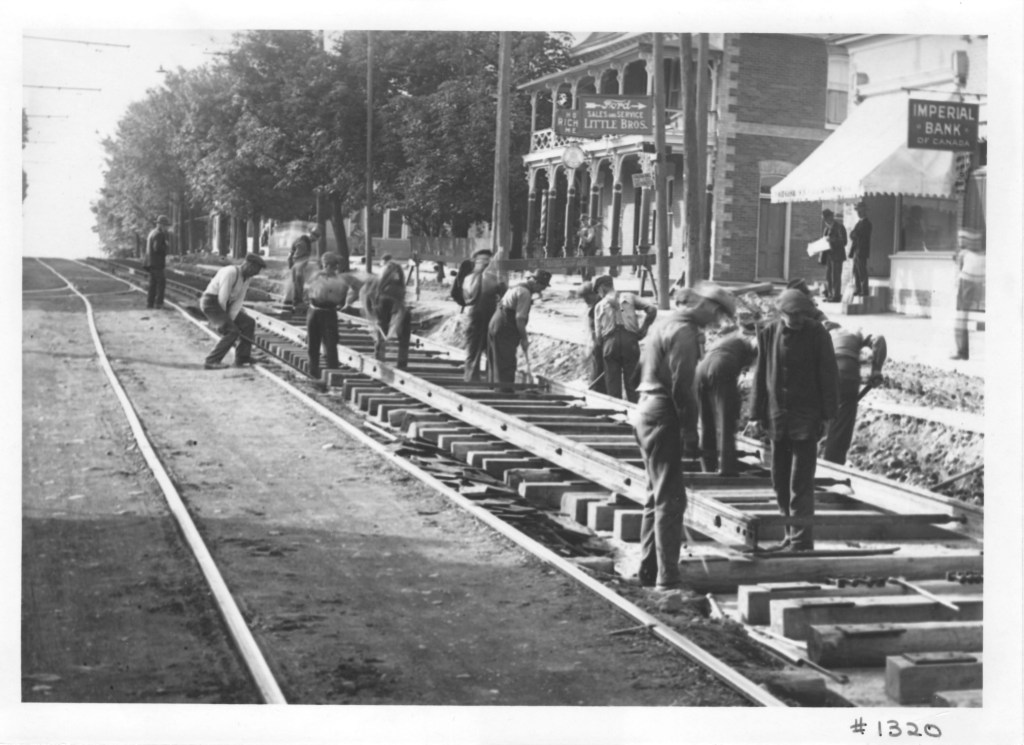
On the north east corner of Lorne/Yonge was the old Radial Station with the spur running beside the loading platform. Here one bought tickets for the radial cars which at this time ran from North Toronto to Lake Simcoe via Aurora and Newmarket with a branch line to Schomberg. Oak Ridges was known as Schomberg Junction in those days. Roses from our several greenhouses were shipped to Toronto from the radial station while we newsboys picked up our Toronto newspapers which arrived by the radial cars.

Moving the radial railway tracks from the east side of Yonge Street to the centre of the road for the first paving of Yonge Street in October 1927 (photo courtesy of Richmond Hill Public Library, RH12-26)

The next block saw several stores over the years, such as Glenn’s Drug Store, Morley’s groceries, Mansbridge’s Meats, Skeele’s house and store, Braithwaite (Charlton’s) Hardware, the telephone exchange in the house at the southeast corner of Yonge/Centre E.

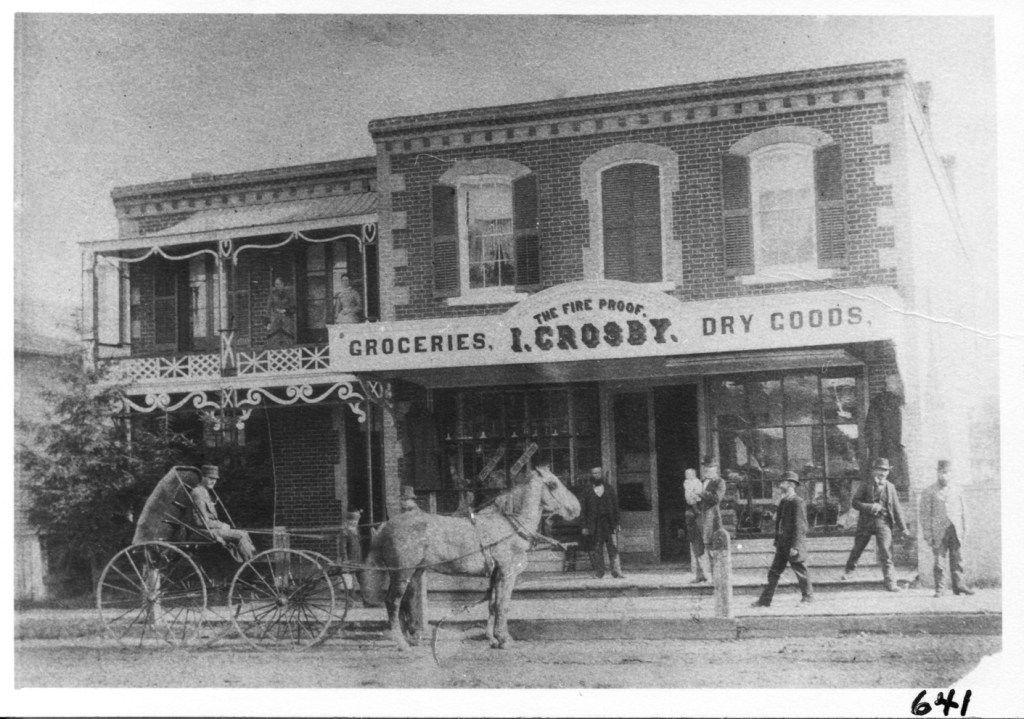
To the north of the United Church, came the Masonic Temple, and close by the “Fireproof Store” which was the location of David Hill’s wholesale tobacco and confectionary business, to become in 1940 our first Canadian Tire Store (still operated by a member of the Hill family at Yonge/16th Ave.).

The Fire Proof, rebuilt by Parker Crosby after the great fire of 1866. (photograph courtesy of Richmond Hill Public Library, PA89-033)
The Fire Proof, rebuilt by Parker Crosby after the great fire of 1866, shown circa. 1880s. (photograph courtesy of Richmond Hill Public Library, PA89-033)

Further north was Hopper’s Meat Market, later to be operated by the Kerr Brothers. At Dufferin St. (now Dunlop St.) was the Hill Bakery but I remember it as Eden’s Grocery and Bakery. Just to the north was then St. Mary’s Catholic Church and rectory.

Although set well back from Yonge St. and these days blocked off by houses on the south side of Bedford Park Ave. was Crosby Hall with it’s magnificent pine trees and lawn stretching to Yonge Street. Later the home of the Angle family (Mr. Angle being the general manager of Bedford Park greenhouses). The huge lawn was often the site of strawberry festivals and the like.

At the edge of the then north village boundary was the home of Col. Moodie who died while trying to reach Toronto to warn of the 1837 rebellion. Then there was the Burr Feed Mill, a great attraction to many young residents of the village.

Granted there are other places of interest, such as Ransom’s Barber Shop and other establishments but space forbids mention of them even if my memory permitted.

Hopefully these comments will stir some happy memories and perhaps the future will permit memories of the west side of Yonge Street in the 20’s to be recalled.

Sixty-Eight Years of Artificial Ice in Richmond Hill

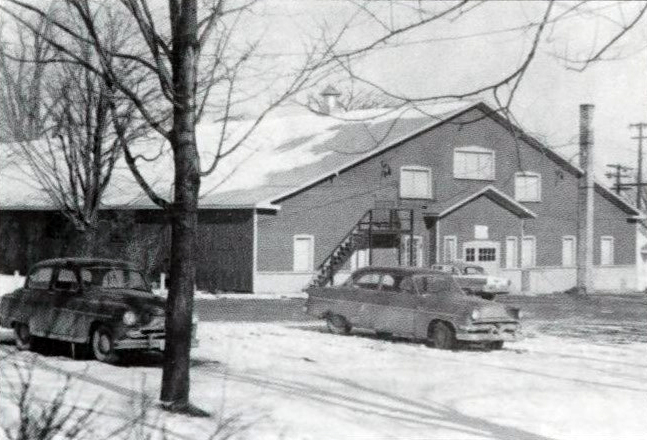
Black and white photograph of the arena at Church Street and Lorne Avenue as it appeared in the 1950s. (photograph courtesy Gerry Roy/Richmond Hill Public Library from Later Days in Richmond Hill: A Portrait of the Community from 1930-1999 by Marney Beck Robinson and Joan Clark)
The arena at Church Street and Lorne Avenue as it appeared in the 1950s. (photograph courtesy Gerry Roy/Richmond Hill Public Library from Later Days in Richmond Hill: A Portrait of the Community from 1930-1999 by Marney Beck Robinson and Joan Clark)

March 19 commemorates 68 years since the official unveiling of artificial ice at the Richmond Hill Arena. The arena, originally built in 1923, frequently had problems with its natural ice surface resulting in many disappointments for residents eager to skate. In fact, in his Sports column in the Richmond Hill Liberal of April 29, 1954, Bill Ellis wrote:

That “No Skating” sign operates on a hinge with a sign that says “Skating.” The affair is locked by a padlock in either position. You might as well lock the “No Skating” portion in place and throw away the key because that’s what it reads 99 and 44/100 per cent of the time.”

Enter the Richmond Hill Arena Association!

In 1954, this not-for-profit organization was formed, whose primary mandate was to raise funds to outfit the arena with artificial ice. The community members that originally spearheaded this effort included: Craig Bowden, Jack Hart, Bill Savage, Alec Clarke, Al White, Jack Hollowell, Bill Gilchrist, Ralph Paris, Morley Hall, Alex Baird, Elgin Barrow, Cec Mabley, Walt Smith, Harry Bawden, Art Gibson, Morley Williams, Floyd Pratt, Norm Todd and Bill Ellis. The group formed subcommittees, including a Campaign Committee led by Ralph Paris and a Technical Committee led by Alex Baird.

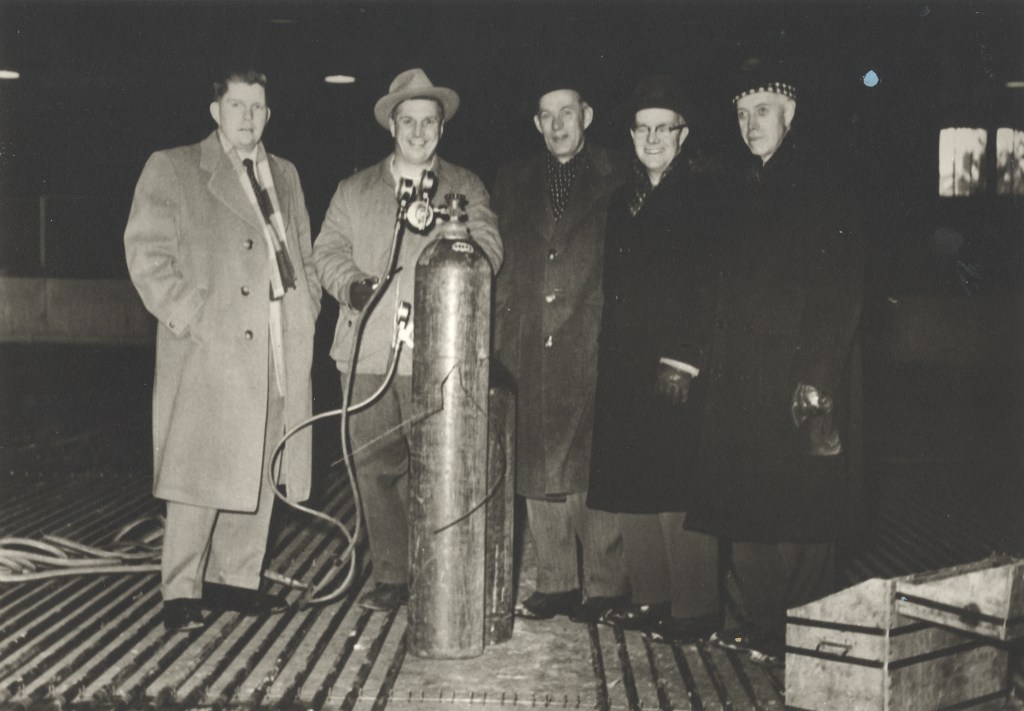
Black and white photograph of Bill Ellis, Elgin Barrow, Bill Hall, Walter Smith and Hugh Mackay during the construction. (RHPL, Burt Hunt fonds, 2012.5.1)
Bill Ellis, Elgin Barrow, Bill Hall, Walter Smith and Hugh Mackay during the construction. (Richmond Hill Public Library, Bert Hunt fonds, 2012.5.1)

On May 10, 1954, the Arena Association launched a $50,000 fundraising campaign. They were quickly helped along by a quick first donation of $1,000 by Bing Lew, owner of the Town Inn and one of our community’s most notable philanthropists. He would later fund the building of a pool at the Loyal True Blue and Orange Home on Yonge Street, near Elgin Mills. These are just two of many contributions that Mr. Lew made, often to the benefit of local children.

While the campaign did not realize its $50,000 goal, the Association was ultimately successful in bringing artificial ice to the arena. Their Fall campaign in 1954 brought in a respectable $24,000 and saw membership in the Association total approximately 600.

In February 1955, Walter Smith and Elgin Barrow signed a 15-year lease on the arena for $1 per year.

Then, on March 19, 1955, a record-breaking crowd of 1,500 people, paid to attend the official opening of the new ice surface. Municipal and Provincial representatives attended the event, officially opened by “Timmy” of the Easter Seals Campaign. Jack Passmore served as master of ceremonies with the Town represented by Reeve W. J. Taylor.

A full program of activities were showcased at the opening, including solo figure skating performances by Richmond Hill’s own Mary MacKay and later Louis Stong. Ede Butlin called a square dance on the ice, with additional performances given by members of the Toronto and Unionville Skating Clubs. The local association was assisted in the preparation of the ice by Bert Kent, the icemaker for the Toronto Skating Club.

Not surprisingly, the introduction of a more reliable ice surface saw the popularity of skating and organized hockey grow, beginning in the mid-1950s. The arena’s importance to the community grew immensely and has seen many important events over the past 68 years of artificial ice, including the old annual midget hockey tournament. Organized by Royal Canadian Legion Branch 375, this hallmark tournament began in 1968 and saw many future NHL stars hit that artificial ice.

So as you lace up your skates for a turn around the ice at the Elgin Barrow Arena, think back with appreciation to those members of our community who worked so tirelessly and hard to make the arena such an important part of Richmond Hill’s history and put the Skating/No Skating sign onto the trash heap for good.

Further Reading:

And Away We Go” Sports column by Bill Ellis, Richmond Hill Liberal, 15 April 1954, p. 6

‘Artificial Ice in 1954’ Motto as Campaign Begins” by Bill Ellis, Richmond Hill Liberal, 20 May 1954, p. 3

First $1,000 Cheque Received for Artificial Ice CampaignRichmond Hill Liberal, 20 May 1954, p. 3

No Money – No Ice” Richmond Hill Liberal, 24 June 1954, p. 2

Official Opening Arena March 19th: Public Skating for EveryoneRichmond Hill Liberal, 3 March 1955, p. 1

‘Timmy’ to Officially Open Installation Artificial Ice in Richmond Hill Arena March 19Richmond Hill Liberal, 10 March 1955, p. 1

Arena OpeningRichmond Hill Liberal, 17 March 1955, p. 2

Record Crowd at Arena OpeningRichmond Hill Liberal, 24 March 1955, p. 1

William McDerment, MBE, Manager Richmond Hill ArenaRichmond Hill Liberal, 22 September 1955, p. 9

Richmond Hill Public Library has digitized the local newspapers from 1857-1979 and they can be searched and browsed for free by visiting https://history.rhpl.richmondhill.on.ca/search.

The Way Freight And Related Memories

by Jim Monkman; originally published in Heritage on the Hill, the newsletter of the Richmond Hill Historical Society of March/April 2010.

The Richmond Hill Historical Society was saddened to learn of the passing of Jim Monkman. Jim supported any and all initiatives regarding history and heritage in Richmond Hill and was always willing to lend a helping hand. He was a member of the Society for many years and served as President. Along with his wife Avonelle, they were dedicated to the preservation of the history of our community.

As part of our 50th Anniversary, as we look back at our own history, we thought it appropriate to share one of Jim’s many contributions to our newsletter from 2010.

Recently, I was enjoying a cup of coffee with John Flood, an old friend. We are both no longer young, indeed, we are well past “middle aged” and if we are not discussing our ailments our conversation is probably about “old times” That particular day we were talking about the era when Richmond Hill was known for the roses grown in the three greenhouses.

The rose growing industry moved from the Bedford Park – Lawrence Avenue area of old North Toronto about 1915 when real estate in that area was increasing in value. Four rose growing greenhouses relocated to Richmond Hill. Mr. Lawrence bought a large acreage bounded by Roseview Avenue, the Railroad Tracks, Markham Road (Major MacKenzie) and Church Street. He built his home, number 114 Roseview, at the corner of Roseview and Pugsley and his greenhouses on Roseview Avenue between his house and the railroad tracks. Harold Mills’ home, number 114 Centre Street East, was built on the north side of Centre Street East and his greenhouses on the west side of Pugsley, north of Centre Street. The Dunlop house was on the north side of what is now Dunlop Street, east of Church Street and his greenhouses ran east from Pugsley to the railroad property. I can’t remember the name of the man who established the fourth rose growing business. It was known as Bedford Park Greenhouse and was at the east end of Bedford Park Rd and east of Pugsley. The Dunlop Greenhouses were later sold to H. J. Mills, which made it the largest greenhouse business in the village

The rose growing business was the main employer in the Village. Men were needed to look after the rose plants, water them and cut the flowers as they grew. The flowers had to be graded and packaged for shipment, some by truck to Toronto and others by train to cities and towns across Canada. Men were also needed to maintain the glass buildings and replace the soil and fertilizer in the raised benches in which the roses were grown. Roses require a lot of heat and stationery engineers were employed to run the high-pressure steam boilers required to heat the greenhouses in our cold climate.

As John and I recalled these long gone days, I mentioned that the coal, which heated the greenhouses, was brought in by the train carload. Our memories and conversation turned to the part that railroad and trains used to play in our lives before the trucking and airline industry took over a lot of their business.

Richmond Hill railway station was a busy place. A great deal of materials arrived by train including coal and lumber.

Spur lines ran from the main railroad track to each of the greenhouse so that the car of coal could be delivered virtually to the boiler room door. John then recalled that another spur line ran to Johnnie Burr’s Mill and Jones coal yard which were located on the east side of Yonge Street almost opposite Levendale. Immediately, my memory took me back through the years to a bright sunny fall day in 1944.

I was fourteen years old, a student in grade 10 in the High School on Wright Street. We lived on Roseview Avenue and I always went home for lunch. This particular day, I didn’t really want to get back to school in time for the first period. I can’t recall why but as I left home I thought I would drop by the Railroad Station first to see if any of my compatriots who felt the same way would be there. The railway station was a gathering place for many of us boys and Y. B. Tracy, the station agent, kept a supply of sports equipment for our use. Not of course when we were supposed to be in school. This day I would keep out of sight of his office. The station was situated at the foot of Centre Street East. It was a fairly big property on which were the Station building, which contained the Station Agent’s Office, a waiting room for passengers and living quarters for the Agent’s family. A plank platform ran between the building and the main set of tracks north to the freight shed and the big water tank. The steam engines usually needed to fill up their tanks after pulling a load of box or passenger cars uphill from downtown Toronto. Water was pumped from a dam the railroad had built on the nearby tributary of the Rouge River to keep this big tank full.

East of the main line was a “siding” which a northbound train could switch onto and wait to allow a fast south bound passenger train to pass. West of the station buildings was the station work yard where spur lines ran to the greenhouses and coal yards.

A work train called a Way Freight would come once or twice a week to deliver full cars of coal or lumber etc and take away empty ones. The Way Freight would call at stations between Toronto’s marshalling yard and other stations on the line to do this. The next large marshalling yard was at Allendale adjacent to Barrie.

There wasn’t anyone at our usual meeting spot but the Way Freight was hooking onto an empty hopper car on I. D. Ramer’s coal yard siding. I stopped to watch and to my surprise the engineer called down to me from the cab of the steam engine “ Would you like to come for a ride. We have to pick up a car at Jones’ Coal Yard”. I leaned my bike against a nearby shed and hastily climbed up into the cab.

What a thrill. I had never dreamed of having such an opportunity. I told the Engineer and the Fireman my name and thanked them for letting me accompany them. Then, I carefully looked around.

The engineer sat on the right hand side of the cab and the fireman on the left. There were some gauges, which I guessed were showing such things as the water level in the tank above the firebox, the steam pressure, the air pressure for the train’s braking system etc. At the rear was a coal tender containing the coal to heat the water for the steam. The throttle to make the train move was by the engineer’s hand and there were some levers beside him which I assumed were to control the direction the engine would travel, the air brakes etc.

The engineer proceeded to move the train away from Ramer’s building and we travelled backwards to where there was a switch which took us onto the main spur line and then over to another switch which directed us onto the tracks which went westward to Burr’s Mill and Jones’ coal yard.

The fireman stepped on the treadle in the floor in front of the firebox. This opened the firebox door. He looked in and then motioned me to stand aside a bit and with a big coal shovel in his hand positioned himself so that he was facing the left side of the cab. Then swinging his body to the left toward the coal tender he scooped up a shovel full of coal and in one continuous motion he swung around on his left foot while raising the shovel of coal and simultaneously stepping down on the treadle with his right foot which immediately opened the door of the fire box and as he completed his swinging turn the coal flew off the shovel into the fire. He lifted his right foot off the treadle causing the fire box door to close, swung back around on his left foot to the coal tender his shovel coming down to the floor scooping up another load of coal which he lifted up and repeated his previous action until he was satisfied no more coal was needed. He did this so easily and gracefully it was as rhythmic as if he had been accompanied by music. I never forgot how he did such a backbreaking job so gracefully that it looked as if he was dancing to music and enjoying it.

In a couple of years, I had a summer job working in John Sheardown’s coal yard. I remembered that fireman’s action and found that if, when I was unloading a load of coal from the truck I could imitate that fireman’s swinging motion the work was so much easier.

How our world has changed. As well as the roses being grown in Richmond Hill there were other large rose growing business, Dale’s in Brampton and Miller’s in Concord. Now the roses we buy for our wives are flown in from South America. Coal, once used to heat the greenhouses and our homes and factories is seldom if ever seen. The coal yards have been replaced by oil trucks and gas lines. The Grist Mills, also as farmers have their own tractor powered equipment to turn their oats into food for their cows. The spur rail lines are long gone and the railway station rests at Richmond Green. And those splendid steam locomotives with their lonesome whistles which warned of their approach are very few in number and used only to give entertaining rides on long abandoned railway lines.

Celebrating 150 Years of Richmond Hill, 1873-2023

by Andrea Kulesh
Published in the Richmond Hill Liberal, February 3, 2023

Although Richmond Hill is a bustling, thriving city today, there was a time it struggled to meet the population requirements needed to incorporate into a village, writes Andrea Kulesh

Richmond Hill is a busy, thriving city but it wasn’t always so. In the early 1800s, the area was sparsely populated. It was located along Yonge Street, which was the main road leading to the north from York (Toronto) for settlers and the businesses that served them. Although Richmond Hill was a recognized village with a post office, it took many years to accumulate (or attract) enough people to be able to incorporate a village in Upper Canada (Ontario). It seemed impossible given the requirements for the number of inhabitants needed to become a village.

In 1853, there were rumblings of incorporation, but it was out of the question without the required population. One of the main issues was the division of the village on Yonge Street, with Vaughan Township on the west and Markham Township on the east. Split between two rural townships, Richmond Hill’s urban issues were often ignored. The village remained divided, delaying the establishment of its own identity, though members of the community served on the Vaughan and Markham councils. One thousand residents were required to incorporate a village, and that was more than twice the population of Richmond Hill in 1853. Public meetings were held, but to no avail — they were simply short of the necessary population.

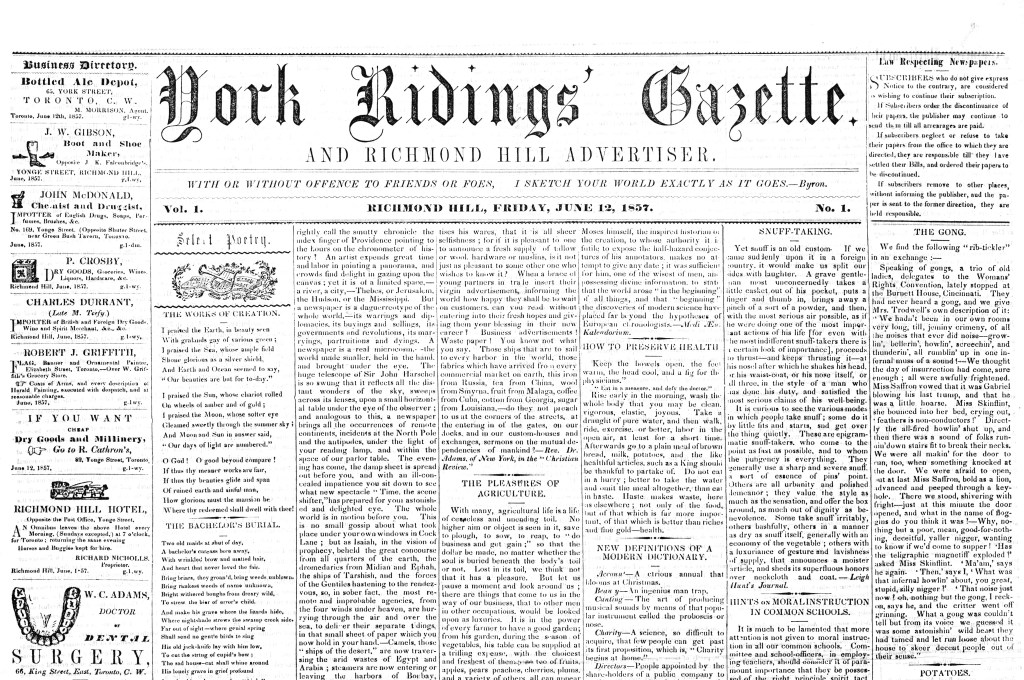
Four years later, in 1857, due to political changes, a special act was introduced with a reduced population requirement of 750. This prompted community leaders to reopen discussions of incorporation. The York Ridings’ Gazette newspaper set out to convince the community incorporation would be a positive step, helping to improve sidewalks, sewers, organized fire prevention and many sanitary problems that needed addressing. In fact, at that time there were the required 750 residents, but the community borders were considered too large of an area. (From Lot 42, just south of Major Mackenzie and Yonge Street, to Lot 52, just north of Elgin Mills, east to Bayview Avenue and west to Bathurst Street). A meeting was held on Oct. 30, 1857 for the residents to consider this recommendation again. Amos Wright Esq., M.P.P. was called to the chair with Matthew Teefy appointed secretary. “Various speakers claimed they were contributing liberally through taxes to Markham and Vaughan townships and receiving little or nothing in return.” Resolutions were submitted and “advocated with as much force by the gentlemen whose names are attached thereto. Moved by George P. Dickson Esq., seconded by David Bridgford Esq.” Once again the resolutions were discussed but the petitioners were defeated. The issue could not be passed with the current size of the borders. The area was judged too extensive — with Elgin Mills now included. Richmond Hill and was considered too “expansionist” in 1857.

A portion of the front page of the York Ridings' Gazette and Richmond Hill Advertiser from Friday, June 12, 1857 (courtesy Richmond Hill Public Library)
A portion of the front page of the York Ridings’ Gazette and Richmond Hill Advertiser of Friday, June 12, 1857 (courtesy Richmond Hill Public Library)

It would take a further 15 years to revisit incorporation. A newly reduced area was to make it all possible. Borders were altered and in 1872, it seemed likely that incorporation would pass. By this time, every ratepayer signed the petition and was presented to York county council. The bylaw was passed without delay, the proposal was approved on June 18, 1872, and Richmond Hill was finally set on the path to its municipal future. The date was set for Jan. 1, 1873.

An advertisement to elect Abraham Law as Reeve. Ad reads as follows: Municipality of Richmond Hill, V. R. Your vote and interest are respectfully submitted for A. Law, J. P. as Reeve at the forthcoming election (from Early Days in Richmond Hill by Robert Stamp)
An advertisement promoting Abraham Law for Reeve in the January 6, 1873 Richmond Hill election. (from Early Days in Richmond Hill: A History of the Community to 1930 by Robert Stamp; courtesy Richmond Hill Public Library)

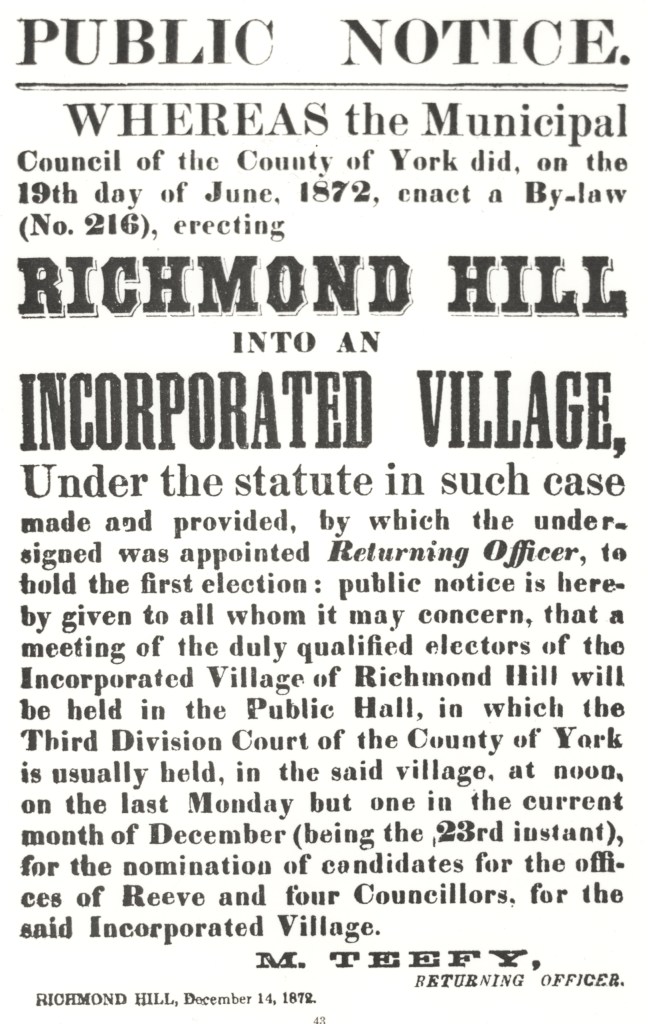
An official announcement declaring the new village status was printed and distributed by Matthew Teefy — the returning officer on Dec. 14, 1872 — inviting nominations of candidates for the new offices of Reeve and four councillors, for the “said Incorporated Village.” The date for the voting was set for Jan. 6, 1873. Eligible voters turned out for the first time to elect their village council. The results announced by the York Herald, were:

  • Abraham Law — 1st Reeve of the Village of Richmond Hill.
  • Matthew Teefy (Postmaster) — Treasurer.
  • William Warren (Farmer) — Councillor.
  • William Powell (Farmer) — Councillor.
  • Jacob Brillinger (Farmer) — Councillor.
  • David Hopkins (General Store Owner) — Councillor.
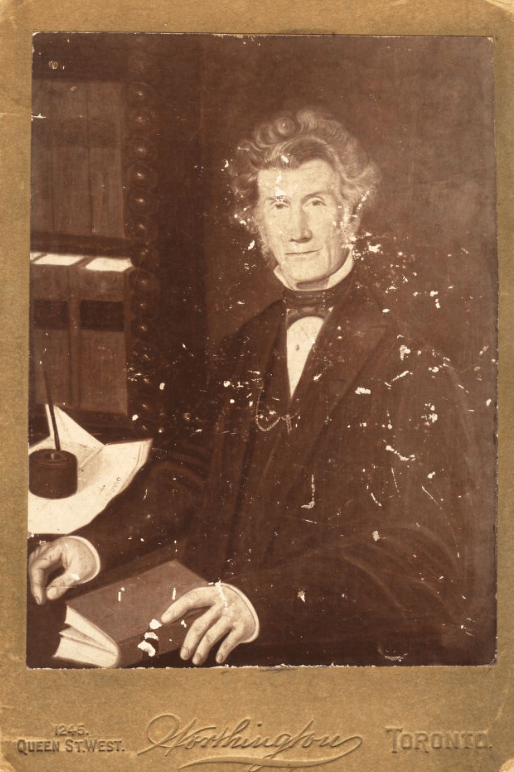
Portrait of Abraham Law, taken by George Worthington (courtesy Richmond Hill Public Library)
Abraham Law, Richmond Hill’s first Reeve. Photograph taken by George Worthington who ran a photography business at 1245 Queen Street West, Toronto (courtesy Richmond Hill Public Library)

The first council meeting on Jan. 20, 1873, was located at the Division Court Room at the Robin Hood Hotel. Civic appointments were decided with Postmaster Matthew Teefy named village clerk and treasurer, a choice position he held for the next 31 years. The following citizens were appointed to the various positions:

  • George A. Barnard & Robert Law (the Reeve’s son) as Auditors.
  • Dennis O’Brien as Assessor.
  • John Brown as Licence Inspector.
  • John Velie (owner of the hotel where council met) as Pound Keeper.
  • Benjamin Davidson as Overseer of Highways.
  • Frederick Crawford as Fire & Nuisance Officer.
  • Robert Robinson, James Freek, & John Arnold as Fence Viewers.
  • James Daniels as Collector of Dog Taxes.
Public Notice. Whereas the Municipal Council of the County of York did, on the 19th day of June, 1872, enact a By-law (Number 2016), erecting Richmond Hill into an incorporated village, under the statute in such case mad and provided, by which the undersigned was appointed Returning Officer, to hold the first election: public notice here-by given to all whom it may concern, that a meeting of the duly qualified electors of the Incorporated Village of RIchmond Hill will be held in the Public Hall, in which the Third Division Court of the County of York is usually held, in the said village, at noon, on the last Monday but one in the current month of December (being the 23rd instant), for the nomination of candidates for the offices of Reeve and four Councillors, for the said Incorporated Village. M. Teefy, Returning Officer, Richmond Hill, December 14, 1872
The Public Notice published by Matthew Teefy, Returning Officer for the nomination of candidates for the Village or Richmond Hill’s first election (courtesy Richmond Hill Public Library)

The subsequent monthly meetings would see a succession of bylaws adopted. Finally, the first Richmond Hill council was able to take responsibility for setting the path to the future of what has become the City of Richmond Hill, 150 years later.


Andrea Kulesh is vice-president of the Richmond Hill Historical Society.

Built to Last: Heritage Properties from York County through to York Region

In undertaking some recent research into local land records, I stumbled across a great collection of heritage resources put together by the Regional Municipality of York. Entitled Built to Last: Heritage Properties from York County through to York Region, it includes a number of historic maps, miscellaneous historical information and a collection of heritage properties from across the region.

The site was created as a Canada 150 project and can be found at https://ww4.yorkmaps.ca/canada150/.

One of the most fascinating parts of the site (I think) is a “spyglass” that you can drag over a recent satellite view of York Region, which has been overlayed on the 1860 Tremaine Map of the County of York, Canada West, published by George R. Tremaine. Tremaine published a number of large county maps in the 1850s and 1860s, which have become invaluable for researchers across the province. Not only do they provide the standard information found on such maps, such as roads, churches, post offices, land owners, etc., but also small illustrations of notable buildings. It also serves as a form of business directory, with businesses and subscribers listed around the map itself.

If you would like to see the full 1860 Tremaine map, it can be viewed online by visiting York University’s website. We also have copies of the Tremaine map in the Richmond Hill Public Library’s Mary-Lou Griffin Local History Room, located on the 4th floor of Central Library at 1 Atkinson Street.

McMaster University has some great information about the Tremaine map of the County of Peel, including a fascinating video on its restoration. Visit McMaster University’s website at https://brighterworld.mcmaster.ca/articles/newly-conserved-rare-map-provides-vivid-snapshot-of-life-in-19th-century-ontario/ to learn more.

Learn more about built heritage in York Region by visiting Built to Last.