We Will Remember

A brief history of the Richmond Hill Cenotaph by Peter Wilson

Originally published online by the Richmond Hill Liberal on April 14, 2020
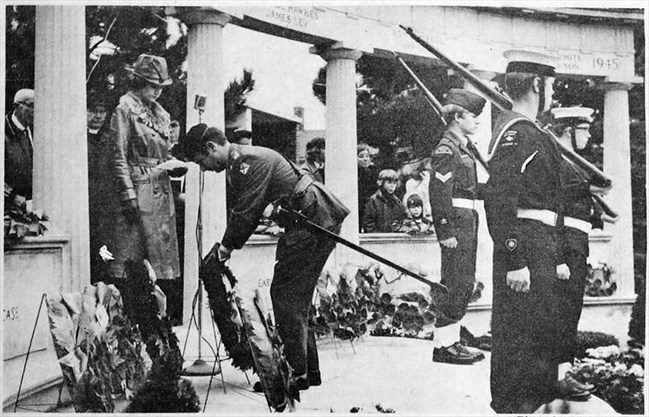
Coun. Lois Hancey reads the names of donors during the laying of wreaths at the Nov. 12, 1972 Remembrance Day Ceremony. – David Barbour/The Liberal

For nearly a century, the Richmond Hill Cenotaph has stood sentinel in the heart of the city. At the time of its 1923 unveiling, Col. William Nisbet Ponton declared: “Their names are engraved forevermore in the stone of remembrance.” He added that, “the situation of the monument, in the centre of the loyal county of York, before a schoolhouse, where it would inspire the generations of future citizens was also most appropriate.”

The Cenotaph’s origins date to a village council meeting of Feb. 13, 1918, where Reeve William Pugsley suggested something to honour the memory of “our boys who have fallen in the war.” The reeve and village clerk A.J. Hume were directed to research a suitable memorial, and within a month proposals were received from several marble dealers. At the council’s Dec. 16, 1918 meeting, a motion passed to commission a monument similar to a model by the Thomson Monument Company.

Reeve Thomas H. Trench organized a meeting for June 9, 1919 at the Masonic Hall to launch a fundraising campaign. In addition to a subscription scheme, a resolution was passed asking ratepayers to co-operate with council’s holding a Field Day on Aug. 4, 1919; the first of many with proceeds earmarked for the building of a monument.

Fundraising and planning took another four years, in which the future of the Cenotaph was put to question. At the Field Day meeting June 26, 1922, considerable interest was voiced over having a Memorial Hall instead. But the majority of returning soldiers preferred a monument, a point well-articulated in a heartfelt November 1922 letter by Louis Teetzel to The Liberal. He wrote, “(the soldiers) have won a place in the world’s history for all time to come … we express ourselves in favour of a permanent monument … that will keep alive in the people the sentimental side of the memorial.”

To settle the matter, a referendum was held during the municipal election on Jan. 1, 1923. It was resoundingly in favour of a monument: 170 votes to 55.

Finally, the Cenotaph was designed by Toronto architect Charles MacKay Willmott — and built at a cost of $4,960 by Nicholson and Curtis (stonework), J. Reynolds (lettering), J. Sheardown (foundation), J. T. Startup (levelling and sodding), and the Architectural Bronze Co. (lamps).
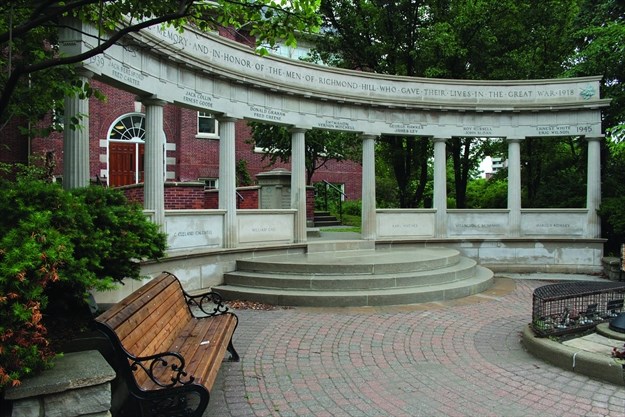
The Richmond Hill Cenotaph as it appeared in 2018, when we marked the centenary of the end of First World War. – Peter Wilson photo

It was dedicated on Aug. 5, 1923, during the Grand Reunion of the Old Boys and Girls. It originally honoured the six individuals etched on the bottom panels who lost their lives in the Great War. A seventh, Starr McMahon who died in 1918 with the Merchant Navy, was added later. And the five-sided stone recognizes 36 soldiers from the First World War, “who so nobly served and by the grace of God whose lives were spared.”

Sadly, the Second World War required the addition of 13 names along the top of the monument. Later plaques recognized those who died in the cause of peace in Hong Kong during the Second World War, as well as those who died in the Korean War and on deployment as peacekeepers.

We will remember.

—Peter Wilson is a member of the Richmond Hill Historical Society. He is also the Local History and Genealogy Librarian at Richmond Hill Public Library.

Names of the Fallen

The following heroes from our community made the ultimate sacrifice during the First World War and the Second World War. These are the brave men whose names are etched on the Richmond Hill Cenotaph.

The First World War

C. Cleland Caldwell

William Case

Arthur C. Cooper

Earl Hughes

Starr McMahon

Wellington C. Monkman

Harold Rowley

The Second World War

Jack Beresford

Fred Carter

Jack Collin

Ernest Goode

Donald Graham

Fred Greene

George Hawkes

James Ley

Vernon Mitchell

Roy Russell

John Sloan

Ernest White

Eric Wilson
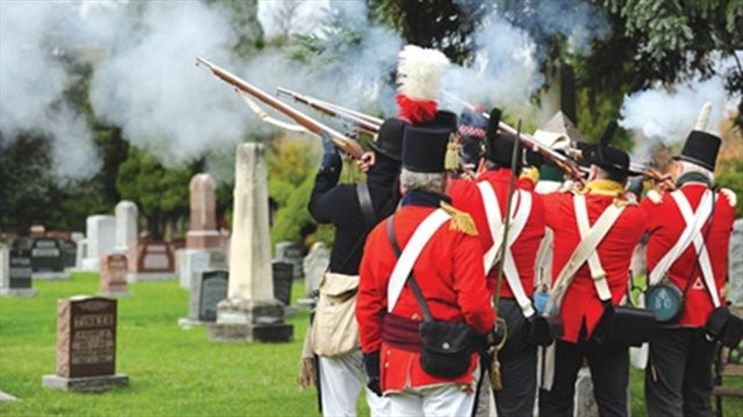
Richmond Hill goes to war — In 1812

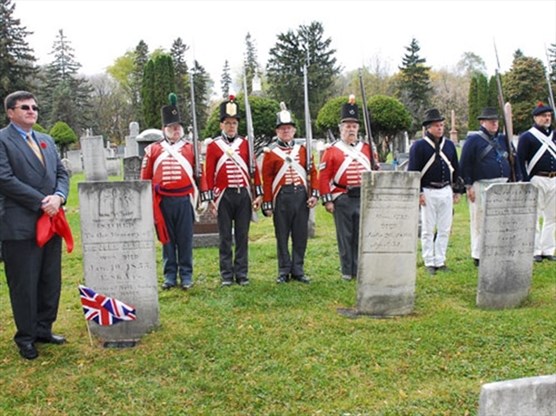
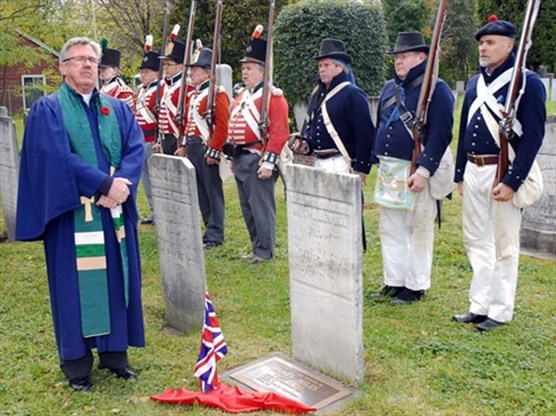
A special ceremony at the Richmond Hill Presbyterian Church in 2013 honours the Richmond Hill veterans who participated in the War of 1812. The graves were re-dedicated and identified. – York Media files

Originally published in the Richmond Hill Liberal (August 31, 2019)
by Jim Vollmershausen, Vice-President, Richmond Hill Historical Society

The men of Miles Hill responded well to Gen. Brock’s call to arms, writes Jim Vollmershausen

In 1812, most citizens of Miles Hill, then a small community a couple of days travel north of York in Upper Canada, were aware of a war that Great Britain was engaged in with France. Many of them also knew that Britain’s naval blockade of France had angered the United States and dragged the young country into the hostilities, against the British.

Britain’s military leadership in Upper Canada, fearing an American attack, was busy fortifying strategic locations along the border, including Kingston and York. As part of this effort, in 1812, Gen. Isaac Brock called for the muster of all available men in the Miles Hill area, and he came to Miles Hill to inspect them. They were formed into a company of the 1st Regiment York Militia, and their superior officers included Capt. John Arnold, Lt. James Miles, and Sgt. John Langstaff.

A special ceremony at the Richmond Hill Presbyterian Church in 2013 honours the Richmond Hill veterans who participated in the War of 1812. The graves were re-dedicated and identified. – York Media files

The York Militia was heavily engaged in the war, and saw early action at Fort Detroit and Queenston Heights, and later at Fort Niagara, Chippewa, Lundy’s Lane and Fort Erie. In the winter and spring of 1812-1813, the regiment was in York, waiting for an American attack. When it seemed that an attack was not imminent, most of the Miles Hill men in the company were allowed to return to their homes, a day or two away up Yonge Street, to prepare for spring planting.

On April 27, 1813, the Americans did successfully attack York, and though there were many killed and injured on both sides of the battle, most of the Miles Hill men missed the action. Capt. Arnold was involved in the fighting but was captured and kept as a prisoner, though later released. Another Miles Hill resident, Capt. David Bridgford of the 3rd Regiment York Militia, was injured when the Fort York magazine exploded.

A special ceremony at the Richmond Hill Presbyterian Church in 2013 honours the Richmond Hill veterans who participated in the War of 1812. The graves were re-dedicated and identified. – York Media files

The men of Miles Hill responded well to Gen. Brock’s call to arms, and they acquitted themselves well in the fighting at a number of locations. By 1815, the war was over, and the Miles Hill veterans were able to get on with their lives, and many of them made lasting contributions to what was to become the City of Richmond Hill.

— Jim Vollmershausen is vice-president of the Richmond Hill Historical Society. The society can be found online at http://www.rhhs.ca.

Remembering the Fun of Mid-century Snow Games in Richmond Hill

Originally published in the Richmond Hill Liberal (January 2019)
by Andrea Kulesh, President

You don’t have to go back too far in time to see playing outside in wintertime has changed considerably.

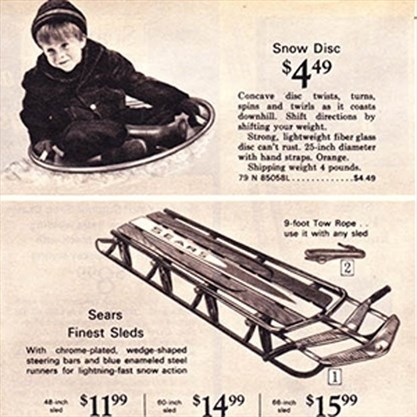
A Sears advertisement for snow saucers and toboggans. – Courtesy of RHHS

As a child from the 1950s, I have wonderful memories of playing in the snow. Sounds of snow crunching and the scuffing of snow pants rubbing together remind me of the fun we made for ourselves — even catching snowflakes on our tongues and eating snow was a thrill. Winter was exciting — imagination reigned and any game was possible. Winter seemed endless — snow on tap for our pleasure. To me — everything was covered in it — telephone poles on Yonge Street — piled half way up after the plows went by and the wires dipping heavily with ice.

Snow transformed outside into a huge playground. That meant building forts, tunnels, and sledding!
Neighbours flooded their backyards for skating. We’d lace up our skates and glide around for hours, shinny, figure eights and lots of races! Ours had a hill — that only the brave would take on!

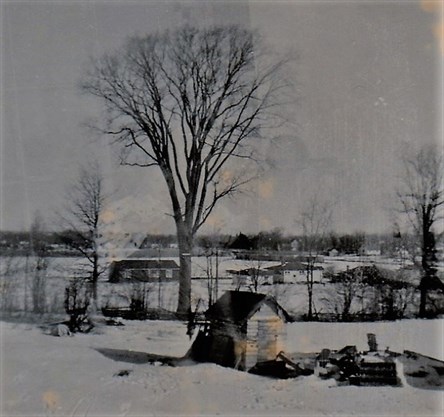
Looking north near Westwood Lane and Charles Howitt Public School in Richmond Hill in the mid-1950s. – Norman Derry photo

We’d venture out in the cold, dressed in snowsuits with scarves tied tightly around our hoods, stranger-danger nor traffic was as big a worry at that time. Nowadays — safety is a key concern for children and most would not be allowed to wander around a neighbourhood.

Tunnelling into drifts, we created our own secret caves. Making snow angels was wonderful and with good packing snow, we could build forts and have snowball fights. Opposing sides, with each army waging battle — snowballs as ammunition. There was always a spoil sport, putting ice or stones in the snowballs so they became lethal weapons and the game would come to a very bad ending …

Bragging how big we could roll the snow, we built endless snowmen. Sledding was the best. Cardboard was great, or sliding down a slope head first, snow flying in our faces. At the farm, where Langstaff High School stands, there was a long hill. We slid on our metal “saucers” uncontrollably — especially if the bottoms were waxed! Wooden toboggans were heavy, but you could squeeze lots of friends on. There was screaming and laughing all the way down and a lot of arguing who was going to drag it back again.

On steep hills, it was particularly precarious especially on the homemade sled my father made with old wooden skis, as we hurtled down the slope at the Thornhill Golf Club and ended up sliding across the creek at the bottom … but wasn’t that the whole idea?

I guess, in retrospect, a little safety never hurts!

—Andrea Kulesh is president of the Richmond Hill Historical Society and has been a member since 2004. The society can be found at http://www.rhhs.ca.

Riding the Radial Line in Richmond Hill

Originally published in the Richmond Hill Liberal (November 2018)
by Andrea Kulesh, President

Historically, Yonge Street has undergone constant improvement since its early beginnings. Currently, the town is experiencing construction of the new Metrolinx transportation system, “an integrated multimodal regional system that puts the traveller’s needs first.” In 1795, John Graves Simcoe, Upper Canada’s first Lieutenant-Governor, made similar plans, by engineering a highway using Aboriginal trails leading to Lake Simcoe, naming it after his friend, Sir George Yonge. This route would be a protected inland passage which had strategic and commercial potential. His troops cut away heavy bush to create a safe route for military and settlers alike.

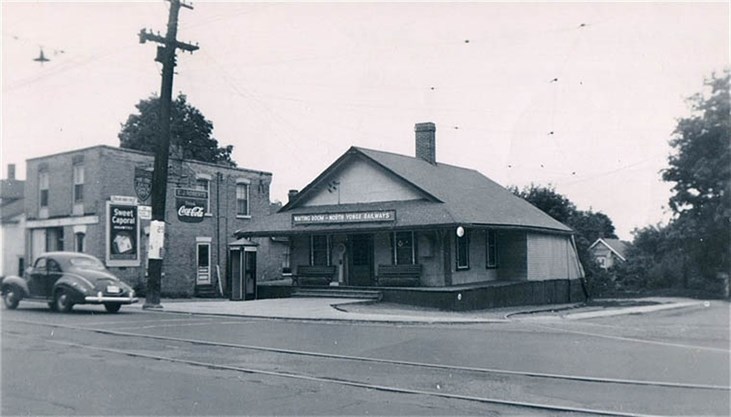
Radial Line Waiting Room at Lorne Avenue and Yonge Street – Courtesy of Julian Bernard

Beginning as a muddy, stumpy walking trail, it slowly evolved and in the later 1800s was given a flattened gravel surface. People walked, rode horses and wagons to reach the new land opened up to settlers who were building farms, villages and towns along the route.

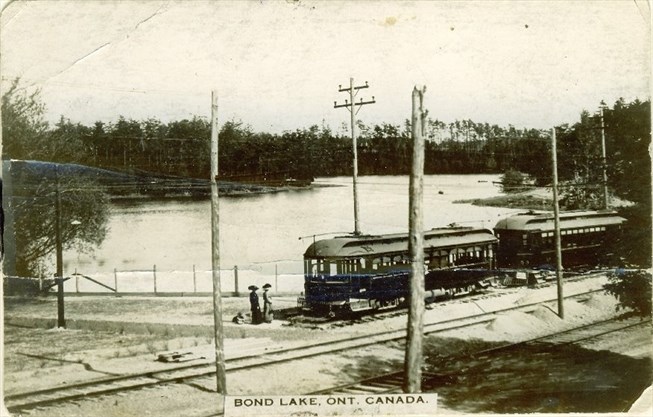
In 1894, the Metropolitan Street Railway Company proposed a new technology — an electric service connecting towns north of the city. Construction was completed in 1897 and Richmond Hill welcomed the new Radial Line as a link with established industrial and commercial activity. The line began in north Toronto and in time, eventually made its way to Sutton on Lake Simcoe. Service was four daily round trips between Richmond Hill and Toronto’s city limits. A one-way trip took 45 minutes, for 40 cents (65 cents, return).

Visiting Bond Lake Park by the Radial Line. – Courtesy of the Richmond Hill Central Library

In early 1930, the TYRR Metropolitan Division decided that the service was no longer viable and was closed down. The line was losing money and road competition was the main reason. Between 1925 and 1930, auto and truck traffic increased along Yonge Street from 4,925 to 11,163 per day, and bus traffic from two to 188 per day. Reeves from Richmond Hill, Markham, Vaughan and North York joined together and began the North Yonge Railway using the abandoned lines, with the new service beginning in July 1930. For 18 years this electric “streetcar” continued to move people around for work and pleasure, finally ending in October 1948 — replaced with TTC buses. This was the last surviving Toronto “Radial” — the end of an era, a mode of transportation that indeed put the “traveller’s needs first.”

—Andrea Kulesh is president of the Richmond Hill Historical Society and has been a member since 2004. The society can be found at www.rhhs.ca.